Category Archives: Strategy

Crafting Museum Mission Statements with ChatGPT: A Quick Guide!

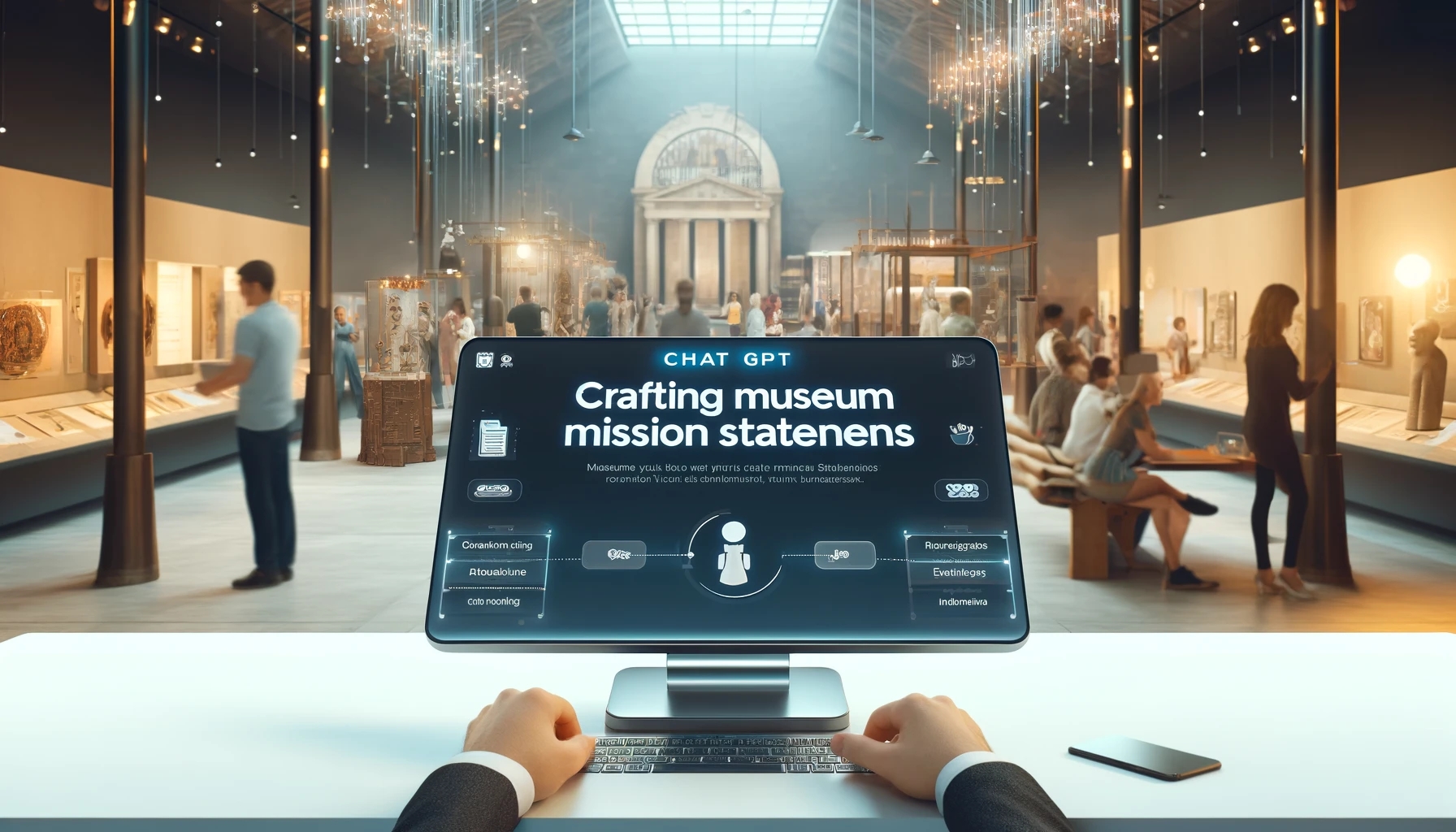
ChatGPT-4o created this image in less than a minute.

The highly anticipated release of ChatGPT-4o has once again thrust artificial intelligence (AI) into the spotlight. So how can historic sites and house museums harness the power of ChatGPT to craft thought-provoking mission statements, an essential element of effective management?

The American Alliance of Museums states that excellence requires that, “all aspects of the museum’s operations are integrated and focused on meeting its mission.” And yet, crafting mission statements is among the most difficult tasks for an organization. Writing and revising as a board or staff committee can result in circular arguments, the infinite parsing of words, or resignation to a milk-toast statement that offends no one. So how can you take a mission statement that’s weak or mild and turn it into something stronger and more meaningful?

My typical response is that a small committee of diverse leaders within the organization discuss the purpose and role of the museum in the community, and then appoint one person to draft a mission statement for approval. Although that’s much more effective than writing-by-committee, it can also result in a tremendous commitment of time and frustrations during the review as members defend their ideas. Instead, I’ve found ChatGPT to be much more efficient and less frustrating. You can revise frequently and quickly, try out variants and new ideas easily, and even better, criticize the “robot” and it won’t care.

For example, in the Reimagining Historic House Museum workshop in April 2023, I introduced the idea of ChatGPT-formulated statements, using the mission of the Gamble House, our host institution:

The mission of The Gamble House is to inspire the public’s appreciation and understanding of architecture as a fine art through the example of The Gamble House, the most complete and best-preserved work of American Arts and Crafts architects Charles and Henry Greene.

Using a simple prompt, “Create a mission statement for the Gamble House in Pasadena, California,” ChatGPT-3’s version was:

Our mission at the Gamble House is to preserve and celebrate the legacy of this iconic American Arts and Crafts masterpiece. As a cultural destination and community resource, we aim to inspire and educate visitors about the significance of the Gamble House’s architecture and design, and its enduring influence on American culture.

The first sentence is the usual celebratory mission statement but notice that the next sentence goes further to explain why it matters today (“its enduring influence on American culture”). That’s a significant improvement that can improve the mission statement’s ability to guide decisions and establish priorities—which is the core function of a mission statement.

Going further, you can use ChatGPT to create mission statements inspired by the ideas of influential thinkers. English designer and writer William Morris inspired the Arts and Crafts Movement, so he’s an ideal choice for the Gamble House. By changing the prompt to, “Create a mission statement for the Gamble House in Pasadena, California in style of William Morris,” the result is:

“Our mission at the Gamble House is to preserve the beauty and integrity of this magnificent home, which is a masterpiece of American craftsmanship and design. Through our efforts to maintain the house and its surroundings in a state of harmony and balance, we seek to embody the principles of the Arts and Crafts movement, which holds that art and beauty should be an integral part of everyday life. By promoting the values of craftsmanship, simplicity, and authenticity, we aim to create a more just and equitable society, one in which the arts and culture are accessible to all, and the beauty of the natural world is cherished and protected.”

Far too long to be a modern mission statement for a museum, it does offer some intriguing ideas, particularly in the last sentence. By mentioning “craftsmanship,” “equitable society,” and “accessible to all,” it addresses values that could be meaningful to modern visitors and supporters of the Gamble House and inspire innovative programming.

In the year that followed, I’ve continued to explore how ChatGPT can help historic sites and house museum improve their mission statements, as well as create a vision and values. Lest anyone think that ChatGPT is a simple mindless hack to the usual hard work of crafting a mission statement, the use of AI requires a thoughtful human hand on the computer keyboard. ChatGPT can be biased, inaccurate, and hallucinate, so you need to know the organization and theories of management strategy. A weak or poor mission statement can harm a nonprofit organization, whether created by humans or AI.
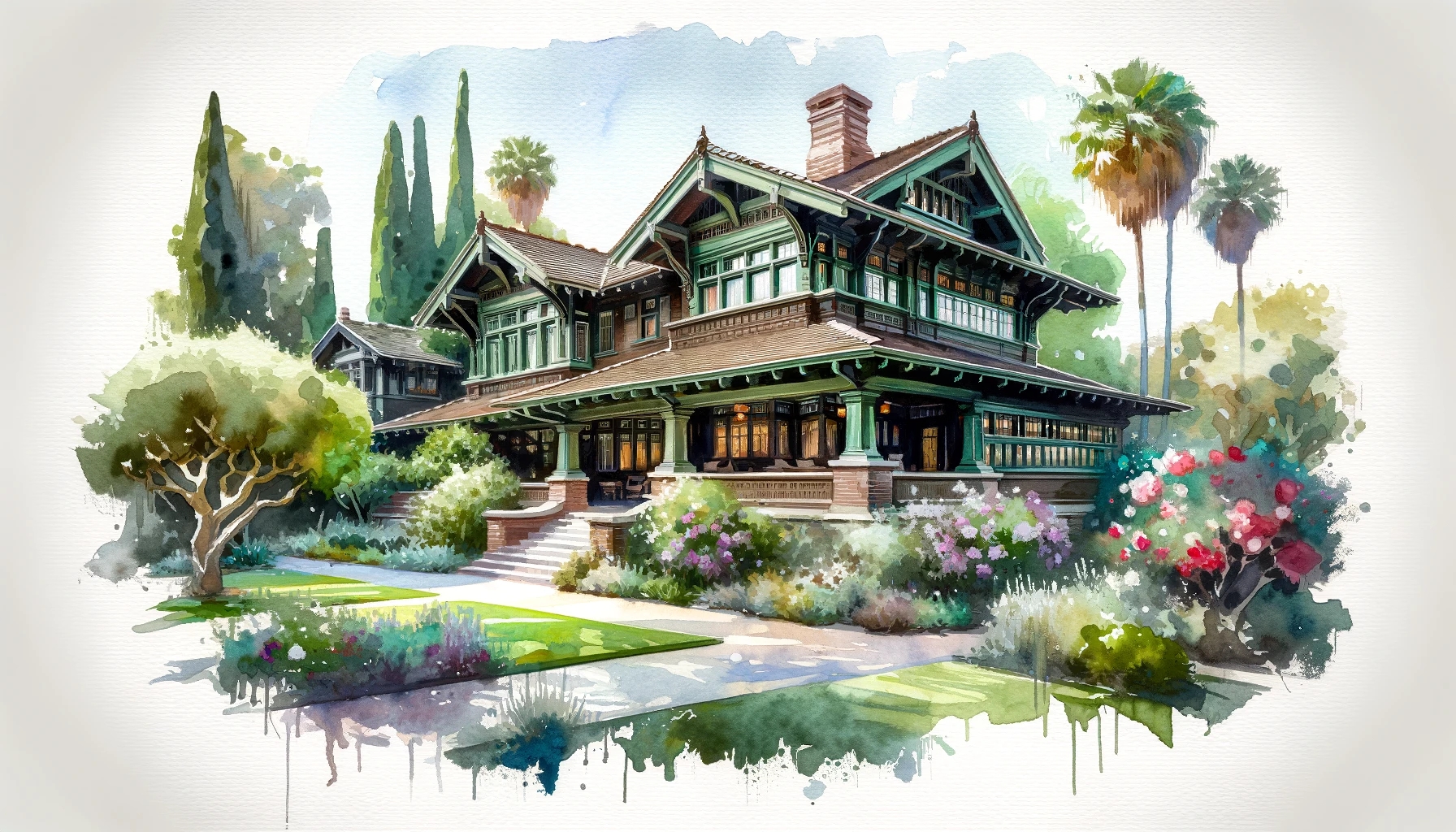
ChatGPT-4o created this image of the Gamble House, demonstrating the need for the human expert—there’s very little that is correct in this image.

Getting Started

If you’re interested in the best explanation and practices of AI and ChatCPT, read Ethan Mollick’s Co-Intelligence: Living and Working with AI (2024) or listen to an interview with him on the HBR IdeaCast, “Tech at Work: What GenAI Means for Companies Right Now.” If you’re interested in practical applications with lots of examples, read AI and the Future of Education (2023) by Priten Shah. AI is being incorporated into an increasing number of applications, including Microsoft Word, Evernote, Notion, and WordPress, but if you want to explore ChatGPT, it is available free with registration at OpenAI.

If you want to use ChatGPT to craft a mission statement, be aware that it relies on the information that is available to it. If your organization has a very small presence on the Internet or in publications (unlike the Gamble House), a simple prompt will be ineffective. You’ll need to take an additional step to provide it with information, such as the museum’s goals, primary audiences, collection strengths, historical background, and what makes it unique or distinctive. If you’re unsure how to do this in ChatGPT, start with the prompt, “I need help writing a mission statement for [your museum name]. Here are the details: [insert information].” You can follow up with additional instructions, such as “”Give me three different mission statement options,” “Can you make this mission statement more engaging for a younger audience?”, or “I like the direction of this mission statement, but can you make it shorter?”

If ChatGPT has helped your organization improve or rethink its mission statement, please share your experiences in the comments.
Demystifying Spending Patterns in Small Museums

In the world of small museums, location and audience significantly influence expenses, rendering a one-size-fits-all approach ineffective. However, gaining insight into the various types of expenses museums incur can shed light on common challenges and their causes. The non-profit financial Form 990 categorizes expenses into five areas, providing a framework for understanding spending patterns. Our goal is to simplify the concept of museum spending and guide museums toward prudent budget management by exploring these key expense categories.

Continue reading

Untangling the “Other” Revenue Stream

In the colorful tapestry of history-focused organizations, every thread of revenue has a role to play in the success of the organization. Perhaps the most unique collection of these threads is the “Other” revenue category. This singular “Other” thread houses a miscellany of revenue sources that don’t fit into the categories of “Investment Income”, “Program Service Revenue”, and “Contributions and Grants”. At first glance, this classification may appear insignificant, yet it often proves to be a silent contributor that underpins the fiscal health of History-Focused Organizations [Museums (NTEE A50), History Museums (A54), History Organizations (A80), and Historical Societies & Historic Preservation (A82)].

Understanding this “Other” revenue can be like deciphering an ancient dialect. It is made no easier by the fact that IRS Form 990 at times uses the terms revenue and income interchangeably. While some categories of this revenue such as royalties and inventory sales may be familiar, “miscellaneous” often contains difficult to parse odds and ends such as third-party events, insurance proceeds, ATM fees, and revenue from hosting satellite towers. Most often this miscellaneous revenue is unspecified and simply named “miscellaneous” or “other” which can make it difficult to get the full picture of a particular institution’s revenue sources. We advise limiting the classification of your total revenue as “miscellaneous” to no more than 1%. While judicious use of this category can help define your other revenue streams more clearly, overuse could lead to a lack of clarity about a significant portion of your revenue. It is crucial to maintain a comprehensive understanding of your financial situation.

Continue reading

Impact, Sustainability, and Non-Profit Programs

For small non-profit organizations operating on less than a million dollars annually, programs are often the beating heart of the operation. The best programs balance mission and financial sustainability to serve their audiences. Program revenue (admissions, events, and membership dues) can be a vital means of maintaining financial stability and growth. For History-Focused Organizations [Museums (NTEE A50), History Museums (A54), History Organizations (A80), and Historical Societies & Historic Preservation (A82)] as overall revenue grows, so does the share of program revenue. This means as your organization grows, so should the prominence of your programs as a true revenue driver (see figure 1 below).

As small history-focused organizations expand, it’s crucial to manage their programs wisely to increase income while keeping the mission in mind. For small groups, program decisions can be very personal, often influenced by board or staff interests. Taking a strategic approach to these decisions can boost the organization’s growth and success.

Continue reading

New NEH Interpretive Planning Grant for Small Organizations

Scholars reviewing the archives at the Haas-Lilienthal House.

The National Endowment for the Humanities, a federal granting agency, recently announced a special grant program to support interpretive planning at small organizations for up to $25,000, no match required.

What does “small” mean? You need to meet at least two of the following:

  • Annual operating expenses of less than $1,000,000
  • Located in a community with less than 300,000 residents
  • A staff of less than 50 people
  • Rely primarily on volunteers or part-time staff.
  • A mission to interpret under-told stories or serving a non-traditional audience

Hmm…that describes most history organizations in the US, so if you’re reading this post, you’re probably eligible.

Now, what will it support? Nearly anything that improves or enhances the interpretation of your collection, site, or community, such as:

  • help you think creatively about the hidden strengths of your collections or historic site
  • generate new ideas for engaging with the community
  • train staff and volunteers on interpretive methods and techniques
  • develop a framework for developing public programs
  • creating interpretive plans for exhibitions, tours, or school programs
  • visiting other historic sites or museums to sharpen skills and knowledge
  • evaluating existing tours or exhibitions
  • testing new programs for their ability to engage new audiences
  • conducting historical research to support new interpretive themes

Projects must include at least one scholar from a humanities discipline (e.g., history) or one consultant specializing in interpretation to the public (Engaging Places can help you with this), as well as at least one expert on your local community. 

Applications are due June 28, 2023 for one to two year projects beginning between March 1 and May 1, 2024. You will need all of that time to prepare an application and NEH will read draft applications submitted by May 24. Remember to register in advance with the System for Award Management (SAM) and Grants.gov—those are steps you cannot do at the last minute.

For more details, scan the overview or jump right to the 35-page grant application instructions (officially called a Notice of Funding Opportunity).

What Drives Revenue at History-Focused Organizations?

If a well-managed museum has robust programming, a large endowment, and a profitable gift shop, should they still rely on contributions and grants? Often regarded as a fundraising burden to reduce or eliminate, instead we might want to consider these revenue sources as one of the best ways to sustain and expand an institution. Sixty-six percent of History-Focused Organizations [Museums (NTEE A50), History Museums (A54), History Organizations (A80), and Historical Societies & Historic Preservation (A82)] depend on contributions and grants for at least half of their annual revenue and nearly forty percent rely on contributions and grants for more than three-quarters of their revenue (see Figure 1 below).

To maximize revenue, museums must navigate fundraising in the present and future. Understanding the donor and engagement pyramids simplifies fundraising and ensures focus. Small history-focused organizations, in particular, must invest their limited bandwidth strategically to achieve success.

Continue reading

How can History-Focused Organizations Invest in Stability?

Figure 1. History-Focused Organizations command large portions of the museum field’s revenue and institutions. Source: Internal Revenue Services and National Center for Charitable Statistics.

Over the past year, Engaging Places has been looking over individual segments of the museum field. While these segments are unique in specific ways, as demonstrated by the data, several of them do share a common theme and mission: an overall goal to promote history. These four segments are History Museums (A54), History Organizations (A80), Historical Societies & Historic Preservation (A82), as well as the broad Museums (A50) category. By combining these segments we can focus on the history-centric portion of the museum field that makes up close to half of its revenue and consists of a whopping 89% of its institutions (see Figure 1). This block of museums is incredibly dominant within the field and a major focus of Engaging Places’ work. For ease of reference, we will be referring to them as History-Focused Organizations.

It is important to remember that as an aggregate these History-Focused Organizations still trend small. Over 90% operate on less than $1 million in revenue annually, with contributions and grants bringing in over half of that vital revenue. For these smaller museums, financial security is a constant and essential priority. While many of these History-Focused Organizations are unable to achieve large pools of investment to stabilize operations, unlike some of their larger counterparts, they can develop practices to move them in this direction. 

Continue reading

What’s Next for the History Leadership Institute?

Max van Balgooy with Robert Indiana’s Numbers 0-9 at Newfields (Indianapolis Museum of Art)

Seven is the number associated with completeness and perfection, but I’m not perfect and rarely satisfied, so before I complete seven years as director of the History Leadership Institute (HLI), I’m turning the chair over to someone else.

When I was appointed director in 2017, applications had fallen for several years and we held the Seminar with just thirteen people, accepting everyone that applied. If this continued, it would no longer be financially feasible to offer the Seminar. I was puzzled because the program had a terrific reputation in the field and saw its impact on my friends and colleagues.

To develop a new vision for the Seminar for Historical Administration, a wall in the Seminar classroom became a space for exploring ideas.

While we gathered for three weeks in November 2017 for the Seminar at the Indiana Historical Society, I worked on a side project to rethink the program to make it more sustainable and attractive. In the usual HLI fashion, I sketched out ideas on flipcharts spread out on the classroom wall, asking everyone who came into the room for their reactions and ideas. By the end of the Seminar, I had diagrammed a long-range plan with immediate and short-term recommendations that included:

  • Affirming its focus on organizational leadership and personal leadership.
  • Changing the name from the Seminar for Historical Administration to shift the emphasis to leadership.
  • Moving the organizational structure from a partnership among several history organizations to AASLH to better facilitate administration and ensure longterm support.
  • Considering alternatives to the three-week residential format to better serve mid-career history professionals.
Continue reading

March Webinars for House Museums and Historic Sites

It’s a webinar bonanza at Engaging Places this month! We’ll be participating in two different back-to-back webinars in March for house museums and historic sites, one on interpreting women’s history and the other on management and strategy.

On Thursday, March 25, 2021 at 10:00 am Central, the Wisconsin Historical Society is hosting a free panel discussion on Sharing Women’s History: Exploring New Stories and Formats for Engaging Audiences. Panelists include Mary van Balgooy, Vice President of Engaging Places, LLC and Executive Director of the Society of Woman Geographers; Meredith S. Horsford, Executive Director, Dyckman Farmhouse Museum; and Brooke Steinhauser, Program Director, The Emily Dickinson Museum. House museums, historic sites, and other cultural organizations can share women’s history through special programs, tours, and other storytelling formats. From a broad view of new directions for interpretation to strategies for virtual engagement, panelists will share examples of innovative programming and best practices for interpreting complex stories that engage new audiences. For more details, visit https://www.wisconsinhistory.org/Records/Event/EV8032

On Friday, March 26 at 3:30 pm Eastern, Stenton, The National Society of The Colonial Dames of American, and Historic Germantown are hosting, “Historic House Museum in the 21st Century: Reimaginings and New Solutions“. Stenton Curator Laura Keim will moderate a discussion with Donna Ann Harris (author of the recently updated New Solutions for House Museums) and Kenneth C. Turino and Max A. van Balgooy of Engaging Places (editors of Reimagining Historic House Museums), who will provide overviews of their recently released publications, share lessons they’ve learned from the field and their researches, and explore the nature and future of historic house museums. Cost is “Pay What You Can” and register in advance at www.stenton.org/programs. Visit http://www.rowman.com to purchase both books and use code 4S21MUS30 for a 30% discount.

Responding to COVID-19: Conversations with & for Consultants

Amidst the tidal wave of museum layoffs and closures, many independent consultants and freelance workers are struggling to stay afloat. As Anne Ackerson writes in The COVID-19 Impact on Museum Consulting, “These are the people who work independently across the field in collections, education, governance, art handling and more. They work from job to job, shouldering the full costs of benefits, building careers while offering services many museums and heritage organizations need, but can’t afford on a full-time basis.” What does the future, both short- and long-term, look like for consultants in the museum field? Join Anne Ackerson, Dina Bailey, and Max van Balgooy to discuss unique challenges facing consultants as they consider envisioning new paths or staying the course. American Association for State and Local History is hosting this conversation on Thursday, April 16 (today!) at 3:00 pm Eastern (sorry, we’re moving rapidly to respond to COVID-19). Registration is $10, $5 for AASLH members; and if you are an organization, consultant, or student that is facing financial strain due to COVID-19, please use promo code FREEWBR20 to waive the registration fee for this conversation.  Register here.

I’ll be on the panel to open the discussion with examples from Engaging Places but we’ll be emphasizing a conversation with the attendees gather perspectives from across the nation to understand where things are now and where they might (or should) be going.