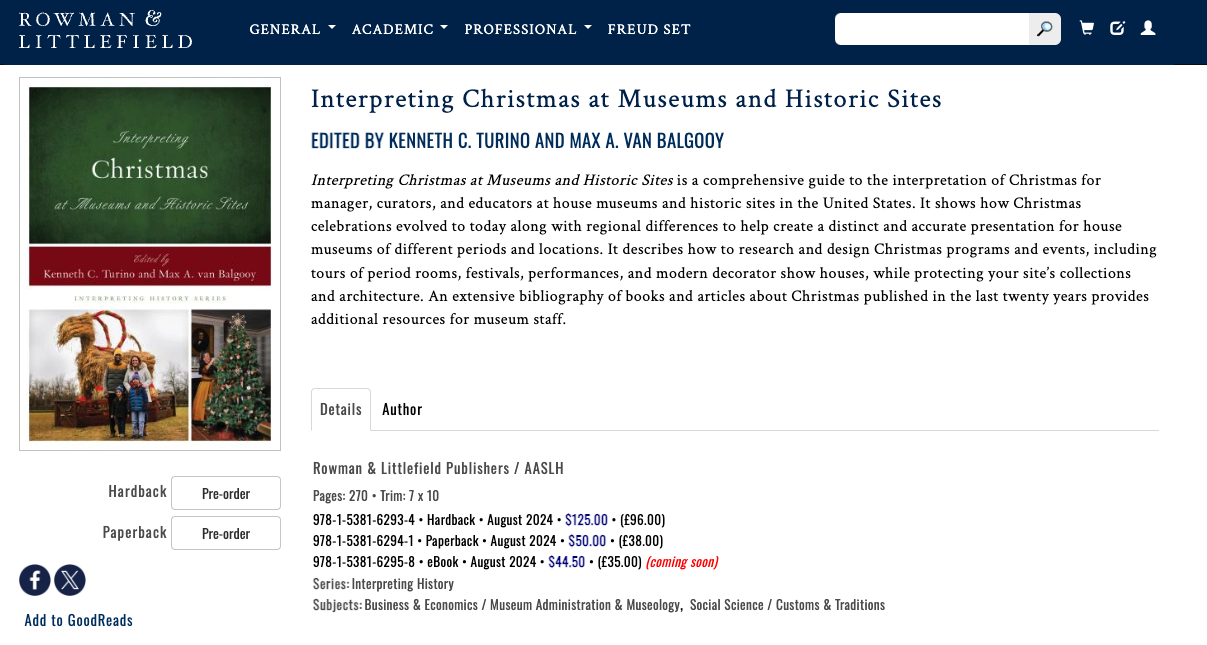
Ken Turino, Sara Bhatia, and I are currently compiling the index for our book Interpreting Christmas at Museums and Historic Sites, while the other authors are meticulously reviewing the proofs for any final corrections. But we are much more excited to announce that we have a colorful cover featuring images from Old World Wisconsin and Strawbery Banke, and that Rowman and Littlefield have made the 270-page book available for pre-orders at this link.
To get a start on the holidays, join us in July when we’ll be hosting a live AASLH webinar, “Jingle All the Way: Maximizing Your Museum’s Holiday Potential.” Drawing from some of the insights in the book, we’ll discuss how your historic house or history museum can leverage December’s holiday season to enhance community engagement. Mark your calendar for July 23 at 3 p.m. Eastern and secure your spot by registering here for $45 ($25 for AASLH members).
For a preliminary glimpse inside Interpreting Christmas, I’m sharing the proofs for the table of contents and introduction. Just remember, they’re publisher’s proofs so they are subject to change!
The Newport Summer School visiting one of the many historic houses in Newport, Rhode Island. Source: Victorian Society of America.
George Washington University recently awarded me a semester-long sabbatical for fall 2024, which will give me a break from teaching in the museum studies program and allow me to more actively pursue my interests in:
the early history of house museums to better understand their formation and evolution of interpretive practices;
the interpretation of house museums; and
the management of historic sites, especially in strategy and leadership to move performance up to the next level or respond to an ever-changing environment.
For a deep dive into these topics, I’m delighted that I’ve been selected for two prestigious programs:
In June, I will be in Newport, Rhode Island attending the Victorian Society’s Summer School. Over ten days, our class will explore four centuries of American architecture, art, culture, and landscape guided by renowned architectural historian Dr. Richard Guy Wilson. The program will delve into Newport’s rich history, often referred to as the “Queen” of American resorts, and includes exclusive tours of private homes, behind-the-scenes access to America’s grandest mansions, and insightful presentations by leading scholars.
In September, I will be in England for Royal Collection Studies, organized by The Attingham Trust for the Study of Historic Houses and Collections. This ten-day residential course in Windsor provides extraordinary access to one of the world’s leading collections of fine and decorative art, all housed within the grand architecture of the royal palaces. The course combines lectures and tutorials, visits to both occupied and unoccupied palaces in and around London, and close-up object study, aiming to give heritage sector professionals a deeper understanding of this remarkable collection.
If you’re working in a house museum or historic site, these specialized residential mid-career courses are both incredibly educational and refreshing. Participating in the Attingham Summer School in 2008 significantly enriched my scholarship, and fifteen years later I continue to draw upon the principles and practices learned during our site visits and insightful discussions. You’ll find a professional development experience for nearly any interest or length of time, and many offer scholarships. For example, if you’re seeking a course more focused on management, consider the History Leadership Seminar or the SEMC Leadership Institute (it appears that the [Getty] Museum Leadership Institute is no longer operating).
And alas, this schedule also means that my plans for attending the AASLH Annual Meeting in September will be postponed to 2025 in Cincinnati, Ohio. And if I don’t see you there, I hope it’s because you’ll be participating in an incredible professional development opportunity (remember to apply 6-8 months in advance!).
The Reimagining the Historic House Museum workshop at the Decorative Arts Center of Ohio in June 2023.
“Reimagining the Historic House Museum,” the one-day workshop co-led by me and Ken Turino (Historic New England) will be held on Friday, April 19, 2024, from 8:30 am to 5:00 pm at Montpelier, a 1780s house museum in Laurel, Maryland (between DC and Baltimore). This workshop is part of the professional development series produced by AASLH. Registration is $325 but it’s $200 for AASLH members (and you receive an additional $50 discount if you register by March 22!). Participation is limited to 35 people.
Our workshop, while inspired by the book Reimagining Historic House Museums (2019), provides a more comprehensive hands-on exploration of house museums’ challenges. We assess current programs using a “double-bottom” line for a holistic view, analyze influencing forces to pinpoint opportunities and hurdles, and spotlight how house museums have successfully reinvented themselves. While the day is rich with information and activities, we ensure a well-deserved lunch break and networking time. You’ll leave with new tools and ideas to enhance your historic site and have an enjoyable experience.
It’s been several years since I attended an AASLH annual meeting due to the pandemic and conflicts with my teaching schedule, but I plan to be in Mobile, Alabama in September 2024 (I’m hoping to see the Clotilda–National Geographic called it the best museum that opened in 2023!). Professional conferences are one of the best ways to mentally stand above your daily work and compare what you’re doing with the rest of the field. You can compare experiences, solve problems, share solutions, and be inspired. Plus I can share meals with some of my colleagues (and meet new ones!).
I’ll not only be attending but hope to lead a session or two to support the good work happening at history organizations around the country. It’s a terrific way to work with others to address a hot topic, provide different perspectives on a common issue, and yes, shape the future of the field–so I hope you’ll join me in proposing a session to support your colleagues.
AASLH has moved beyond the traditional three-panelists-and-a-moderator format to include roundtable discussions, in-depth workshops, debates, and a series of quick presentations to allow more variety, so if you have an idea for an educational session, there’s probably an interesting way to present it. I’m having a hard time choosing!
Like most conferences, a committee reviews proposals to assemble the program. Because this is a national conference, they’re looking for sessions that address issues that are affecting history organizations nationally, offer a national perspective on a topic through a geographically diverse session, or relate to the conference theme. Avoid “show and tell” sessions about a program or event that’s unique to your organization and can’t be easily duplicated by others (plus they tend to be really boring self-congratulatory panels). Finally, the attendees want results to justify the time and money they’ve spent at the conference. What will they learn? It’s got to be more than “understand” and “appreciate”–that’s far too vague. By the end of the session, what will they specifically know, what will they be able to do, and how will they feel (e.g., more confident, less confused)?
AASLH is accepting proposals until December 20, 2023. Because proposals are prepared online, it may be difficult to know what information they are seeking, so I’ve attached a one-page summary of the core questions to answer.
This small selection of historic sites operated by The National Society of The Colonial Dames reveals the enormous diversity of house museums and historic sites in the United States.
In 2007, I helped organize the Forum on Historic Site Stewardship in the 21st Century, which resulted in an influential issue of Forum Journal that laid out the major challenges and opportunities, including the need for financial sustainability, a willingness to change in response to the needs of the community, and a balance between the needs of buildings, landscapes, collections, and the visiting public. It also recognized that museum standards may not be the best practices for historic sites and that the profession “must develop new measures, beyond attendance, that document the quality of visitor engagement at sites and the extent of community outreach beyond the bounds of historic sites.”
So what has happened in the 16 years that followed? We’ll find out this week as the American Association for State and Local History hosts a virtual summit on the Sustainability, Relevance, and the Future of Historic House Museums on July 11-12. Sessions will address measuring the impact of house museums, broadening interpretation, care of buildings and landscapes, and the evolution of mission statements.
Scholars reviewing the archives at the Haas-Lilienthal House.
The National Endowment for the Humanities, a federal granting agency, recently announced a special grant program to support interpretive planning at small organizations for up to $25,000, no match required.
What does “small” mean? You need to meet at least two of the following:
Annual operating expenses of less than $1,000,000
Located in a community with less than 300,000 residents
A staff of less than 50 people
Rely primarily on volunteers or part-time staff.
A mission to interpret under-told stories or serving a non-traditional audience
Hmm…that describes most history organizations in the US, so if you’re reading this post, you’re probably eligible.
Now, what will it support? Nearly anything that improves or enhances the interpretation of your collection, site, or community, such as:
help you think creatively about the hidden strengths of your collections or historic site
generate new ideas for engaging with the community
train staff and volunteers on interpretive methods and techniques
develop a framework for developing public programs
creating interpretive plans for exhibitions, tours, or school programs
visiting other historic sites or museums to sharpen skills and knowledge
evaluating existing tours or exhibitions
testing new programs for their ability to engage new audiences
conducting historical research to support new interpretive themes
Projects must include at least one scholar from a humanities discipline (e.g., history) or one consultant specializing in interpretation to the public (Engaging Places can help you with this), as well as at least one expert on your local community.
Applications are due June 28, 2023 for one to two year projects beginning between March 1 and May 1, 2024. You will need all of that time to prepare an application and NEH will read draft applications submitted by May 24. Remember to register in advance with the System for Award Management (SAM) and Grants.gov—those are steps you cannot do at the last minute.
Join Conny Graft and Max van Balgooy on May 24 at 3:00 pm Eastern for a ninety-minute webinar on interpretive planning as we prepare for the U.S. 250th anniversary in 2026. To help you feel more confident in this specialized topic, we will discuss the basic process of interpretive planning, provide a simple rubric to develop goals, and distinguish topics and themes (and why themes are more valuable). As a bonus, we’ll briefly mention ways to identify target audiences and expand your thinking about methods and formats. Registration is $20; $10 for AASLH members.
It’s the start of a three-part series on interpreting the 250th at historic sites and house museums. Other sessions will dive into the field-wide themes for the 250th with Ashley Jordan (African American Museum in Philadelphia) and Steve Murray (Alabama Department of Archives and History) and offer an interactive platform to workshop ideas with fellow practitioners with Sarah Pharaon (Dialogic Consulting). Whether you have a clear tie to the Revolution or not, this webinar series will help you make history relevant and captivating for your audience. Attend all three webinars for $55; $25 for AASLH members.
Max van Balgooy with Robert Indiana’s Numbers 0-9 at Newfields (Indianapolis Museum of Art)
Seven is the number associated with completeness and perfection, but I’m not perfect and rarely satisfied, so before I complete seven years as director of the History Leadership Institute (HLI), I’m turning the chair over to someone else.
When I was appointed director in 2017, applications had fallen for several years and we held the Seminar with just thirteen people, accepting everyone that applied. If this continued, it would no longer be financially feasible to offer the Seminar. I was puzzled because the program had a terrific reputation in the field and saw its impact on my friends and colleagues.
To develop a new vision for the Seminar for Historical Administration, a wall in the Seminar classroom became a space for exploring ideas.
While we gathered for three weeks in November 2017 for the Seminar at the Indiana Historical Society, I worked on a side project to rethink the program to make it more sustainable and attractive. In the usual HLI fashion, I sketched out ideas on flipcharts spread out on the classroom wall, asking everyone who came into the room for their reactions and ideas. By the end of the Seminar, I had diagrammed a long-range plan with immediate and short-term recommendations that included:
Affirming its focus on organizational leadership and personal leadership.
Changing the name from the Seminar for Historical Administration to shift the emphasis to leadership.
Moving the organizational structure from a partnership among several history organizations to AASLH to better facilitate administration and ensure longterm support.
Considering alternatives to the three-week residential format to better serve mid-career history professionals.
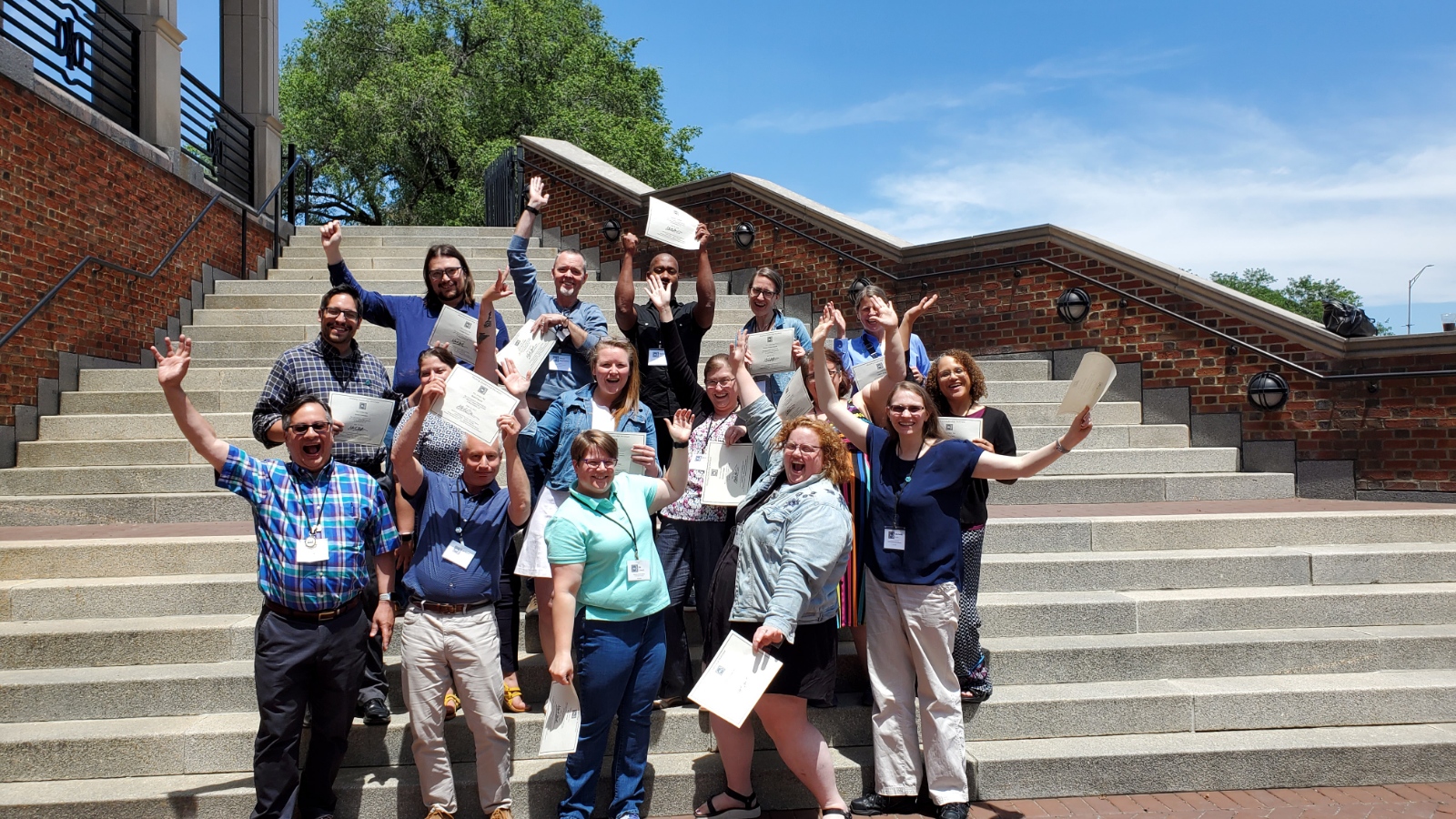
The Class of 2022 celebrating their graduation from the HLI Seminar.
The History Leadership Institute, AASLH’s professional development program for mid-career history professionals, introduced its long-running Seminar in a new format in June.
In 1959, the Seminar began as an effort to train newly graduated history students and directors of history museums in the unique skills of managing museums, historic sites, and archives in a six-week program held at Colonial Williamsburg, During the decades that followed, the Seminar has continually changed to meet the needs of the field and explore new and emerging practices.
Amidst the tidal wave of museum layoffs and closures, many independent consultants and freelance workers are struggling to stay afloat. As Anne Ackerson writes in The COVID-19 Impact on Museum Consulting, “These are the people who work independently across the field in collections, education, governance, art handling and more. They work from job to job, shouldering the full costs of benefits, building careers while offering services many museums and heritage organizations need, but can’t afford on a full-time basis.” What does the future, both short- and long-term, look like for consultants in the museum field? Join Anne Ackerson, Dina Bailey, and Max van Balgooy to discuss unique challenges facing consultants as they consider envisioning new paths or staying the course. American Association for State and Local History is hosting this conversation on Thursday, April 16 (today!) at 3:00 pm Eastern (sorry, we’re moving rapidly to respond to COVID-19). Registration is $10, $5 for AASLH members; and if you are an organization, consultant, or student that is facing financial strain due to COVID-19, please use promo code FREEWBR20 to waive the registration fee for this conversation. Register here.
I’ll be on the panel to open the discussion with examples from Engaging Places but we’ll be emphasizing a conversation with the attendees gather perspectives from across the nation to understand where things are now and where they might (or should) be going.




 Engaging Places