
Responses to Government Shutdown Vary at Historic Sites and Museums

This slideshow requires JavaScript.

Washington, DC is one of the nation’s museum meccas with nearly 19 million annual visitors so with the partial shutdown of the federal government, tourists are frustrated and confused.  Closed are the most popular destinations such as the Smithsonian Institution, National Gallery of Art, Lincoln Memorial, US Holocaust Memorial Museum, National Archives, and Capitol Visitor Center (tours of the White House ended in March 2013 due to sequestration).  Although it is a federal city, many of its museums and historic sites are privately operated so places such as the Phillips Collection, Corcoran Gallery of Art, President Lincoln’s Cottage, Tudor Place, Woodrow Wilson House, and International Spy Museum, are open as usual.  “National” may be in its name, it doesn’t mean it’s affected by the shutdown, so the National Building Museum, National Geographic Museum, National Museum of Women in the Arts, National Museum of Health and Medicine, and National Museum of American Jewish Military History are open (as is the National Aquarium in Baltimore).  Adding to the confusion are parts of the federal government that remain open (hence its more precise definition as a “partial shutdown”), so historic sites such as the US Supreme Court and Arlington National Cemetery (but not Arlington House), continue to be open to tourists.

Washington DC is definitely a confusing places for tourists at the moment, but it’s also confusing at the Continue reading

HBR: The Truth About the Customer Experience

Harvard Business Review, September 2013

Harvard Business Review, September 2013

The September 2013 issue of Harvard Business Review features four articles on women in leadership, which will be of interest to many people who work at historic sites and museums.  The first is on the subtle gender bias that obstructs women’s access to leadership in even the most well-meaning organizations (and how to correct the problem), the second article describes companies who have successfully incorporated inclusivity, and the third reveals the way women make buying decisions differently in a business-to-business (B2B) setting from men.  The fourth article is a roundup of recent research on women in the workplace, such as women receive less criticism but also less challenging assignments.  Of course, the museum and historic site field is dominated by women, so I wonder what these statistics would look like for us.

There’s also a good article on “customer journey mapping.”  It’s a relatively new method of studying a customer’s buying experience by identifying all the places that a company interacts with a customer and evaluating each of these “touchpoints.”   By mapping the customer’s journey to buy a product from their initial search for information to its delivery and installation, a company can better understand the Continue reading

Video: Rembrandt Enlivens Shopping Mall

A painting by Rembrandt van Rijn, the Dutch master artist, comes to life in this video staged in a busy shopping mall.  Using the slogan, “Our Heroes are Back” and inspired by Rembrandt’s Night Watch (1642), it promotes the return of all the major artworks after a decade’s long renovation of the Rijksmuseum in Amsterdam.  It’s chaotic and confusing, so hang on to the end and it’ll come together.   Thanks to Cathy Fields for suggesting this video.

Snapshots of AASLH in Birmingham

This slideshow requires JavaScript.

I’ve just returned from three days in Birmingham, Alabama, where I attended the annual meeting of the American Association for State and Local History.  Lots of great sessions and I was often caught struggling to decide which one to attend.  Of course, it’s always great to meet colleagues from around the country but I was struck by how many graduate students attended.  Melissa Bingmann, who directs the public history program at West Virginia University, brought a dozen students because she believes it’s a more effective use of her limited funds–students hear more “guest” speakers, visit more museums and historic places, and learn more about the field than if they had stayed on campus all year.

This slideshow requires JavaScript.

Birmingham isn’t high on my list of tourist destinations, but the AASLH meeting gave me a chance to see Continue reading

AASLH Award Winners

Lee Wright at the History List created a Slideshare presentation of the 87 history projects that will be receiving awards today from the American Association for State and Local History at their annual meeting in Birmingham, Alabama.   You’ll see exhibits, books, websites, preservation projects, outdoor multimedia tours, and much, much more.  It’s an easy way to get ideas for your museum and historic site (perhaps your staff can watch it over lunch together?).

Lee also mentioned that he’ll be offering the “Make this Holiday Historic” at the History List again in December to promote events, gifts, and membership at historic sites and house museums but may include some tweaks to make it more engaging.  If you are interested in participating (I especially encourage sites that are in a city or region that’s a tourist destination), contact Lee@TheHistoryList.com.

AASLH Meets in Birmingham

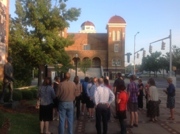
The American Association for State and Local History is holding its annual meeting in Birmingham, Alabama, attracting about 700 people from a variety of history organizations around the country.  The schedule is packed into three days and today started with an outstanding tour of the Civil Rights movement using historic sites around and the public art in Kelley Ingram Park.  We learned about the many people involved, the strategies and obstacles, using both local and national (sometimes even international) stories. A new sculpture was just installed to honor the children who were killed fifty years ago (four girls from a bombing of the church and two boys on the streets of Birmingham), now accompanying statues of Martin Luther King Jr., children facing fire hoses, and the famous walk-through sculpture of attacking police dogs.  I’ll be sharing more from the annual meeting in the following days, including a summary from the discussions on the relevance of history.  

Video: The Heart of the Matter

The American Academy of Arts and Sciences produced this 7-minute video to accompany its report, The Heart of the Matter: The Humanities and Social Sciences for a Vibrant, Competitive, and Secure Nation.   You’ll see lots of familiar names and faces along with many provocative and inspiring thoughts to bolster your day (and some sufficiently pithy to make great quotes in a fundraising letter).

We’ll be discussing the Heart of the Matter report and the state of history at the AASLH annual meeting this week, first at today’s CEO Forum chaired by Kent Whitworth of the Kentucky Historical Society, which will include presentations by Conny Graft and Pharabe Kolb and discussions facilitated by me.  Tomorrow, Tim Grove of the Smithsonian Institution moderates a general session with Conny Graft, Pharabe Kolb, and Kim Fortney.  I’ll be sharing the results of those meetings in the weeks that follow.

Video: History Lives in Alnwick Castle

This is a 0:30 television commercial promoting Alnwick Castle in England, which uses the slogan “Where History Lives.”  This historic site continues as the home of the Dukes of Northumberland, so along with tours of the castle and gardens, they offer a very wide range of activities, such as broomstick training (just like Harry Potter), archery (“one of England’s oldest skills”), and a theatrical behind-the-scenes adventure (called “The Lost Cellars”).  Historic sites rarely are able to produce advertising for television, so enjoy this rare treat.

Review of 2013 NEH Grants Reveals Opportunities and Challenges

This slideshow requires JavaScript.

The National Endowment for the Humanities has announced their last round of grants in the America’s Historical and Cultural Organization‘s (AHCO) program for fiscal year 2013, and a review suggests that opportunities and challenges await applicants–and NEH.  AHCO offers the largest grants for both planning and implementation of exhibits, programs, and activities for history organizations, and it’s often the one that people think of first for funding from NEH.

NEH awarded twenty-five grants totaling $4.2 million in 2013, with history organizations (i.e., historical societies, history museums, historic sites) receiving ten grants (40 percent) and $1.3 million in funding (32 percent).  That’s pretty good compared to the other categories, such as art museums and universities, although I’ll admit it’s a bit subjective depending on how you categorize an organization (I counted the Peabody Essex Museum as a history organization but could as easily be considered an art museum).  NEH funding has long been known as prestigious but rare (NEH states that about 9 percent of applications are funded) so history organizations are doing pretty well.

A Closer Look

A deeper analysis suggests that the chances of obtaining a grant may be easier for some than others.  When you examine Continue reading

Video: History Lives in Charleston

Charleston, South Carolina has one of the most active convention and visitor bureaus in the nation and it has embraced the value of history and historic preservation in its promotion of the region.  This past year they launched a series of videos on different distinctive aspects of Charleston, including “History Lives,” which features interviews with George McDaniel of Drayton Hall, Kitty Robinson of the Historic Charleston Foundation, Charles Duell of Middleton Place, and Robert Russell of the College of Charleston.  At 5:41, it’s a bit longer than most videos I’ve shared previously but it’s a good example of content, production, and pacing.  If you’d like to see all of their videos, visit the Charleston Area Visitors and Convention Bureau website or their channel on YouTube.