New England’s History and Architecture Explored in June

Program in New England StudiesHistoric New England presents the tenth annual Program in New England Studies (PINES), an intensive learning experience with lectures by curators and architectural historians, workshops, and behind-the-scenes tours of Historic New England’s properties and collections, as well as of other museums and private homes in the region.  This year’s program begins on June 17 with Cary Carson on the 17th century in the Boardman House and ends on June 22 with Richard Nylander and Nancy Carlisle on the Colonial Revival at Beauport.

PINES examines New England history and material culture from the seventeenth century through the Colonial Revival, and delves into building design and technology, and the wide-ranging lifestyles illustrated by the historic sites on the itinerary.  Highlights include private tours of Historic New England properties in Greater Boston; Essex County, Massachusetts; Portsmouth, New Hampshire; South Berwick, Maine; and Woodstock, Connecticut; workshops in furniture, ceramics, and textiles at Historic New England’s facility in Haverhill, Massachusetts; and a private tour of Continue reading

WebWise Conference Coming Up in Early March

WebWise 2012: Project demonstrations

WebWise 2012: Project demonstrations

WebWise, the annual conference hosted by the Institute of Museum and Library Services, will be held in Baltimore on March 6-8, 2013. This year’s conference is co-sponsored by the Roy Rosensweig Center for History and the New Media and is being organized and presented in a very different manner.  In advance, participants (anyone, actually) voted on the proposed workshop topics and then the conference organizers recruit speakers to fill the slots. For the project demonstrations, the participants will be divided into three groups and then rotate through three different sets of presentations. In addition, there will be a series of three-minute lightning talks over lunch, facilitated project/partnership incubator groups, and one-on-one speed consulting sessions. Indeed, there’s only one plenary session scheduled for the entire conference–Audrey Watters of Hack Education–as a keynote on the last day.

I’ve attended as many WebWise Conferences as possible because the content has been outstanding and I often come away with new approaches and strategies, even from the sessions that are far outside my field. This year’s reformatting seems intriguing, but much of the content remains a mystery so Continue reading

Resources for Historic Sites from the American Alliance of Museums

The American Alliance of Museums (formerly known as the American Association of Museums) is offering several resources and workshops that may be interest to historic sites, including:

TrendsWatch 2013: Upcoming Town Hall
This year’s edition of TrendsWatch, the annual report on key social, economic, technological and other trends that are shaping the future of museums, will be released next month.  You can also learn about it at the Alliance’s Web-based Town Hall on March 27 at 2 pm ET, which will be hosted by their Center for the Future of Museums.  Registration is free for Alliance members, and will open soon.  Meanwhile, read (or re-read) TrendsWatch 2012 for a taste of the future.

2012 National Comparative Museum Salary Study Available
A national salary study has long been a top request from Alliance members. Demonstrating that we’re stronger together, the 2012 study was prepared in collaboration with the Association of Midwest Museums (AMM), the Mountain-Plains Museums Association (MPMA), the New England Museum Association (NEMA) and the Southeastern Museums Conference (SEMC) and based on surveys conducted in their regions. Together, these associations represent 36 states, 64 percent of the American population and approximately two-thirds of all museums in the United States. Available free to Continue reading

IMHO: Seismic Shifts Predicted in Historic Preservation

SeismographUnlike the environmental movement, which has many national organizations devoted to its many and varied causes, historic preservation has just a handful. When something happens at one or two of them, it can significantly shape what’s happening at the state and local level.  This year promises seismic shifts because of transitions occurring at three national organizations:  Preservation Action, the National Conference of State Historic Preservation Officers, and the National Trust for Historic Preservation.

The National Trust for Historic Preservation has been undergoing tremendous transformation since 2009, when Dick Moe’s long 17-year tenure as president ended. Stephanie Meeks, a former executive with the Nature Conservancy, took the helm and introduced a new strategic plan that narrowed its work by closing most of its regional offices, cutting Preservation magazine from six to four issues a year, closing its Save America’s Treasures office, reorganizing the National Main Street Center as a wholly-owned subsidiary, and cutting its ties with state and local preservation organizations. The plan (sometimes called Preservation 10X) also prompted a turnover of much of the staff through reorganizations and layoffs and put in place a new management team, most of whom are outside the field of history or preservation, suggesting a major retreat from its leadership position in historic preservation.

This year the focus at the National Trust seems to be on raising cash to survive. The last fiscal year ended Continue reading

Video: Smithsonian Museum of African American History and Culture

This short feature by BET includes an interview with director Lonnie Bunch, highlights of artifacts, and a computer-generated fly-through of the new Smithsonian Museum of African American History and Culture.  In honor of African American history month, I’ll be sharing other related videos on Fridays.

Seeing Indiana’s Historic Sites From an Artist’s Perspective

Ronald Mack. Photo courtesy of Indiana Plein Air Painters Association.

Ronald Mack. Photo courtesy of Indiana Plein Air Painters Association.

Indiana Landmarks, one of the most active statewide historic preservation organizations in the nation, has an innovative program that brings together local artists and historic sites.  To preserve the tradition of plein air painting and focus artists on capturing historic places, Indiana Landmarks is partnering with the Indiana Plein Air Painters Association (IPAPA) on the third volume of the coffee-table book series, Painting Indiana

“Plein air painting is an important tradition, famously practiced in the late nineteenth and early twentieth centuries by T. C. Steele, William Forsyth, Ottis Adams and other noted Hoosier artists,” says Indiana Landmarks’ president Marsh Davis. “When places are captured in paintings, it increases the public’s Continue reading

Predictions for Education Technology in 2013


Image courtesy of HamiltonRentals.Wordpress.com.

Image courtesy of HamiltonRentals.Wordpress.com.

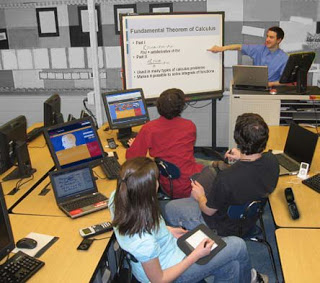
T.H.E. Journal brought together five technology experts who work in schools to predict the future of technology in the classroom–and may help you decide where the opportunities lie for your museum or historic site as you work with students and teachers. Here’s a quick summary, and if you want more details, check out the entire article in the December 2012 issue.

  • HOT: Common Core Online Assessments. “As more and more curriculum departments align their learning resources to the Common Core, the next step will be to create the systems for implementation, including content management and new methods of assessment. Mobile devices will play a role in Common Core assessments.”  [Every history organization that works with schools should notice that this issue not only suggests following and understanding the Common Core but that schools continue to have inconsistent and unreliable computer technology, so providing information only online may hinder students and teachers, rather than help.]
  • HOT: iPads. LUKEWARM: Tablet Computers other than iPads. “iPads will continue to Continue reading

Workshops for History Museums and Historic Sites

The American Association for State and Local History unveiled an assortment of workshops for spring (there’s one in every time zone!):

Project Management for History Professionals
Dates: March 7 – 8
Location: History Colorado, Denver, CO
Instructor: Dr. Steven Hoskins, Trevecca Nazarene University, Nashville, TN
Cost: $475 members / $550 nonmembers
$40 discount if payment is received by January 31 (coming up next week!)

This unique two-day workshop improves how history museums operate and serve their community by teaching the fundamentals of project management to history professionals. Everyday work—exhibitions, programming, fundraising, special events, outreach, and collections care—benefit from the knowledge gained. Registration for the onsite workshop also includes access to an online course with related material.

From Children to Adults: Public Programming at History Organizations
Dates: March 14 – 15
Location: Homestead Museum, City of Industry, CA
Instructors: Tim Grove, National Air and Space Museum, Smithsonian Institution, Washington, DC; Alexandra Continue reading

Nation’s Nonprofits Caught in a Fundraising Whirlpool

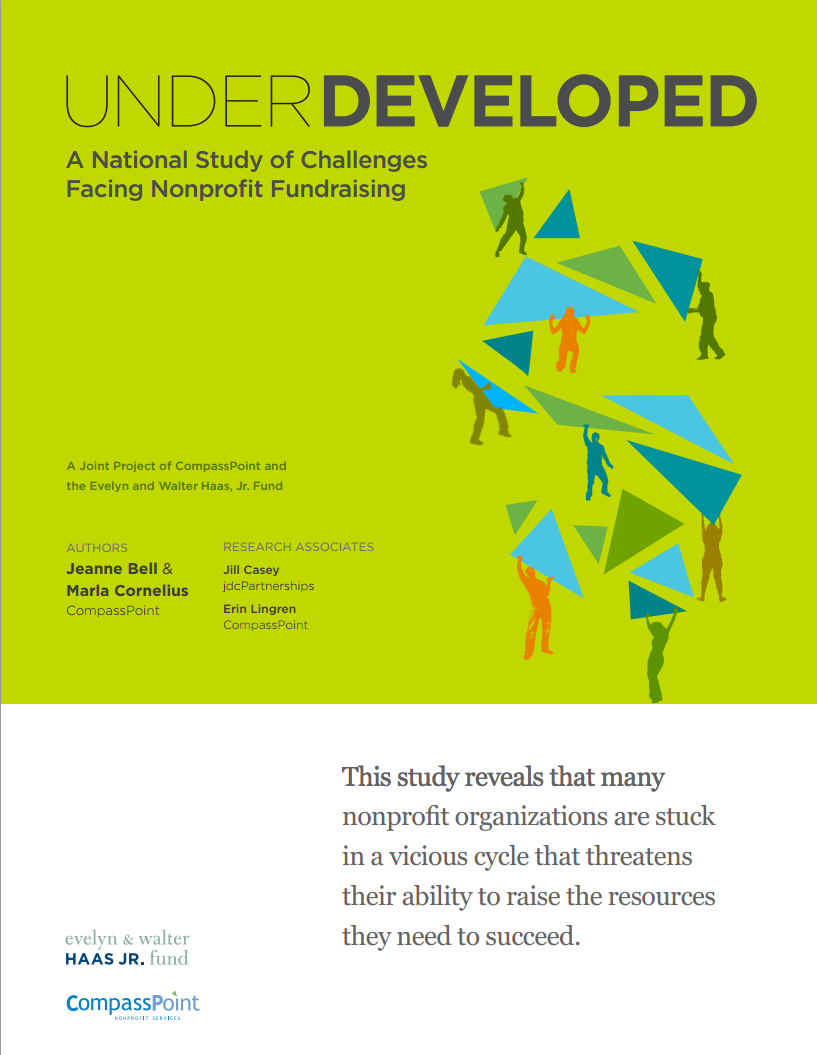
Under Developed 2013Many executive directors aren’t happy with their development directors and many development directors aren’t happy with their jobs–the result is an inability to adequately raise funds for the nation’s non-profit organizations and deliver much-needed community services and benefits.  That’s one of the findings of Under Developed, a recently released national study by Compass Point.  In a nutshell, “many nonprofit organizations are stuck in a vicious cycle that threatens their ability to raise the resources they need to succeed.”  Their findings and recommendations come from 2,700 surveys of both executive directors and senior development staff, and focus group discussions with 53 executives and board members across the country.

I always assumed that the “revolving door” in the fundraising office was a result of better opportunities (in my ten years at the National Trust, the development department turned over completely nearly three times) but the Compass Point report suggests there are more serious issues at work:   Continue reading