
One of the traditions in Washington, DC is a long vacation in August because it’s just too hot and humid to work. Even though most offices, homes, and cars are now air conditioned, the tradition still holds (note that Congress recently adjourned until September) and we’ll be observing it here as well. There won’t be any posts unless something incredibly interesting happens and we’ll focus on sweeping out spam, refreshing pages, and perhaps even get around to a little remodeling. We’ll be back again after Labor Day with the usual 2-3 posts each week, so it’s a good time to subscribe so you don’t miss the news when it comes out again this fall. Thanks for your continued support and interest this year and we look forward to seeing you in a few weeks.
Video: Summer Walk on the British Coast
Summer has arrived and what better time of year to get out and explore the best of British wildlife. Join Fred Rumsey, Botanist at the Natural History Museum in England, as he goes on a coastal walk in search of plants living in extreme conditions at West Wittering Beach in West Sussex. This is part of a series of videos exploring nature in different seasons. Can your site be interpreted differently in summer than it can in winter?
News from Montpelier and Belle Grove in Virginia
Last Friday I was in Virginia and thought I’d share what’s been happening at James Madison’s Montpelier and Belle Grove, two historic sites that I’ve been associated with for more than a decade.  James Madison’s Montpelier as seen from the entry drive.
  Montpelier’s Interiors and Interpretation Committee.
  Drawing Room at Montpelier.
  Committee visiting the Dining Room of Montpelier.
  Committee in Madison’s office.
The day started with a meeting of the Interiors and Interpretation Committee at James Madison’s Montpelier to see the most recently restored rooms at the mansion, advise them on the next phase of work, and to meet Kat Imhoff, the new president of the Montpelier Foundation. The committee hasn’t met for a couple years so I was particularly anxious to see what’s been happening at this nationally significant site. The drawing room, dining room, new library, and James Madison’s office are furnished (or nearly so) and with revisions to the tour, it’s a dramatically different visitor experience. If you haven’t been there in a couple years, it’s well worth another visit. I enjoy participating as a committee member because Montpelier gives me the unique privilege of staying overnight on site (not in the mansion, alas, but in a nicely updated house in the Constitutional Village). Even better are the people I work with when I visit–passionate and enthusiastic colleagues who are among the best in their fields. This meeting included Conny Graft, Betty Monkman, Gail Serfaty, David Mattern, and Robert Leath and to give you a glimpse of their fervor, one of the committee members brought an undiscovered Madison letter that descended through her family and we stayed up until midnight (at least that’s when I went to bed) to discuss and analyze it.

Belle Grove retirement party for Elizabeth McClung.

Kent and Elizabeth McClung and Max van Balgooy.

Belle Grove retirement party for Elizabeth McClung.

Model unveiled by Jane Dodds and Scott Guerin of 4274 Design Workshop.

Detail of Belle Grove in 1820 model.
In the evening, I stopped by Belle Grove in Middletown on the way home to congratulate Elizabeth McClung on her retirement. Their board of trustees hosted a well deserved celebratory party with lots of speeches, food, and wine. Elizabeth has served for 17 years at the helm of this historic site, making tremendous strides in preservation and interpretation to make it a major point of pride in the community. She helped create the Cedar Creek and Belle Grove National Historical Park, launched new research initiatives on African American and women’s history, acquired extremely important family portraits and adjacent land parcels, fought bloody preservation battles in the Shenandoah Valley, revised the website, authentically restored the parlor and dining room, and raised LOTS of money (those are just the things I’m aware of from my distant view!). Her last major project was the rehabilitation of an early 20th century barn for educational activities and while funds still need to be raised for the exhibits, 4274 Design Workshop unveiled a new model of Belle Grove as it appeared in 1820.
It was an incredibly full and fun day visiting these two historic sites, and because I was mostly traveling the Virginia countryside, a great day of driving on a beautiful day as well.
Burma Shave Inspires Signs at St. Jones Reserve
St. Jones Reserve in Dover, Delaware is a 3,750-acre nature preserve on the edge of Delaware Bay dominated by salt marsh. Deep inside is an environmental education, training, and research facility at the end of the long unpaved road–how do you ensure visitors that they’re on the right track and not getting lost in the countryside?
Education Coordinator Jennifer Holmes came up with a clever idea to install a series of signs along the entry road to Continue reading
Video: History Summer Camp in China
This 4:49 video is titled, “Dailian History Summer Camp” but I can’t figure out what’s going on. The music is bubbly but the scenes make no sense: children playing basketball in kimonos, performances of Korean traditional music, song and dance numbers, jumping rope, and a visit to a historic POW camp (including weapons and torture devices). I can’t even figure out if the titles are written in Chinese, Japanese, or Korean, but it looks like they’re have a good time (the opening titling is a bit long, so you might want to skip to 0:30). Can anyone translate this and share what’s going on? Thank you all.
A Clever Model of Engagement for Your Desk or Office
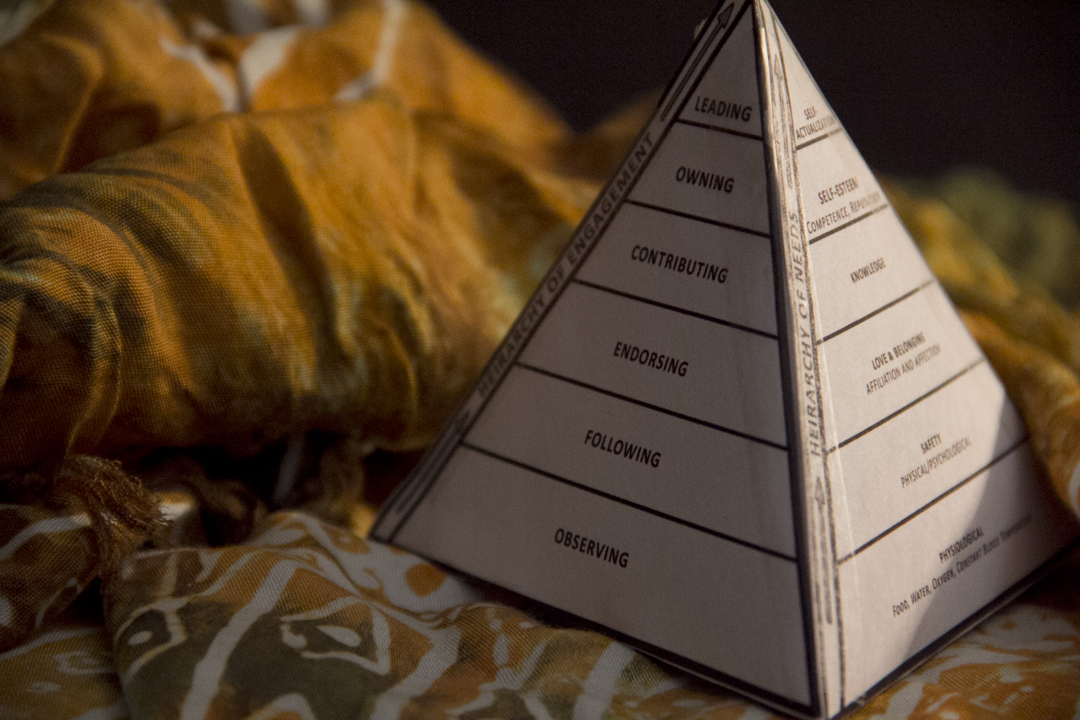 I’ve been working on a strategic plan for the Division of Historical and Cultural Affairs for the State of Delaware for the past few months and after a recent meeting, I stopped by the office of Travis Kirspel, one of the planning team members and the Curator of Digital Assets. A set of geometric solids in his bookcase caught my eye–I associate them with early science and cabinets of curiosity–and it turns out he created them. He’s interested in community engagement, so he used his skills as a graduate of the Savannah College of Art and Design to develop a clever model that pulls together various theories into one object. He graciously provided more details, as well as the blueprints so you can create a pyramid for your desk or office.
The Pyramid of Engagement: A Psychological Model for Building Community Relationships by Travis Kirspel
It is said (albeit on Wikipedia) that the Egyptian pyramids were, well, pyramid-shaped as a nod to the “primordial mound” from which the earth was created. They have also been described as more like “resurrection machines” than “tombs” by design. Essentially, the deceased pharaohs’ souls became superhuman cannonballs launched through Continue reading
Early Bird Registration Discount on AASLH Meeting Ends this Week
The American Association for State and Local History just released its program for its annual meeting on September 18-21, 2013 in Birmingham, Alabama this year and it’s full of educational sessions, workshops, and field trips for people who work, volunteer, and love historic sites, including:
- A tours of historic sites in Birmingham, Montgomery, and Florence
- A visit to the Sixteenth Street Baptist Church on the week of the 50th anniversary of the bombing that killed four girls.
- A workshop on interpreting slavery at historic sites and museums
- A breakfast for professionals working in historic house museums with the provocateurs who wrote The Anarchist Guide to Historic House Museums.
- Sessions on interpreting women at historic sites, incorporating the arts, integrating African American voices into historic plantation tours, strategic planning through scenarios, and the creation of heritage trails.
Lots of events happen at the same time so it’s always hard choosing, but this year’s meeting is being held in partnership with the International Coalition of Sites of Conscience, so along with the sessions that focus around historic sites, there are also many sessions on community engagement, organizational leadership, interpretation of controversial topics, and the incorporation of new perspectives. It’ll be a good meeting and I plan to be there, so I’m taking advantage of the early bird discount that ends this Friday, July 26. Registration is $325 for members, but this week it’s only $235 (staff of institutional partners get this same low price until August 16, so you have a few more weeks). For more information, visit AASLH.org.
Video: A Virtual Summer Camp using Google+
Invention meets social media in a summer camp format. In 2012, MAKE held a Maker Camp on Google+, introducing an online summer camp inspired by the creative and diverse maker culture. It was a six-week program featuring 30 days of projects and activities for teens 13-18. Every day a different counselor posted how-to instructions and hosted a Hangout, giving campers a chance to ask questions and show off their projects. It was free and open to everyone with a Google+ profile.
How can new technologies transform or expand your programs? Can Google+ or Hangout help you work with colleagues to complete projects? Check out what the Henry Ford Museum is doing with Maker Faire Detroit. Can your summer camps incorporate some ideas from Maker Faire®?
An Exhibit that Teases You For a Closer Look
I’ve just returned from Yellowstone National Park–the nation’s first–and while I have much to share on my experiences from my visit, I wanted to start with an exhibit that teases you to take a closer look. In the new visitor education center at Old Faithful Geyser, you’ll find a diorama of a hot spring as the centerpiece of the exhibit gallery. It would be easy to just point out the blue waters of the hot spring or the coyote nearby, but several flipbooks on the railing encourage you to “Look Closely” with the words, “Life abounds in Yellowstone’s hydrothermal areas. How many things can you find here that are evidence of plants, animals, or other life?” Rather than just put the answers on the next page, they first say, Continue reading
Video: Extreme Journey Camp
The Journey Through Hallowed Ground Partnership works with the Loudoun County Public Schools in Virginia to provide an unusual summer camp that visits historic sites to create vodcasts on leadership. This 3:11 video describes the camp and includes interviews with students, teachers, and staff. According to one 7th grader, “I would recommend it to kids that like history, computers, or sports. If you don’t like one of those three, then some parts you won’t enjoy.” This video is the first in a series of nine, and you’ll find them all on YouTube.

