Tag Archives: American Historical Association

When “Accuracy” Means Ideology: A Closer Look at the Heritage Foundation’s Historic Sites Guide

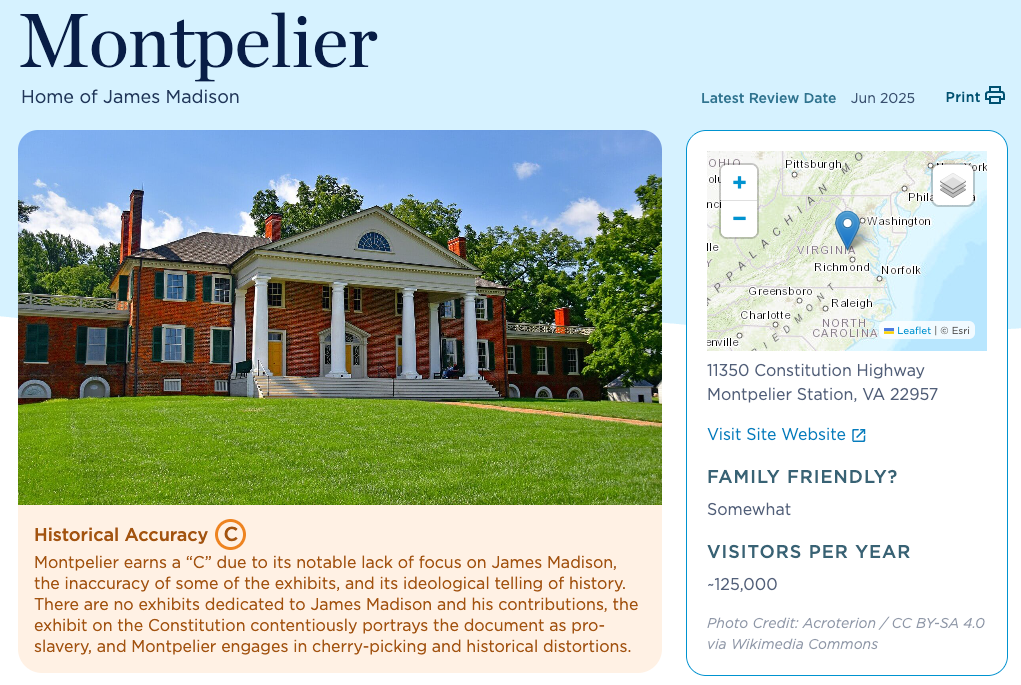
The Heritage Foundation’s new The Heritage Guide to Historic Sites: Rediscovering America’s Heritage promises to help Americans find “accurate” and “unbiased” history at presidential homes and national landmarks. Presented as a travel and education tool for the nation’s 250th anniversary, the site grades historic places from A to C for “accuracy” and “ideological bias.”

At first glance, it looks like a public service. But a closer look reveals that even when Heritage cites “evidence,” its historical reasoning exposes deep methodological and ideological flaws.

The Appearance of Evidence

The Heritage Foundation awards James Madison’s Montpelier in Virginia a C for historical accuracy, claiming the site shows a “notable lack of focus on James Madison” and that:

Continue reading

History Redacted? What Museums Can Do About Censorship and Content Restrictions

Across the United States, museums and historic sites are feeling the pressure of growing efforts to limit how history is interpreted and shared with the public. Whether it’s school boards restricting curricula, exhibitions removing stories about women or African Americans, or state legislatures targeting specific narratives, the landscape for public history is shifting. Two recent statements—one from national associations of professional historians and another from a leading association of history organizations—offer timely guidance for navigating this challenge.

Upholding Academic Freedom and Public Access to History

In their joint statement, the American Historical Association (AHA) and the Organization of American Historians (OAH) raise alarm over federal directives aimed at censoring public-facing historical content. Specifically, they object to restrictions on the use of terms like “diversity,” “equity,” and “inclusion,” as well as efforts to remove access to resources about gender, race, and immigration history across government platforms. These actions, the associations argue, “deny the American public access to the complex, nuanced, and evidence-based historical knowledge that is essential to democratic society.”

For museum professionals, this serves as a reminder that we are not only stewards of collections but also of public understanding and trust. AHA and OAH call on historians–including those in museums and historic sites–to resist these pressures by reaffirming their commitment to historical accuracy, critical inquiry, and public service. The practical takeaway? Review interpretive plans, online content, and programs to ensure they are grounded in evidence-based scholarship, even–and especially–when the topics are politically charged.

Standing with the National Park Service: A Sector-Wide Response

Continue reading

Is Twitter Effectively Engaging Your Audiences?

twitter-afpWith the new year on the horizon, I’ve been evaluating my projects from the last year to determine how I can help historic places better connect to their audiences. For the past two years, I’ve used Twitter to share news about history, historic sites, historic preservation, and history museums.  Each morning I scan the New York Times and other newspapers for stories, aiming to tweet about three stories daily to my @maxvanbalgooy account so that my followers can quickly learn what’s happening.  The result? I have created 4,180 tweets and attracted nearly 500 Followers since I joined Twitter in June 2009.  This blog, on the other hand, has 1000 subscribers, so it seems my time is better spent on my blog than Twitter.  It could be very different for you, but how do we decide if Twitter is effectively engaging your audiences?

A useful place to start is with the metrics that Twitter provides: Followers and Likes.  Likes are a low level of engagement because they only require that readers support a specific tweet or find it especially useful or enjoyable—but that’s it. Followers are a mid-level form of engagement because it means that a reader wants to engage with you and read everything that you tweet (“read” is probably overstating things; “scan” is more appropriate for Twitter). Retweets engage at a high level because your Followers share your tweet to their Followers (did you follow that? it’s about the impact of the multiplier effect)—unfortunately, there’s no easy way to measure Retweets (but boy, we would have more impact if we promoted Retweeting instead of Liking).

To better understand how effectively Twitter can engage audiences, I collected statistics for a variety of major history organizations to measure Tweets, Followers, and Likes as of today (December 8, 2016) to develop the following chart: Continue reading

Hangout with Historians to Discuss the Nation’s Report Card

NAEP History Scores 1994-2014Discuss strategies to improve history education in our schools with people coming at it from different perspectives on Tuesday, July 7 at 12 noon (Eastern) in a Google Hangout co-hosted by the National Assessment Governing Board and the American Historical Association.  It’s in response to the latest results of the Nation’s Report Card, which shows that many students lack a strong understanding of our nation’s history (as seen in the chart, scores have been flat for the past twenty years, and the conversation will explore ways that students can become more engaged and informed.  Hmm, can historic sites and house museums play a role?

Participants include

  • Jim Grossman, executive director of the American Historical Association
  • Chasidy White, history and geography teacher at Brookwood (Ala.) Middle School and member of the National Assessment Governing Board
  • Judith Gradwohl, MacMillan associate director for education and public engagement at the National Museum of American History
  • Libby O’Connell, chief historian at the History channel
  • Frank Valadez, executive director of the Chicago Metro History Education Center

and the conversation will be moderated by Jessica Brown, contributing writer at Education Week.

To register or for more information, visit Why History Matters at the National Assessment Governing Board.

Relevance of History Discussed at AHA Session

This slideshow requires JavaScript.

Last Friday, January 3, about 65 people braved the winter cold of Washington, DC (okay, compared to Midwest right now, it’s balmy) to participate in a discussion on the relevance of history to Americans.  Leading the discussion with me were Tim Grove of the Smithsonian Institution and Cathy Gorn and Kim Fortney of National History Day.

It was an exciting mix of participants.  The room was not only filled with historians who were attending the American Historical Association conference, but also people who work at history organizations in the DC region.  These various perspectives sparked a Continue reading

College History Degree is Getting A Tune Up; Historic Sites Get a Flat Tire IMHO

The American Historical Association recently announced that it is initiating a nationwide, faculty-led project to articulate the disciplinary core of historical study and to define what a student should know and be able to do at the completion of a history degree program. Professors Anne Hyde (Colorado College) and Patricia Limerick (University of Colorado Boulder) will lead faculty from more than sixty colleges and universities across the country to frame common goals and reference points for post-secondary history education. According to the AHA, “these faculty participants will work together to develop common language that communicates to a broad audience the significance and value of a history degree.”

Hmm, just the degree?  What about the significance and value of history?  My sense is that this project is being prompted by the funder, Continue reading