Author Archives: Max van Balgooy

Unknown's avatar

About Max van Balgooy

President of Engaging Places LLC, a design and strategy firm that connects people to historic places.

Put Your Website to the PageSpeed Test

Google PageSpeed InsightsYou may have spent lots of time and money refreshing your website, but how well does it actually perform on people’s desktops and mobile devices?  If it’s too slow, people will give up and go elsewhere, so loading speed is important to monitor.  Thanks to Google, you can test the speed of your website plus receive suggestions for improvement for free.  Go to PageSpeed Insights and enter your website address. In a few seconds, you’ll receive a detailed report.  EngagingPlaces.net scored 70/100 for desktop performance and if you think that’s low, I checked a couple of my client’s websites and they fared much worse.  If you’d like to learn more, watch the Dotto Tech video “Episode #47: Importance of Site Speed” that explains how he redesigned his WordPress website to perform better.


San Francisco’s Newest House Museum is a Conceptual Artwork. Or Is It?

The David Ireland House, 500 Capp Street, San Francisco.

The David Ireland House, 500 Capp Street, San Francisco.

A couple weeks ago I had an opportunity to visit the David Ireland House, a house museum that recently opened in San Francisco.  Unlike New York, Los Angeles, Chicago, or Washington, DC, San Francisco has only a handful of house museums so the addition of the Ireland House is a significant one—and unusual.

David Ireland was a conceptual artist active from the 1970s to 2000s, becoming an artist in his 40s after serving in the Army and leading safaris in Africa. In 1975 he purchased a modest 1880s Italianate-style house in the Mission District from an accordion maker and proceeded to use it as his home while transforming it into an artwork, most visibly by peeling away layers of wallpaper and then coating the plaster walls in polyurethane varnish.  Yes, strange but true. With his death in 2009, the 500 Capp Street Foundation (the address of the David Ireland House) saved the house, hired the Architectural Resources Group to lead an extensive conservation process, included a sensitive award-winning addition by Jensen Architects, and opened the house last year to the public.

This is a difficult place to interpret because Ireland not only treated the historic house as a contemporary artwork, but it is conceptual art, which puzzles most people when encountered in an art museum (remember Marcel Duchamp’s Fountain?). It’s not only non-traditional, but questions the very nature of art.  When you encounter a pile of neatly stacked firewood, you’re wondering if you’re looking at an artwork or simply a stack of firewood.

"The Sound of Blue," by David Ireland.

“The Sound of Blue,” by David Ireland.

The David Ireland House handled this very well by starting the tour with a conceptual artwork (or was it two?).  Visitors first step into a sparse room, where you purchase tickets and are welcomed by the guide.  After a few minutes of chatting, the guide points out an artwork that was discovered in the house: a butane torch mounted on a stand made of copper plumbing pipes.  He proceeded to explain it was called the “Sound of Blue,” lit the torch, and turned on a cassette tape recorder whose microphone was aimed at the torch.  We watched it together for a minute, when another guide picked up a newspaper laying on a table, read aloud the date and a headline, and then placed the newspaper on a stack forming in the corner of the room.  The tape recorder was then turned off along with the torch.

That was weird. What just happened? This is art? What does this mean? What’s going on? Is this serious or an elaborate hoax? Is the whole tour going to be like this? What’s going to happen next?

Yup, that’s exactly the reaction they want you to have. It provoked the kinds of questions and reactions that David Ireland would have liked, so the rest of the tour was a combination of short explanations followed by a lot of questions from me, which they encouraged.  Although the entire house is treated as an artwork, there are no stanchions and you can wander where you want.  Tours are guided and intentionally kept small to protect the objects, so you have a great sense of freedom to explore and wonder if you’re looking at an artwork or it’s just a chair hanging on the wall.  It is at times bizarre (you encounter a piece of birthday cake preserved in a Mason jar) and amusing (a pile of firewood stamped with the artist’s initials), but it did cause me to think about the nature of art, art curators, and art museums. Others, however, might find it silly and shallow, but that’s one of the points of conceptual art as well: the viewer determines the significance and meaning of an artwork, not the art dealer, curator, or museum. Indeed, is this an art museum, an historic site, or just David Ireland’s house?

Google’s New Data Gallery Suggests Directions for Historic Sites

Screen Shot 2016-07-15 at 10.16.58 AMGoogle has regularly shared findings from studies conducted from various sources (including its own analytics from searches and YouTube) in Think with Google, which I receive as an email a couple times each month as a subscription.  They’ve now gathered those studies together in a new Data Gallery which, of course, can be searched by topic.  There’s nothing for “museums,” “historic sites,” or “tourism,” but there is lots for “travel & hospitality.”  You can also narrow your search by industry (e.g., “travel & hospitality”), by platform (e.g., mobile, video), by themes (e.g., consumer trends, Millennials, U.S.).

A quick browse through the “travel & hospitality” shows the growing importance of video.  For example, their research shows that two out of three U. S. consumers watch online travel videos when they’re thinking about taking a trip and nearly 90 percent of YouTube travel searches focus on destinations, attractions/points of interest or general travel ideas.  This suggests that historic sites and house museums need to Continue reading

Video: Evaluation Consultant Randi Korn on Impact

In this 2:01 video, Randi Korn explains how museums and historic sites can define impact and how an “impact statement” integrates personal passion, the organization’s strengths, and the audience’s interests and needs.  And to measure impact you have to go beyond the usual numbers involving attendance and income and instead look at the experience that people had.  This is one in the “Questions of Practice” video series produced by the Pew Center for Arts and Heritage.

Vision Statement: Encyclopedia Edition

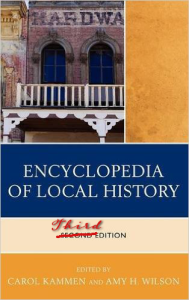
The Encyclopedia of Local History will issue its third edition in 2017.

The Encyclopedia of Local History will issue its third edition in 2017.

Carol Kammen and Amy Wilson are preparing the third edition of the Encyclopedia of Local History for publication in early 2017 and invited me to update my entry on “Historic House Museums in the 21st Century” as well as contribute a couple new entries, including “Vision Statement.”  Businesses and nonprofit organizations have been adopting vision and mission statements for the past two decades but drafting this encyclopedia entry gave me a chance to step back to look at its evolving history and see where they might be headed.  Here’s what I submitted (and remember, while books have been written about this topic, I have to condense it into a short summary):

Vision Statement. A vision statement describes a business’ or non-profit organization’s long-term major goal or desired end state and directs the planning, implementation, and evaluation of its programs and activities. There are many definitions for vision statements, some that conflict with each other, but the consensus is that they describe an ambitious but achievable long-term goal (10-30 years ahead, beyond the term of the current board or tenure of the executive director); that the statement is clear, compelling, and short (about 25-50 words); and yet is sufficiently vague and abstract to be unaffected by typical economic cycles or social fads.

An often-cited example of a vision statement is found in John F. Kennedy’s address to Congress in 1961 on urgent national needs: Continue reading

Video: How Collectors Influence the Art Market

Artsy: How and Why Patrons Support an Artist

In this 4:03 video, Artsy explains why a patron supports an artist and how this influences the art market. What compels patrons to support artists’ careers? How has the model of commissioning impossible ideas lasted from the ancient Egyptians until today? This short film is the third and latest in a series of four short films about the art market by Artsy.  Even if you’re not interested in this topic, the interpretive presentation may be a model for your videos.

Campbell House using Simple and Durable Interpretive Tools

This slideshow requires JavaScript.

When I recently visited the Campbell House Museum in St. Louis, I was really impressed by their use historic images and documents throughout the tours.  It wasn’t just that they were integrating lots of different historic materials into the tours (that’s always a good practice), but they looked great.  In the entry hall, a couple 16″x20″ historic maps on the wall put the house in a historical context.  In the parlor, a stand held an assortment of historic photos on lightweight boards, which the docent passed around so that visitors could examine them more closely.

They were clearly modern so there was no confusion you were handling something historic and the docents could easily use them because they were so simple and light.  They were easy to examine because the matte surface reduced glare from the sun and lights. But what really surprised me is that they were more than ten years old—they looked brand new!  No edges were peeling and the images hadn’t been worn out or bent by the constant handling.  Even better, they were cheap to produce—about $8-10 per square foot by a local sign maker. These are so much better than laminated or framed interpretive tools I’ve seen and used elsewhere.

If you’re interested in creating these for your site: Continue reading

St. Louis’ new Blues Museum Needs More Artifacts (and Music)

National Blues Museum, St. Louis, Missouri.

National Blues Museum, St. Louis, Missouri.

In April, I had a chance to visit the newly opened National Blues Museum in St. Louis, Missouri while I was in town to lead a workshop with Ken Turino of Historic New England.  As the “only museum dedicated exclusively to preserving and honoring the national and international story of the Blues and its impact on American culture in the United States,” its mission is “to be the premier entertainment and educational resource focusing on the Blues as the foundation of American music.”  Those are pretty bold claims and we’ll have to give them some time to see if they can achieve them.  In the meantime, I wanted to share my initial reactions to the primary permanent exhibit designed by Gallagher & Associates of Silver Spring, Maryland (near my hometown!), who also designed exhibits for Mount Vernon, Gettysburg Visitor Center, and Jamestown Settlement Museum.

Housed in a former historic department store near the city’s downtown convention center, the bold use of panels filled with text, images, video, textures, and colors as well as a strong horizontal lines that pull you through each space, make it a compelling and attractive design. Indeed, it’s so effective that it didn’t strike me until about halfway through that the exhibit feels two-dimensional and there are hardly Continue reading

Values of History: Encyclopedia Edition

The Encyclopedia of Local History will issue its third edition in 2017.

The Encyclopedia of Local History will issue its third edition in 2017.

Carol Kammen and Amy Wilson are preparing the third edition of the Encyclopedia of Local History for publication in early 2017 and invited me to update my entry on “Historic House Museums in the 21st Century” as well as contribute a couple new entries, including “Values of History.”  Businesses and nonprofit organizations have been adopting values along with mission and vision statements for the past two decades but drafting this encyclopedia entry gave me a chance to step back to look at its evolving history as well as include the work of the History Relevance Campaign.  Here’s what I submitted (and remember, while books have been written about this topic, I have to condense it into a short summary):

Values of History. Values are beliefs shared by an individual or a community about what is important or valuable. Although values and ethics are terms used interchangeably at times, ethics are the action and manifestation of values. In addition to a mission and vision, some history organizations have adopted a statement of values or a code of ethics to clarify their identity and guide decisions. For example, Society for Historical Archaeology includes in its code of ethics that members “shall not sell, buy, trade, or barter items from archaeological contexts,” an action based in part from their belief that “historical and underwater cultural resources” are a “valued resource for knowledge exchange.” The importance of values was underscored nearly a generation ago in Museums for a New Century (1984): “An effective museum leader—whether scholar or M.B.A. or both—must first understand, believe in, and speak for the values of the institution.”

A common challenge for state and local history organizations is explaining Continue reading

Mission Statements: Encyclopedia Edition

The Encyclopedia of Local History will issue its third edition in 2017.

The Encyclopedia of Local History will issue its third edition in 2017.

Carol Kammen and Amy Wilson are preparing the third edition of the Encyclopedia of Local History for publication in early 2017 and invited me to update my entry on “Historic House Museums in the 21st Century” as well as contribute a couple new entries, including “Mission Statement.”  I’ve long been familiar with mission statements (who isn’t nowadays) but drafting this encyclopedia entry gave me a chance to step back to look at its evolving history as well as a today’s context to see what’s happening.  Here’s what I submitted (and remember, while books have been written about this topic, I have to condense it into a short summary):

Mission Statement. A mission statement describes the purpose of an organization and directs the planning, implementation, and evaluation of its programs and activities. These statements can vary as seen in these two historic sites that are adjacent to each other in Hartford, Connecticut:

  • Mark Twain House and Museum: to foster an appreciation of the legacy of Mark Twain as one of our nation’s defining cultural figures, and to demonstrate the continuing relevance of his work, life, and times.
  • Harriet Beecher Stowe Center: to preserve and interpret Stowe’s Hartford home and the Center’s historic collections, promote vibrant discussion of her life and work, and inspire commitment to social justice and positive change.

Had Twain or Stowe heard the term “mission statement” in their lifetimes, they probably would have regarded it as Continue reading