One of the most common challenges for nonprofit organizations—whether museums, historic sites, or community groups—is understanding who does what when it comes to decision-making, planning, and day-to-day operations.
Board members sometimes worry they are getting too involved in management or don’t know enough about what’s going on. Staff members, on the other hand, can feel their authority is being questioned when board members step into operational details. Yet when everyone understands their distinct responsibilities, organizations thrive.
We would never expect a new volunteer to suddenly step into a historic house and deliver a flawless tour. They need orientation, resources, and time to develop their skills before they feel confident leading visitors.
Back in 2014, I shared a classic business matrix as a tool to help museums and historic sites think more strategically about their programs and activities. It plotted mission alignment on one axis and financial sustainability on the other, providing a quick visual way to categorize whether something was worth continuing, needed revision, or should be reconsidered altogether, using metaphors of stars, hearts, cash cows, and bunnies.
The response was strong—many found it useful for internal discussions, staff retreats, and board meetings. But since then, my thinking has evolved.
Over the last decade, I’ve come to see that we need a broader lens. It’s not enough to think about money and mission alone. Sustainability today must account for more than just dollars, and impact is shaped not only by mission statements, but also by vision and values.
A Matrix for Today
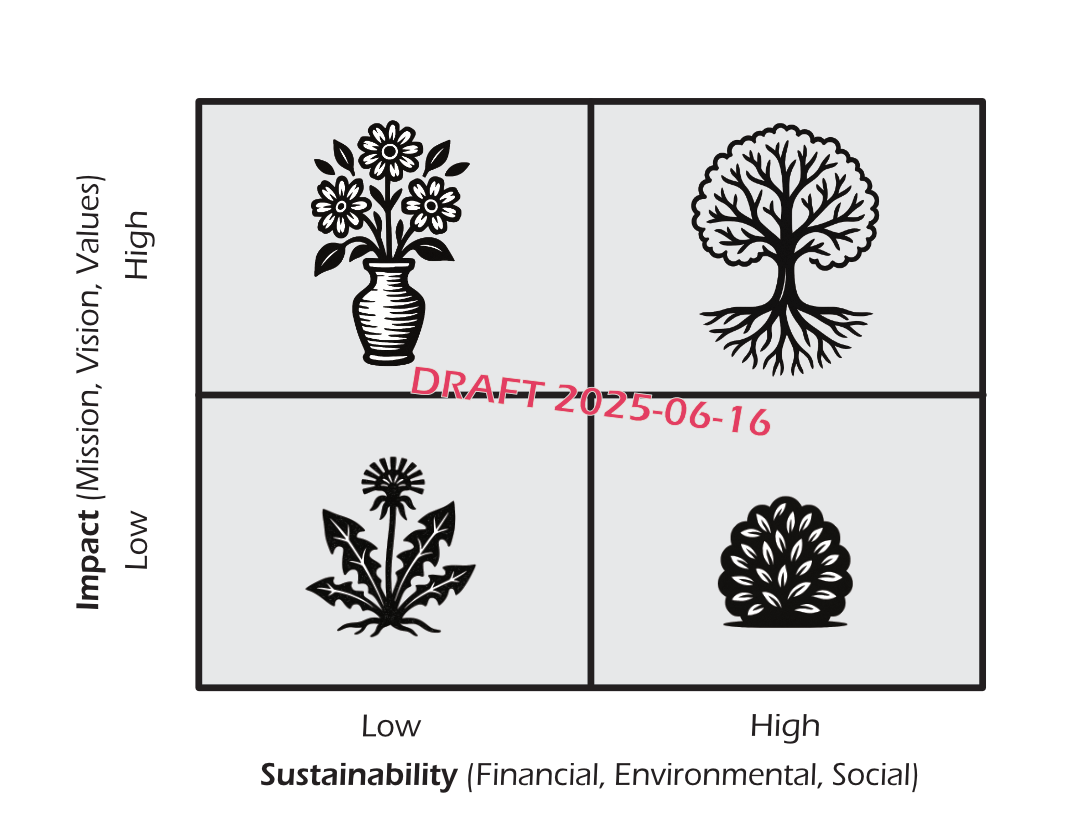
Here’s the updated version:
The vertical axis is now Impact, encompassing not just your mission but also your vision and values—your full organizational purpose.
The horizontal axis is now Sustainability, which considers financial, social, and environmental dimensions.
This updated Impact-Sustainability Matrix helps museum professionals assess whether a program or initiative is aligned with what matters most and whether it can endure in a resource-constrained world.
A Living Metaphor: From Bloom to Root
To make the matrix easier to understand and more memorable, I’m using a botanical metaphor. Every program or initiative can be thought of as a kind of plant—some deeply rooted and thriving, others beautiful but short-lived, and a few that are sadly distractions. I’m not sure if the metaphor is as clear and apt as my previous star/heart/cash cow/bunny matrix, so I’d love your thoughts and suggestions in the comments below.
Below are descriptions of each quadrant using this metaphor:
On March 14, 2025, President Trump issued an Executive Order directing the elimination of the Institute of Museum and Library Services (IMLS) and the Woodrow Wilson Center at the Smithsonian Institution “to the maximum extent consistent with applicable law.” While the full impact of this order is still unfolding, museums that rely on IMLS resources should take immediate steps to safeguard critical information. IMLS websites and databases may be taken down soon, limiting access to funding guidelines, research reports, and professional development materials. If your institution depends on these resources, now is the time to download and archive what you need.
If your museum has an active IMLS grant, there’s reason to believe that existing awards will be honored, but based on past experience with federal grant funding disruptions, delays are highly likely. Be proactive in communicating with your IMLS program officer, tracking your grant-related expenses, and preparing contingency plans for potential funding interruptions.
This Executive Order may also signal broader cuts to federal cultural funding. It wouldn’t be surprising to see similar threats to the National Endowment for the Humanities (NEH), National Endowment for the Arts (NEA), National Gallery of Art, and even the Smithsonian Institution. If these agencies are reduced or eliminated, the impact on museums, historic sites, and cultural organizations nationwide will be profound.
If your museum is affected by these potential cuts, now is the time to act. Inform your board, staff, members, and community stakeholders about what this means for your institution. Contact your elected representatives in Congress and urge them to protect federal support for museums, libraries, and cultural heritage. Without direct advocacy from the field, lawmakers may assume these cuts will go unnoticed.
Museums are no strangers to navigating shifting policy landscapes, but recent executive orders issued by the White House signal significant changes that will affect funding, interpretation, and educational outreach. Whether you work in a history museum, a historic preservation organization, or a community-based historical society, understanding these policies is crucial for adapting to new challenges and opportunities.
Key Themes Across the Executive Orders
1. A Shift Toward Patriotic and Nationalist Narratives
Executive Orders 14190 (Ending Radical Indoctrination in K–12 Schooling) and 14189 (Celebrating America’s 250th Birthday) prioritize “patriotic education” and reinforce a government-endorsed interpretation of American history. This shift is exemplified by the reestablishment of the 1776 Commission and the creation of Task Force 250, which will oversee programming related to the 250th anniversary of American independence. “Patriotic education” is defined as “the history of America grounded in:
(i) an accurate, honest, unifying, inspiring, and ennobling characterization of America’s founding and foundational principles;
(ii) a clear examination of how the United States has admirably grown closer to its noble principles throughout its history;
(iii) the concept that commitment to America’s aspirations is beneficial and justified; and
(iv) the concept that celebration of America’s greatness and history is proper.”
2. The Elimination of Federal DEI and Environmental Justice Programs
Executive Order 14151 (Ending Radical and Wasteful DEI Programs and Preferencing) eliminates all federal support for diversity, equity, and inclusion (DEI) initiatives. This includes the termination of DEI-related grants, plans, contracts, programs, initiatives, training programs, offices, positions, and employment policies within federal agencies, “under whatever name they appear.” Museums that have benefited from federal DEI funding or programs may need to reassess their funding strategies and institutional policies.
3. Renaming and Monument Preservation
Executive Order 14172 (Restoring Names That Honor American Greatness) renames Denali back to Mount McKinley and designates the Gulf of Mexico as the Gulf of America. Additionally, the reinstatement of the National Garden of American Heroes and the protection of existing monuments signal a renewed emphasis on traditional historical figures. Museums may face increased scrutiny when interpreting contested histories, particularly around geographic names and public commemorations.
Museums are feeling the pinch as public funding declines and operational costs grow. But don’t worry—there are creative ways to boost your financial health without losing sight of your mission. Two recent studies offer fresh ideas to help museums thrive while connecting more deeply with their audiences.
Make the Most of What You Offer The first study, “Value Capture for Nonprofits: The Case of Museums’ New Business Models” (Thomas & Tobelem, 2024), urges museums to think more like entrepreneurs. Museums create tremendous value through exhibitions, programs, and digital content—but often struggle to turn that value into income. The solution? Find ways to align financial opportunities with what you already do best.
For instance, you could:
Introduce tiered pricing for digital experiences, like charging for premium virtual tours.
Partner with local businesses to create themed events that support your mission.
Offer exclusive experiences, like behind-the-scenes access, for a fee.
These strategies not only bring in revenue but also allow museums to stay true to their values. The takeaway: look at what you already offer and think creatively about how to monetize it in a way that feels authentic.
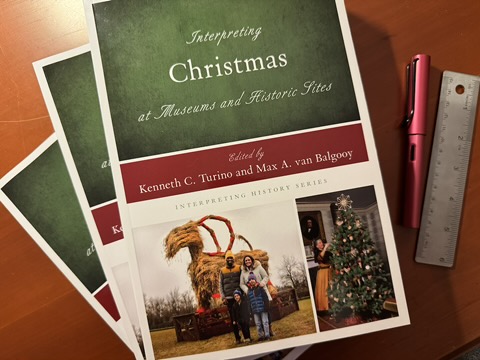
As 2024 comes to a close, it’s time to reflect on what turned out to be a busy and productive year. The highlight was completing Interpreting Christmas at History Museums and Historic Sites, co-edited with Ken Turino, which released in September. This project was a labor of love for the two dozen contributors, and it’s been gratifying to see it resonate with so many museum professionals.
Another major milestone was taking a sabbatical from George Washington University in the fall. During this time, I attended two intense and inspiring programs: the Newport Summer School, which focused on Victorian architecture and decorative arts, and the Royal Collection Studies course, which explored the management and interpretation of royal palaces and their collections. These experiences gave me fresh insights into interpretive strategies and leadership in historic sites that I look forward to integrating into my work and teaching. I can easily recommend these two professional development programs (and a sabbatical)!
Are you ready to explore how the holiday season can transform your museum? Today at 12 pm Central Time (1 pm Eastern), the Illinois Association of Museums is hosting its monthly “Museum People Call”, and this month’s topic is Christmas at Museums and Historic Sites!
I’ll be joined by Ken Turino, my co-editor of the new AASLH book series Interpreting Christmas at Museums and Historic Sites, to discuss how your organization can leverage the holiday season to its fullest potential.
We’ll cover key topics to help you:
Leverage the holiday season to attract visitors and engage your community.
Increase financial stability through creative programming, gift shop sales, and end-of-year giving campaigns.
Enhance cultural sensitivity and inclusivity, ensuring your holiday interpretation is meaningful and welcoming to diverse audiences.
Whether your site has a long history of holiday programming or you’re just starting to explore the possibilities, this session will offer practical tips and inspiring ideas to align holiday traditions with your mission.
Let’s come together to make the holiday season brighter, more inclusive, and impactful for your museum and its visitors. We look forward to seeing you there!
In the world of small museums, location and audience significantly influence expenses, rendering a one-size-fits-all approach ineffective. However, gaining insight into the various types of expenses museums incur can shed light on common challenges and their causes. The non-profit financial Form 990 categorizes expenses into five areas, providing a framework for understanding spending patterns. Our goal is to simplify the concept of museum spending and guide museums toward prudent budget management by exploring these key expense categories.
In the colorful tapestry of history-focused organizations, every thread of revenue has a role to play in the success of the organization. Perhaps the most unique collection of these threads is the “Other” revenue category. This singular “Other” thread houses a miscellany of revenue sources that don’t fit into the categories of “Investment Income”, “Program Service Revenue”, and “Contributions and Grants”. At first glance, this classification may appear insignificant, yet it often proves to be a silent contributor that underpins the fiscal health of History-Focused Organizations [Museums (NTEE A50), History Museums (A54), History Organizations (A80), and Historical Societies & Historic Preservation (A82)].
Understanding this “Other” revenue can be like deciphering an ancient dialect. It is made no easier by the fact that IRS Form 990 at times uses the terms revenue and income interchangeably. While some categories of this revenue such as royalties and inventory sales may be familiar, “miscellaneous” often contains difficult to parse odds and ends such as third-party events, insurance proceeds, ATM fees, and revenue from hosting satellite towers. Most often this miscellaneous revenue is unspecified and simply named “miscellaneous” or “other” which can make it difficult to get the full picture of a particular institution’s revenue sources. We advise limiting the classification of your total revenue as “miscellaneous” to no more than 1%. While judicious use of this category can help define your other revenue streams more clearly, overuse could lead to a lack of clarity about a significant portion of your revenue. It is crucial to maintain a comprehensive understanding of your financial situation.
For small non-profit organizations operating on less than a million dollars annually, programs are often the beating heart of the operation. The best programs balance mission and financial sustainability to serve their audiences. Program revenue (admissions, events, and membership dues) can be a vital means of maintaining financial stability and growth. For History-Focused Organizations [Museums (NTEE A50), History Museums (A54), History Organizations (A80), and Historical Societies & Historic Preservation (A82)] as overall revenue grows, so does the share of program revenue. This means as your organization grows, so should the prominence of your programs as a true revenue driver (see figure 1 below).
As small history-focused organizations expand, it’s crucial to manage their programs wisely to increase income while keeping the mission in mind. For small groups, program decisions can be very personal, often influenced by board or staff interests. Taking a strategic approach to these decisions can boost the organization’s growth and success.