Category Archives: Historical interpretation

Reinventing the House Museum in Portsmouth

This slideshow requires JavaScript.

A sold-out crowd of history enthusiasts packed the auditorium at the Strawbery Banke Museum in Portsmouth, New Hampshire on April 21 to discuss ways to reinvent the house museum.  Sponsored by the American Association for State and Local History and the New England Museum Association, the one-day workshop explored ways that historic house museums can more successfully engage their community and improve their financial sustainability.

The morning featured several presentations and the afternoon was a hands-on workshop at a nearby historic house.  I opened the day with a process for developing a plan and then focused on Michael Porter’s Five Forces, a diagnostic tool that’s superior to SWOT for assessing a house museum’s strategic position.   Ken Turino of Historic New England provided a smorgasbord of ideas from house museums around the county to rethink existing conceptions.  Larry Yerdon, CEO of the Strawbery Banke Museum, discussed ways they are introducing new programs and activities to be both more engaging and financially sustainable.

After lunch, we gathered at the Governor John Langdon House, a property of Historic New England, where Joanne Flaherty and Linda Marshall led us on a quick inspection of the property and described its operations and recent efforts to use it for temporary exhibits.  Then the audience became temporary consultants using the Five Forces, analyzing existing and potential competition for exhibits, interests from visitors, and collaborating with exhibit providers.  The consensus seemed to be that an exhibit program could have a competitive advantage if it focused on the collections of Historic New England and may be better suited for rooms other than the parlor or dining room, which are architecturally significant.

This workshop will travel next to Atlanta, Georgia on June 12, where we’ll be using the Margaret Mitchell House as the case study.  To register and for more information, visit AASLH.org.


Reconstructing a Lost “Field Quarter”

In this 34-second time-lapse video, James Madison’s Montpelier in Virginia constructs a log “field quarter” (a dwelling for enslaved field workers).  It’s first constructed in a building to cut and fit all the pieces in a protected place during winter, then re-assembled in the field on a beautiful spring day in 2015.  It’s now on the exact spot where the foundations for a house were uncovered through archaeology (if you look carefully to the horizon on the left, you’ll see the Visitor Center).

Montpelier is in the midst of reconstructing many of the lost buildings associated with the enslaved African community, using archaeological and documentary evidence assembled over the past decade.  Their major project is the South Yard, six buildings next to the Madison’s mansion, which will be completed in the next few years, thanks to a generous gift from David Rubenstein.

Video: Smithsonian’s Museum Goes High Tech

In this 3:35 video, The Verge interviews Aaron Cope, the head of engineering, about the new high tech exhibits at the Cooper Hewitt Museum, which is in the former home of Andrew Carnegie and part of the Smithsonian Institution.  The Cooper Hewitt closed for the last three years for an extensive renovation to imagine a museum that was part of the Internet and served as a bridge to their huge 130-million-object collection.

How to Get a Behind-the-Scenes Look at Historic New England

Program in New England StudiesHistoric New England presents its annual Program in New England Studies (PINES), an intensive week-long exploration of New England from Monday, June 15 to Saturday, June 20, 2015.  PINES includes lectures by noted curators and architectural historians, workshops, behind-the-scenes tours, and special access to historic house museums and collections. The program offers a broad approach to teaching the history of New England culture through artifacts and architecture in a way that no other museum or historic site in the Northeast can match.  It’s like the Attingham Summer School as a week in New England.

Examine New England history and material culture from the seventeenth century through the Colonial Revival with some of the country’s leading experts in regional architecture and decorative arts. Curators lecture on furniture, textiles, ceramics, and art, with information on history, craftsmanship, and changing methods of production. Architectural historians explore architecture starting with the seventeenth-century Massachusetts Bay style through the Federal and Georgian eras, to Gothic Revival and the Colonial Revival.

Expert presenters include: Continue reading

Are There Cultural Connections Between North and South?

Newport Symposium Banner 2015On April 26-29, 2015, the Preservation Society of Newport County (aka the Newport Mansions) is hosting a symposium on the cultural connections between the North and South from the Colonial Period to the Gilded Age as seen through furnishings, silver, textiles, painting, architecture, and interiors.  Scholars include:

  • Daniel Kurt Ackerman, Associate Curator, Museum of Early Southern Decorative Arts
  • Brandy Culp, Curator, Historic Charleston Foundation
  • Caryne Eskridge, Project Manager & Research Coordinator, The Classical Institute of the South
  • Stephen Harrison, Curator of Decorative Art & Design, Cleveland Museum of Art
  • Brock Jobe, Professor of American Decorative Arts, Winterthur Museum, Garden & Library
  • Alexandra Kirtley, The Montgomery Garvan Associate Curator of American Decorative Arts, Philadelphia Museum of Art
  • Jefferson Mansell, Historian, Natchez National Historical Park
  • George McDaniel, Executive Director, Drayton Hall
  • George H. McNeely IV, Vice President, Strategic & International Affairs, World Monuments Fund
  • Richard Nylander, Curator Emeritus, Historic New England
  • Tom Savage, Director of Museum Affairs, Winterthur Museum, Garden & Library
  • Susan P. Schoelwer, Robert H. Smith Senior Curator, George Washington’s Mount Vernon
  • Arlene Palmer Schwind, Curator, Victoria Mansion
  • Carolyn Weekley, Juli Grainger Curator, Colonial Williamsburg Foundation
  • Martha Willoughby, Senior Specialist, Christie’s

Registration is $600 and includes an opening reception at Rosecliff (1902) and dinner in the Great Hall at the Breakers (1895).  Scholarships are available to undergraduate and graduate students, as well as arts and humanities professionals.  To register or for more information, contact symposium@NewportMansions.org or call 401-847-1000 x 160.  Tell them that you heard about it from Engaging Places and you’ll receive a 10% discount!

Historic House Museums Gather for AASLH Workshop in Charleston

This slideshow requires JavaScript.

For the past fifteen years, George McDaniel and I have taught a two-day workshop on the management of historic house museums for the American Association for State and Local History.  We cover a wide range of topics from fundraising to interpretation to disaster response to collections management–we really need a week, especially if there’s a lot of discussion.  That was certainly our experience last week in Charleston, South Carolina (and thanks to our hosts, the Historic Charleston Foundation!), where our discussions were so rich that I wasn’t able to complete most of my presentations.  That’s okay because the workshop is for the participants and as long as they find a topic that’s worth exploring, I’ll stay with them.  Indeed, George and I often find that we’re not instructors but facilitators, raising ideas and questions to provoke thoughtful discussions to help participants improve the management of their historic sites.

At the core of workshop is each participant’s “burning question.” They share their biggest concern or issue at the start of the class and at the end, they describe how they might address it when they return to their site.  It’s not only a way to make the workshop more relevant to the participants, but it also gives us a glimpse into the issues facing historic house museums around the country.  This year the questions included: Continue reading

Tackling Race, Gender, Religion, and Sex in Prison: Oh My!

The big gray brooding mass of Eastern State Penitentiary in Philadelphia.

The big gray brooding mass of Eastern State Penitentiary in Philadelphia.

Despite the winter weather, I’ve been traveling extensively this month around the country.  In Philadelphia I finally had a chance to visit the Eastern State Penitentiary, an enormous prison close the city’s art museums but otherwise oh so far away.  When built in the early 19th century, it was the most famous and expensive prison in the world, but after it closed in 1971, it became a forgotten ruin.  Today, a private non-profit organization preserves and manages this National Historic Landmark with an usual mission statement:

Eastern State Penitentiary Historic Site, Inc. works to preserve and restore the architecture of Eastern State Penitentiary; to make the Penitentiary accessible to the public; to explain and interpret its complex history; to place current issues of corrections and justice in an historical framework; and to provide a public forum where these issues are discussed. While the interpretive program advocates no specific position on the state of the American justice system, the program is built on the belief that the problems facing Eastern State Penitentiary’s architects have not yet been solved, and that the issues these early prison reformers addressed remain of central importance to our nation.

In a way, old prisons are historic houses so I’ve been intrigued by the way these popular tourist destinations are interpreted to the public.  Eastern State is a significant contrast from Alcatraz Island, which Continue reading

Thump! Interpreting African American History and Culture Arrives

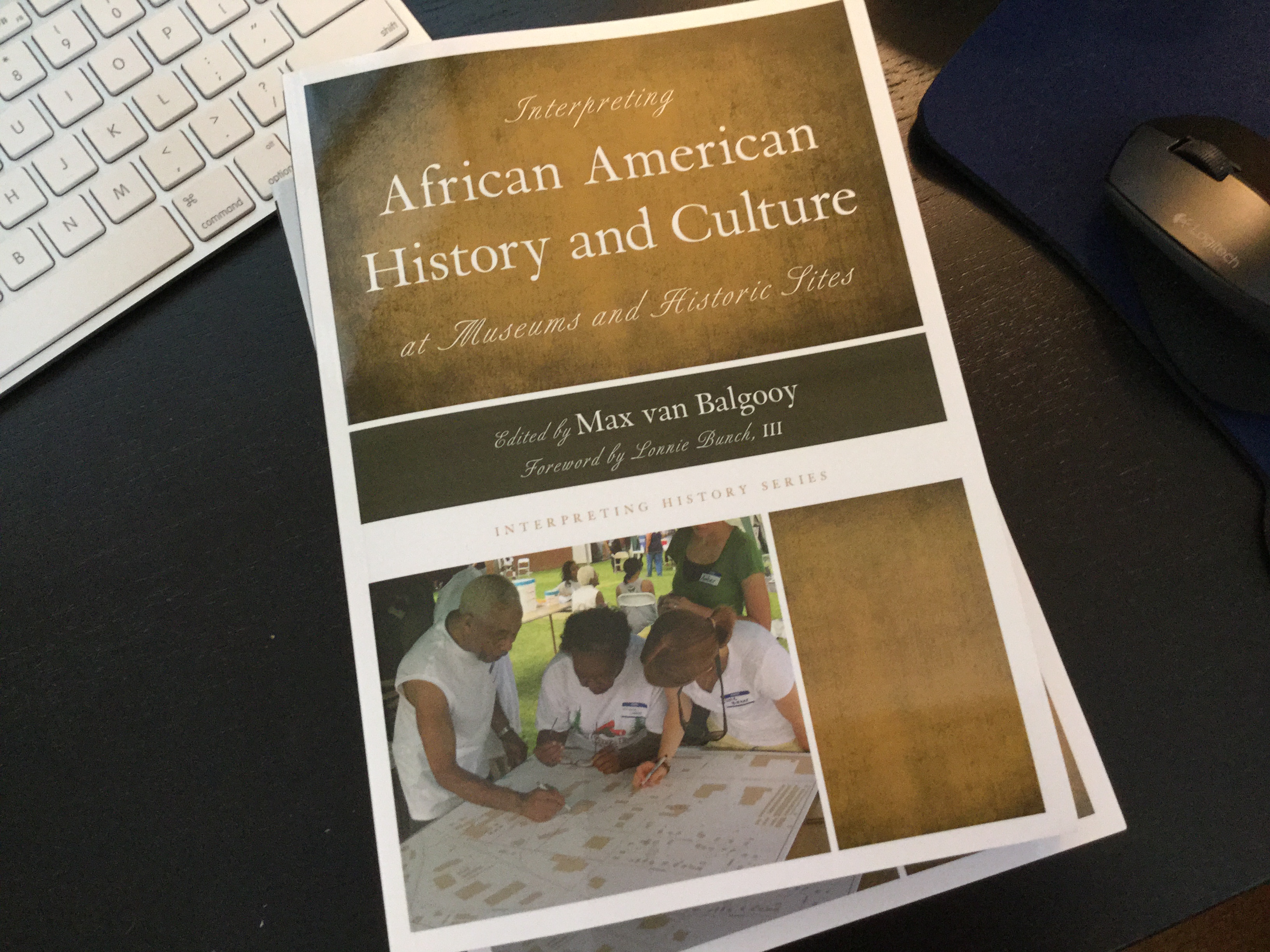
Interpreting African American History and CultureThis morning brought the first snow of the season.  While schools closed and cars were slipping on the road in front my house, the mail arrived with a thump on my doorstep.  Inside was Interpreting African American History and Culture at Museums and Historic Sites, the book I worked on for the last few years with two dozen contributors.  I try not to judge a book by its cover, but Rowman and Littlefield has increased its attention to graphic design and it really paid off.  It’s a handsome book. But it’s even better inside!

If African American history isn’t a topic at your historic site, do check out the others in this major new series produced by the American Association for State and Local History.

On Ferguson and Related Events: How Should Historic Sites Respond?

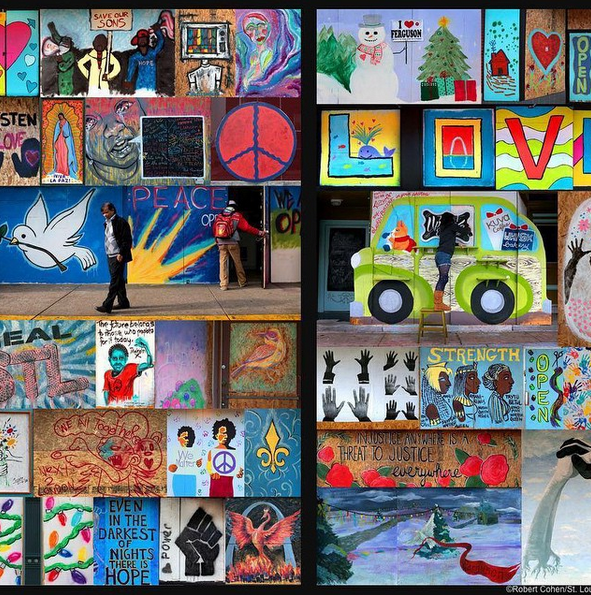
Storefronts that were covered with plywood during the protests in Ferguson were painted by local artists and collected by the Missouri History Museum.

Ferguson and related events are sparking broad protests over the treatment of African Americans by the police and the courts.  Should museums and historic sites be involved?  Should they be collecting, preserving, or interpreting these present-day events? Should they provide a place for protest or response?  Or are these beyond their roles and responsibilities?  There are no easy answers because every site and every community is different, but ultimately, people engage with historic places because there’s a personal connection–historic sites are collecting, preserving, or interpreting topics that are relevant and meaningful to the visitor.

Identifying what is relevant and meaningful isn’t always easy but contemporary events offer a glimpse.  People discuss, explore, study, question, react to, and protest about issues that matter to them, and the more people that are involved around the same issue, the more significant it is.

Museums and historic sites inhabit a special “third space” in society that allows us to do things that can’t happen at home or work. They allow diverse people to discuss, explore, study, question, react to, and protest about issues in a safe place.  As Presence of the Past has shown, we are Continue reading

Looking for Interpretive Inspiration? Head to Charleston

What historic sites are doing great interpretation?  

Behind the Velvet Ropes tour at the Gamble House.

Behind the Velvet Ropes tour at the Gamble House.

That’s a question I’m often asked by my clients and while I can usually rattle off a half dozen examples, it’s usually not very satisfying.  If I suggest a ranger-led tour of Mesa Verde National Park in Colorado, the behind-the-velvet-ropes tour at the Gamble House in California, and the Dennis Severs’ House in London, you can quickly see the problems—you need to experience them to understand them, plus they’re thousands of miles apart.

Although I’ve been working in Charleston, South Carolina for more than a decade, it was just this past month that I realized that it’s an ideal place for experiencing a wide range of interpretive approaches for historic house museums.  In November, I joined Mike Buhler, the executive director of San Francisco Heritage, in Charleston to study a wide range of interpretive methods, from guided to self-guided, from furnished to unfurnished, from exhibits to period rooms, from grand mansions to humble cabins.  Heritage is in the midst of re-interpreting the Haas-Lilienthal House, so Mike found the research trip to be incredibly helpful because it showed him various possibilities and clarified what methods would be most effective for his historic house museum.

If you’d also like to be inspired, here’s my suggested itinerary: Continue reading