
Melissa Rymer wrote, directed and produced this 14:50 video which was made in conjunction with an exhibition at the Jewish Museum of Australia. It is a small snapshot of some of the Jewish run businesses that operated out of Flinders Lane, the fashion district of Melbourne in the late 1940s through to the late 1980s. It includes historic images intercut with oral histories of former employees and employers.
Category Archives: Historical interpretation
AASLH Annual Meeting in September Offers Lots for Historic Sites

Alexander Ramsey House in St. Paul, an historic site of the Minnesota Historical Society.
Historic sites and house museums will find lots of educational sessions and workshops just for them at the upcoming annual meeting of the American Association for State and Local History on September 17-20 in St. Paul, Minnesota (the right half of the Twin Cities). There are more than 70 sessions and workshops offered this year, so I’m only highlighting a few to show the diversity of topics on or about historic sites:
- Putting the Native American Voice into Historic Sites
- Saving the Charnley Norwood House
- Interpreting Religion at Historic House Museums
- Two Very Different Historic Houses Ask: We Got the Money–Now What?
- Telling a Whole History: Methods of Interpreting Domestic Servants
- Welcoming All Visitors: Accessible Programs at History Museums and Sites
- Diversity and Inclusion: What Does that Really Mean for Museums and Historic Sites?
- Diversity in Education: Teaching About Slavery, Innovative Strategies, and Best Practices
- Making the Invisible Visible: Using Mobile Technology to Reach New Audiences, Improve Accessibility, and Breathe New Life into a Virginia Historic Site
- Redefining Success: Tips and Techniques for Training Interpreters to Talk About Slavery
- They Can’t All be Museums
- Pocket Change: Moving a House Museum into the 21st Century on a Budget
Of course, there are many more sessions that address related topics, such as boards, fundraising, Continue reading
Video: Happy 4th from Philadelphia
In this 1:39 video, Historic Philadelphia features Benjamin Franklin and a dozen living history actors dancing to Pharrel William’s “Happy” on the streets of the City of Brotherly Love. Dozens of ongoing and special events will take place on and around Independence Mall over Independence Week and the summer and this video shows the fun and lively side of its history. It was produced by Historic Philadelphia, Inc. (@HistoricPhilly), Independence Visitor Center (@PHLVisitorCntr), National Constitution Center (@ConstitutionCtr), Visit Philadelphia (@VisitPhilly), and Independence National Historical Park (@INDEPENDENCENHP). More information is available at www.historicphillysummer.com. Thanks to Sandy Lloyd for sharing this video.
A Bibliography on Interpreting African American History and Culture
As many of you know, I’m assembling an anthology on the interpretation of African American history and culture at historic sites and in history museums, expected to be published by Rowman and Littlefield later this year as part of the AASLH book series. To provide an overview of the field during the past twenty years, I’ve developed an eleven-page bibliography of published articles and books. Although not comprehensive nor definitive, it provides a gateway to the breadth and width of the work underway in the United States for inspiration and best practices, and suggests needs and opportunities in the field. Due to limited space, this bibliography will be reduced in the book so I wanted to provide it here for those who are interested in the expanded version.
This bibliography primarily focuses on theories and methods (the “how”) of interpreting African American history and culture at museums and historic sites, such as tours, exhibits, events, programs, videos, and websites. Related, but not part of this bibliography, are Continue reading
Video: Why Study History?
In this 3:25 video, teacher Joanna Hayes shares the value of history through images and the music of Coldplay. She presents it on the first day of her social studies class.
Video: David McCullough’s 5 Lessons Every High School Student Show Know
In this 5:17 video, author David McCullough shares the five most important ideas high school students should learn before graduating (and it’s not memorizing dates and quotations). This was recorded by CSPAN at the 2011 National Book Festival.
Can the Exploratorium Help Us Explore History?
Last week I visited the Exploratorium in its new home on Pier 15 in San Francisco. If you haven’t veen there, it’ll seem like a science center but you’ll quickly discover it’s really a place about learning, especially through direct experiences with art, tinkering, and phenomena (yep, that’s how they describe it). It’s an incredibly active place (almost to the point of overwhelming) that seems to effectively engage its visitors, so I continually watch to see if any of their exhibits or ideas can be applied to historic sites or history museums. During my latest visit, I found two exhibits that with a mild tweak could be really be innovative for interpreting history.
1. Question Bridge: Black Males. This temporary exhibit is, “comprised of many individuals asking and answering questions about the experience of black men in modern America.” Inside the small dark room are Continue reading
Video: 2014 NCPH Conference Recap
The Institute of Oral History at the University of Texas at El Paso just produced a 2:49 video covering the 2014 annual conference of the National Council Public History in Monterey, California. Using video from the conference and Monterey along with interviews, it highlights the value of the conference. This was created by Karina Arroyo and Jesus Genaro Limon, who I believe are students at UTEP. Perhaps your site could create something like this for your events or conferences with the help of a local college or university.
Webinar: Making Heritage Tourism Work for Your Community
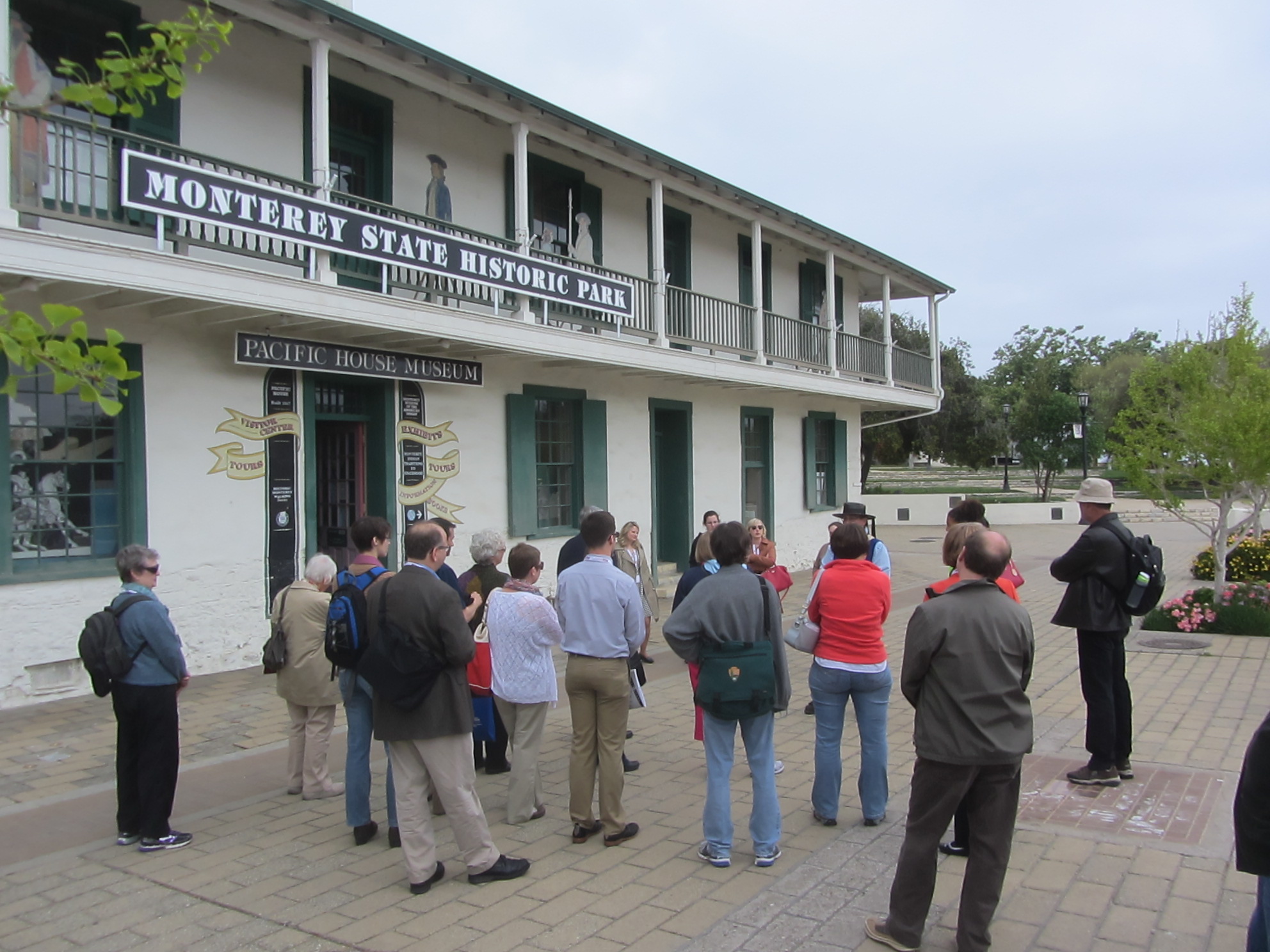
Walking tour of historic Monterey, California.
Heritage tourism is a growing industry that can improve community engagement, economic revitalization, and preservation advocacy. People want authentic and meaningful experiences—and are willing to pay for them. On May 13, 2014 from 12 noon to 1:30 pm Pacific Time, I’ll be presenting a webinar for the California Preservation Foundation exploring the benefits of heritage tourism and how it may (or may not) benefit your community or region. We will examine the latest research on the motivations and interests of tourists (they’re not all alike), how to identify or create destinations that will attract tourists, and how to build support and attract funding for a heritage tourism program. You’ll learn the overall elements of a heritage tourism program and leave with a list of the next steps to take in your community. Although much of the webinar will be focused on California, the principles and process for developing a heritage tourism program will be same for other places. Cost is $45 for CPF members ($60 for non-members) and advance registration is required.
It’s part of a three-part webinar series on economic development using historic preservation from the California Preservation Foundation. For those interested in continuing education credit, it’s available for AIA, AICP, and ASLA.
Video: YAP! The North Star Journey
In this 5:29 video, students in the Youth Ambassador Program (YAP) discuss their visits to historic sites as inspiration for their music. Featured are the Nathan and Polly Johnson House in Connecticut and the Bucktown Village Store in Maryland.

