Category Archives: Training

Stanford Offers Webinars on Non-profit Management

Stanford Social Innovation Review Fall_2015Everyone knows that Harvard University has the Harvard Business Review, but did you know that on the opposite coast, Stanford University has an equivalent for non-profit organizations called the Stanford Social Innovation Review?  Both have been useful to me because along with the magazine, they offer webinars led by authors of their articles or who are leaders in the field.  Here are a couple coming up from the Stanford Social Innovation Review that you might find useful for your museum or historic site:

Overcoming the Overhead Myth

Presented by Jacob Harold, Ann Goggins Gregory, & Jan Masaoka
September 2, 11 a.m. – 12 noon PDT / 2 – 3 p.m. EDT

A dangerous myth prevails among funders that overhead can be used as a proxy for efficiency. In fact, research shows that under-investing in administrative overhead is often linked with poor performance by nonprofits. Ann Goggins Gregory and Don Howard dubbed this process “the nonprofit starvation cycle” in the eponymous Stanford Social Innovation Review article. In this webinar you will learn:

  • Why the nonprofit starvation cycle exists in the sector
  • How organizations that invested in administration subsequently improved their programmatic work
  • Strategies for explaining to funders the importance of overhead costs for future success
  • Tips for evaluating whether grantees are skimping on crucial investment areas in their budgeting

Price: $49, which includes access to the live webinar; unlimited access to the webinar as many times as you’d like for twelve months; and downloadable slides. Learn more about this webinar and register here.

Valuing Frontline Work

Presented by Lehn Benjamin, Katya Fels Smyth, Maria Peña, & Jesús Gerena
September 23, 11 a.m. – 12 noon PDT / 2 – 3 p.m. EDT

An increasing focus in the social sector on performance-driven frameworks can make it difficult for direct-service organizations to measure their impact. Some nonprofits are using creative strategies to measure and communicate their work’s value to funders. This webinar will:

  • Explain how some of the most popular performance models used in the nonprofit sector fail to measure the true impact of what nonprofit professionals do
  • Examine the reasons why it can be so difficult—yet so important—to recognize the value that on-the-ground work delivers to beneficiaries and their communities
  • Explore examples of nonprofits that have succeeded in capturing and conveying the full value of frontline work

Price: $49, which includes access to the live webinar; unlimited access to the webinar as many times as you’d like for twelve months; and downloadable slides. Learn more about this webinar and register here.

International Museum Management Conference Coming to US

Screen Shot 2015-07-31 at 10.56.44 AM The International Committee of Museum Management (InterCom) of the the International Council of Museums (ICOM) with be holding its annual meeting in Washington, DC from October 28-31, 2015, the first time it has held its meeting in the United States. InterCom works toward the development of sound museum management throughout the world, including the managerial aspects of policy formulation, legislation, and resource management.  Registration is $350 ($150 for students) and early bird registration for $295 ends today (July 31).

This year’s conference focuses on three themes–The Sustainable Leader, The Enduring
Organization, and the Essential Museum–and plenary speakers include Lonnie Bunch, Founding Director, Smithsonian National Museum of African American History and CultureElaine Heumann Gurian, author and museum consultant; and Richard C. Harwood, Harwood Institute for Public Innovation. Sessions involve diverse topics from around the world and several caught my eye. I wonder what someone from Columbia has to say about museums as tourist attractions; how violence or civil unrest are affecting museums in Mexico, Denmark, and Minnesota (Minnesota??); or how the Research Center for Anatolian Civilizations in Turkey tackles the value of history and heritage in the contemporary world (how do you make thousands of years of history relevant?).

I’ll be there to expand my horizons and reporting out when I get a chance. It also looks like we’ll be having special tours of several museums in DC (it’s the behind-the-scenes experience at museums that lured me into this field) so that will be great fun. Hope to see you there!

What Historic Sites Have Learned After 25 Years with ADA

ADA logoThis month marks the 25th anniversary of the Americans with Disabilities Act (ADA), which ensured equal access to persons with limited mobility, limited vision, limited hearing, and other disabilities. Shortly after this law was enacted in 1990, museums and historic sites were scrambling to figure out the consequences, especially the cost of installing ramps or hiring sign-language interpreters.

Much of it also revolved thinking bigger and realizing that improving access for the disabled would improve the experience for everyone.  For example, lever handles replaced doorknobs, which makes it easier to open a door when you’re carrying a package; enlarging type and increasing contrast on exhibit labels makes them easier to read (which I really appreciated as I grew older); and integrating ramps and removing thresholds is nice for visitors in wheelchairs and for staff who are always hauling tables and chairs for events.  For several years, professional associations hosted sessions and printed books to explain ADA to help museums figure out how to respond in an effective and thoughtful manner.

Little discussed, however, is that the US Department of Justice (DOJ) also investigated several museums and historic sites for Continue reading

Interpretive Planning Workshop coming to Tennessee

AASLH Historic House Museum workshop at the Oaklands Museum, 2013.

AASLH Historic House Museum workshop at the Oaklands Museum, 2013.

On Monday, August 17, I’ll be leading a one-day workshop on interpretive planning for history museums and historic sites in Murfreesboro, Tennessee.  Sponsored by the American Association for State and Local History, Humanities Tennessee, and the Tennessee Association of Museums, the workshop will layout effective strategies for interpreting history and the humanities at museums and historic sites, explain how to use StEPs as a model for standards and best practices, and show how to conduct a self-evaluation of interpretation in order to prioritize activities.  It’ll be hot in Middle Tennessee but the workshop will be held in the comfortable and cool visitor center at the Oaklands Museum.  Registration is $75 and $15 for members (you read that correctly–$15!) and includes lunch.  To register or for more details, visit AASLH.org.

So Many Possibilities for Historic Sites at AASLH Annual Meeting

AASLH Louisville 2015The American Association for State and Local History (AASLH) just delivered the preliminary program for its annual meeting, which will be held in Louisville, Kentucky from September 16-19, 2015.  Obviously, the conference is centered around history but there are several sessions, workshops, and field trips that focus on historic sites and house museums, including:

  • Heritage Tourism in the 21st Century with James Stevens of ConsultEcon Inc., who recently studied the heritage tourism sector in Philadelphia
  • Restoration and Reconstruction: Fulfilling the Possibilities of a 21st Century Museum, a discussion about the reinterpretation of the Woodrow Wilson Family Home in South Carolina (also reviewed in the recent issue of the Public Historian and the Journal of American History; not to be confused with the Woodrow Wilson Boyhood Home in Georgia)
  • Old House, New Diverse Stories, a brainstorming session led by Ken Turino of Historic New England
  • An Untapped Resource: How to Locate and Use Legal Cases at Historic Sites, a session to learn how to mine legal case files to find compelling narratives for exhibits and programs
  • Interpreting Religion at Historic Sites, a discussion on leveraging “historical truth when interpreting religion” led by the historian of the Navigators.
  • An afternoon tour of the exuberant Second Empire Culbertson Mansion and Farmington, the Federal-style home of Lucy and John Speed.
  • There may be bourbon at the breakfast for historic house museums when Dennis Walsh from Buffalo Trace Distillery discusses the preservation of this historic sites (and it’s pretty cool website, too)
  • An evening at Locust Grove, a National Historic Landmark, with costumed interpreters, live music, and a three-course buffet.
Sam Winburg

Sam Wineburg

With 65 sessions, there is much, much more happening and you’ll be torn about what to do.  There’s certainly enough to appeal to directors, curators, historians, educators, and preservationists.  I’m particularly eager to hear Sam Wineburg, professor of education and history at Stanford University and author of Historical Thinking and Other Unnatural Acts: Charting the Future of Teaching the Past (see “A History of Flawed Teaching“), and the follow-up discussion led by Tim Grove, chief of museum learning at the Smithsonian National Air and Space Museum.  Wineburg is currently developing new forms of assessment to measure historical understanding and undertaking a longitudinal study on the development of historical consciousness among adolescents in three communities.  But I don’t want to neglect the three other outstanding plenary speakers: Wendell Berry, James Klotter, Renee Shaw, and Carol Kammen.

I rarely ever skip the AASLH annual meeting and I plan to be there this year.  Registration is $250 if you jump in before July 24 and there’s the alternative online conference featuring six sessions.


Reinventing the House Museum in Portsmouth

This slideshow requires JavaScript.

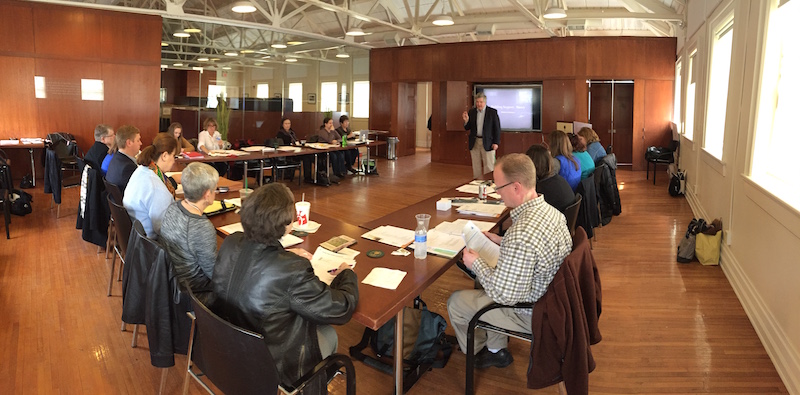
A sold-out crowd of history enthusiasts packed the auditorium at the Strawbery Banke Museum in Portsmouth, New Hampshire on April 21 to discuss ways to reinvent the house museum.  Sponsored by the American Association for State and Local History and the New England Museum Association, the one-day workshop explored ways that historic house museums can more successfully engage their community and improve their financial sustainability.

The morning featured several presentations and the afternoon was a hands-on workshop at a nearby historic house.  I opened the day with a process for developing a plan and then focused on Michael Porter’s Five Forces, a diagnostic tool that’s superior to SWOT for assessing a house museum’s strategic position.   Ken Turino of Historic New England provided a smorgasbord of ideas from house museums around the county to rethink existing conceptions.  Larry Yerdon, CEO of the Strawbery Banke Museum, discussed ways they are introducing new programs and activities to be both more engaging and financially sustainable.

After lunch, we gathered at the Governor John Langdon House, a property of Historic New England, where Joanne Flaherty and Linda Marshall led us on a quick inspection of the property and described its operations and recent efforts to use it for temporary exhibits.  Then the audience became temporary consultants using the Five Forces, analyzing existing and potential competition for exhibits, interests from visitors, and collaborating with exhibit providers.  The consensus seemed to be that an exhibit program could have a competitive advantage if it focused on the collections of Historic New England and may be better suited for rooms other than the parlor or dining room, which are architecturally significant.

This workshop will travel next to Atlanta, Georgia on June 12, where we’ll be using the Margaret Mitchell House as the case study.  To register and for more information, visit AASLH.org.


How to Get a Behind-the-Scenes Look at Historic New England

Program in New England StudiesHistoric New England presents its annual Program in New England Studies (PINES), an intensive week-long exploration of New England from Monday, June 15 to Saturday, June 20, 2015.  PINES includes lectures by noted curators and architectural historians, workshops, behind-the-scenes tours, and special access to historic house museums and collections. The program offers a broad approach to teaching the history of New England culture through artifacts and architecture in a way that no other museum or historic site in the Northeast can match.  It’s like the Attingham Summer School as a week in New England.

Examine New England history and material culture from the seventeenth century through the Colonial Revival with some of the country’s leading experts in regional architecture and decorative arts. Curators lecture on furniture, textiles, ceramics, and art, with information on history, craftsmanship, and changing methods of production. Architectural historians explore architecture starting with the seventeenth-century Massachusetts Bay style through the Federal and Georgian eras, to Gothic Revival and the Colonial Revival.

Expert presenters include: Continue reading

Historic House Museums Gather for AASLH Workshop in Charleston

This slideshow requires JavaScript.

For the past fifteen years, George McDaniel and I have taught a two-day workshop on the management of historic house museums for the American Association for State and Local History.  We cover a wide range of topics from fundraising to interpretation to disaster response to collections management–we really need a week, especially if there’s a lot of discussion.  That was certainly our experience last week in Charleston, South Carolina (and thanks to our hosts, the Historic Charleston Foundation!), where our discussions were so rich that I wasn’t able to complete most of my presentations.  That’s okay because the workshop is for the participants and as long as they find a topic that’s worth exploring, I’ll stay with them.  Indeed, George and I often find that we’re not instructors but facilitators, raising ideas and questions to provoke thoughtful discussions to help participants improve the management of their historic sites.

At the core of workshop is each participant’s “burning question.” They share their biggest concern or issue at the start of the class and at the end, they describe how they might address it when they return to their site.  It’s not only a way to make the workshop more relevant to the participants, but it also gives us a glimpse into the issues facing historic house museums around the country.  This year the questions included: Continue reading