The third edition of the Encyclopedia of Local History, edited by Amy Wilson, is now available for free to members of the American Association for State and Local History. The print version is a nearly two-inch thick, 814-page resource to a wide range of topics related to the issues and practices in local history, but now available digitally as a pdf to AASLH members. This edition includes my contributions on mission, vision, values and house museums in the 21st century, plus a photo of the Gamble House—but there are dozens of experts who share their knowledge of the field in one place.
For more details, visit the AASLH Resource Center or you’re not a member, you can purchase it for $161.50 (hmm, membership is less than half that cost).
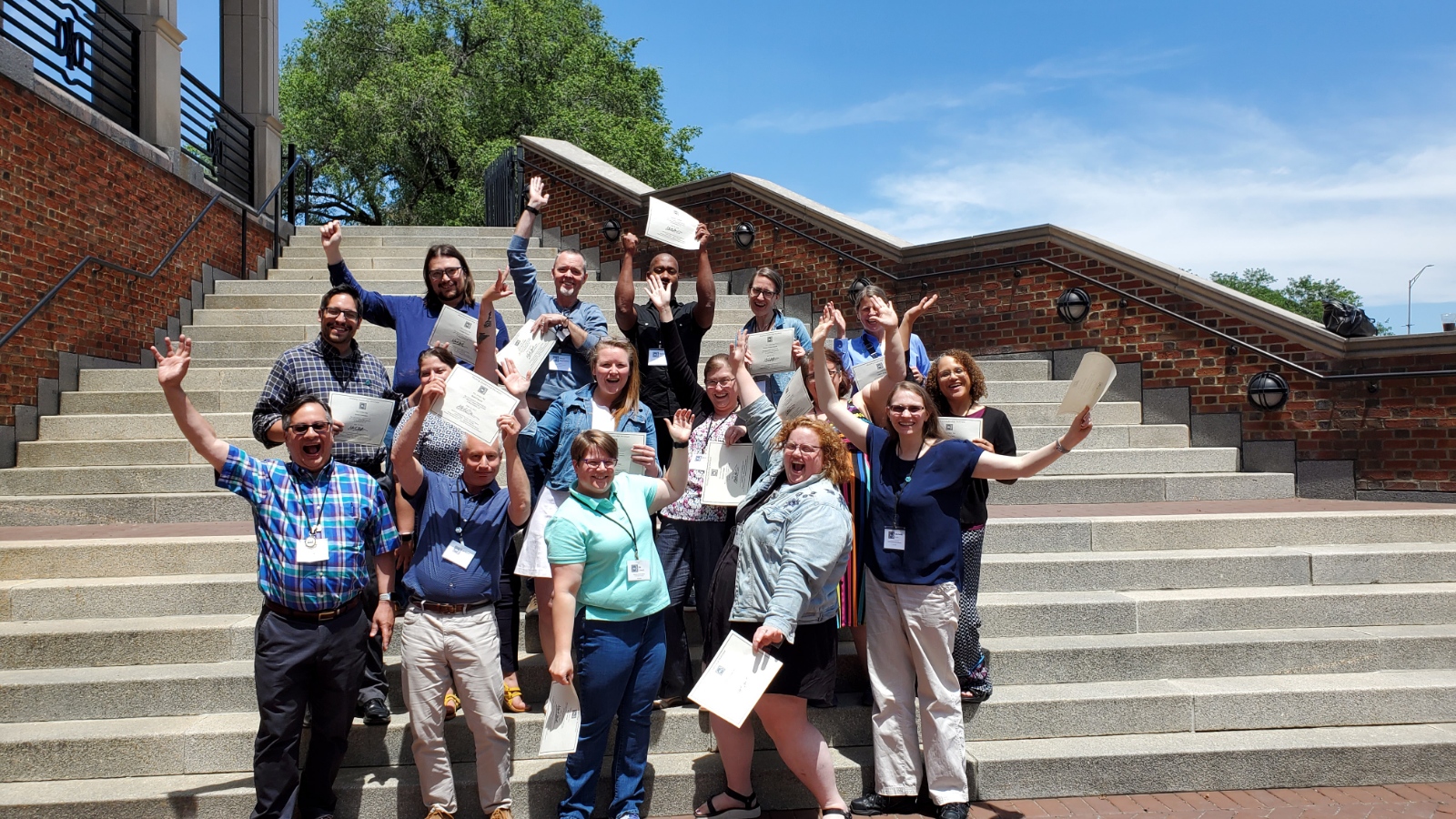
Our last Reimagining House Museums workshop was held at Dumbarton House in Washington, DC in June 2019!
Ken Turino and I will once again lead our workshops on reimagining historic house museums in 2023 after taking several years off due to the pandemic. Our first workshop will be held at the Gamble House in Pasadena, California on Friday, April 1 and our second will be held at the Decorative Arts Center of Ohio in Lancaster, Ohio on Thursday, June 22. AASLH is managing the workshop and registration is $325 but it’s $200 for AASLH members (and it’s $150 if you register by February 1!). Participation is limited to 25 people for the April workshop.
The workshop is closely related to the book, Reimagining Historic House Museums (2019), but we take a much deeper dive into the challenges facing house museums, assess current programs against a “double-bottom” line for a big-picture perspective, analyze the five forces that affect programs and events to find opportunities and obstacles, and highlight some of the ways that house museums have reinvented themselves. The day is packed with information and activities, but we take a good break in the middle of the day for lunch and we get to meet lots of other people who are working hard to make their historic site better. Plus it’s great fun!
An experiment with a virtual tour of the famous Hagia Sophia in Istanbul.
Warning: this is an experiment in historic site interpretation. Things went wrong but we’re also learning a lot together.
I’ve been working on improving and enhancing the interpretation of historic sites and house museums for decades, plus I’ve also been interested in ways to improve access to these incredible places. If you’ve ever met me at a historic site, you know I take LOTS of photos and share them in my workshops, classes, and in this blog.
Last year, a friend introduced me to the Insta360 One X2, a small camera with two lenses that captures 360-degree photos and video. It’s popular with skiers, mountain bikers, skateboarders, and other active sport players because it captures everything, which can later be edited to the best views and moments. But how can it be used in the interpretation of historic sites? Is this a low-cost solution to create immersive videos?
I’ve just returned from a vacation in Greece and Turkey, where I visited several museums and historic sites that have long been on my list. As usual, I took lots of photos, including video using an Insta360. Fixed at the end of a yard-long selfie stick, it allowed me to capture drone-like views above the heads of the people around me without interfering with their experiences.
This first video experiment simply stitches four videos together of the Hagia Sophia in Istanbul during a daily prayer service. There’s no voice-over or narration as in a traditional tour, just a simple walkthrough with ambient sounds. Remember that it was originally a 360-degree video that was edited to frame the view and add camera movements. I discovered that the video is smudged or blurred at times. I’m not sure if that due to a dirty lens or the low light conditions, but I hid the worst parts with photos from my iPhone (yes, I was juggling two cameras at the same time!).
Take a look at the video and tell me what you think. How might this format enhance the interpretation of historic sites? What are possible next steps?
Figure 1. History-Focused Organizations command large portions of the museum field’s revenue and institutions. Source: Internal Revenue Services and National Center for Charitable Statistics.
Over the past year, Engaging Places has been looking over individual segments of the museum field. While these segments are unique in specific ways, as demonstrated by the data, several of them do share a common theme and mission: an overall goal to promote history. These four segments are History Museums (A54), History Organizations (A80), Historical Societies & Historic Preservation (A82), as well as the broad Museums (A50) category. By combining these segments we can focus on the history-centric portion of the museum field that makes up close to half of its revenue and consists of a whopping 89% of its institutions (see Figure 1). This block of museums is incredibly dominant within the field and a major focus of Engaging Places’ work. For ease of reference, we will be referring to them as History-Focused Organizations.
It is important to remember that as an aggregate these History-Focused Organizations still trend small. Over 90% operate on less than $1 million in revenue annually, with contributions and grants bringing in over half of that vital revenue. For these smaller museums, financial security is a constant and essential priority. While many of these History-Focused Organizations are unable to achieve large pools of investment to stabilize operations, unlike some of their larger counterparts, they can develop practices to move them in this direction.
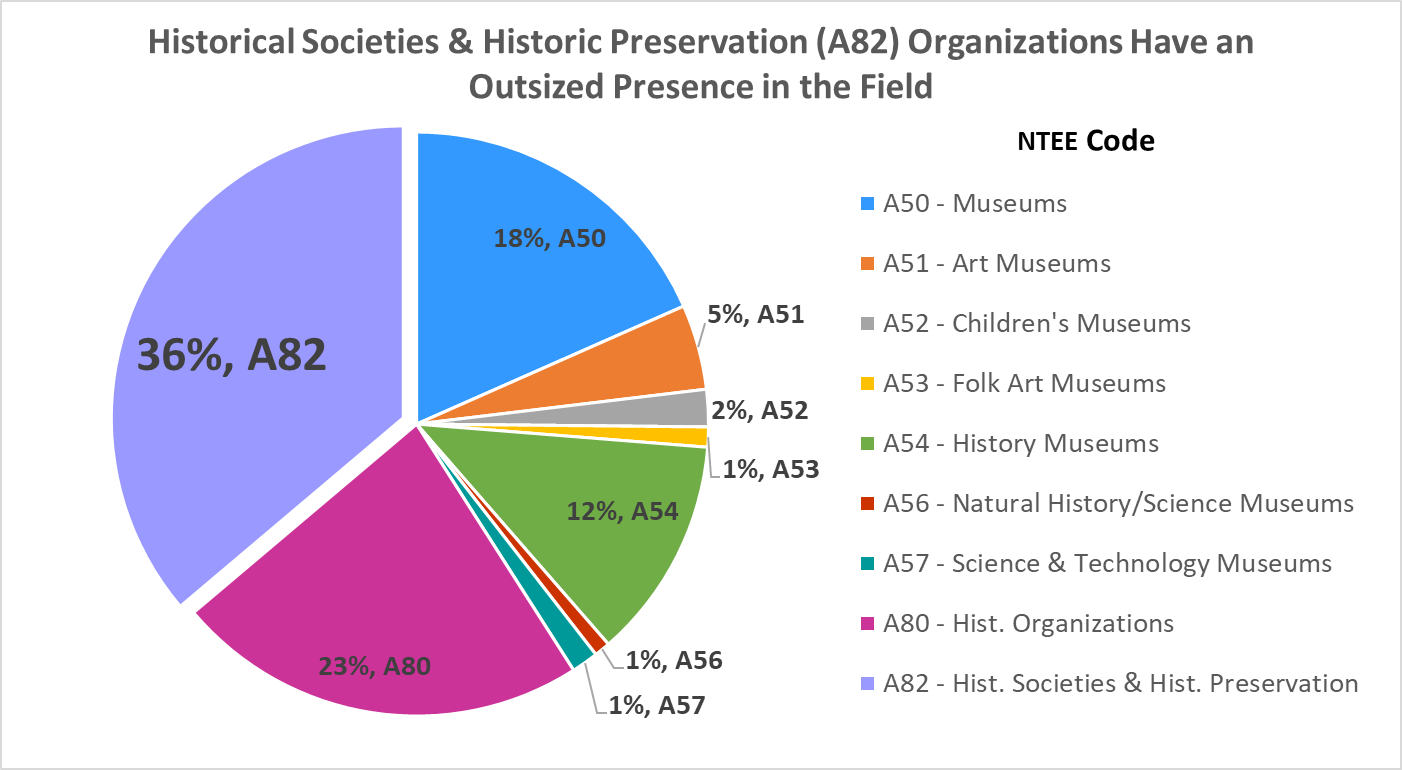
Figure 1. Historical Societies & Historic Preservation (A82) organizations have an outsized presence in the field. Source: Internal Revenue Service and National Center for Charitable Statistics.
Of all the organizations in the United States devoted to arts, culture, and humanities, Historical Societies & Historic Preservation (NTEE A82) organizations have an outsized presence. More than a third of all organizations “sponsor activities which celebrate, memorialize and sometimes recreate important events in history such as battles, treaties, speeches, centennials, independence days, catastrophes that had an important impact or other similar occasions.” “Historical society,” “historical association,” “heritage society,” “preservation,” and “restoration” are in the name of nearly 80 percent of institutions in this category. They are also focused on local history—only one in twenty institutions appear to have a geographic scope larger than the county level.
While preserving and interpreting local history is their primary interest, these organizations are the smallest by revenue. More than 90 percent operate with less than $1 million in revenue annually and have a median revenue near $64,000 (yes, the median is $64,000 annually for all A82 organizations for 2011-2017—half of these organizations operate with less than this amount). Only Historical Organizations (A80) produce similar financials, albeit with slightly higher figures.
Max van Balgooy with Robert Indiana’s Numbers 0-9 at Newfields (Indianapolis Museum of Art)
Seven is the number associated with completeness and perfection, but I’m not perfect and rarely satisfied, so before I complete seven years as director of the History Leadership Institute (HLI), I’m turning the chair over to someone else.
When I was appointed director in 2017, applications had fallen for several years and we held the Seminar with just thirteen people, accepting everyone that applied. If this continued, it would no longer be financially feasible to offer the Seminar. I was puzzled because the program had a terrific reputation in the field and saw its impact on my friends and colleagues.
To develop a new vision for the Seminar for Historical Administration, a wall in the Seminar classroom became a space for exploring ideas.
While we gathered for three weeks in November 2017 for the Seminar at the Indiana Historical Society, I worked on a side project to rethink the program to make it more sustainable and attractive. In the usual HLI fashion, I sketched out ideas on flipcharts spread out on the classroom wall, asking everyone who came into the room for their reactions and ideas. By the end of the Seminar, I had diagrammed a long-range plan with immediate and short-term recommendations that included:
Affirming its focus on organizational leadership and personal leadership.
Changing the name from the Seminar for Historical Administration to shift the emphasis to leadership.
Moving the organizational structure from a partnership among several history organizations to AASLH to better facilitate administration and ensure longterm support.
Considering alternatives to the three-week residential format to better serve mid-career history professionals.
The Class of 2022 celebrating their graduation from the HLI Seminar.
The History Leadership Institute, AASLH’s professional development program for mid-career history professionals, introduced its long-running Seminar in a new format in June.
In 1959, the Seminar began as an effort to train newly graduated history students and directors of history museums in the unique skills of managing museums, historic sites, and archives in a six-week program held at Colonial Williamsburg, During the decades that followed, the Seminar has continually changed to meet the needs of the field and explore new and emerging practices.
When your history organization is modeling itself on other museums or historical societies, are you choosing the right ones? Are they doing things that are well within your capacity or are you following an impossible dream? There’s nothing wrong with observing the extraordinary leaders in the field, but if you’re modeling your life on a superhero, you may be destined for an avoidable series of crashes and burns. You would have been much more successful had you devoted your time and energy on more achievable efforts.
For example, Historical Organizations (NTEE Code A80) are “organizations that promote awareness of and appreciation for history and historical artifacts,” which is mostly composed of local historic sites, house museums, and memorials that are not solely history museums or historical societies. A sample of Historical Organizations shows that many focus on local history, support museums, or memorialize people, places, or events (see Table 1). Of the 2,500 Historical Organizations providing IRS Forms 990 in 2017, nearly 40 percent include the words “memorial,” “foundation,” “friends,” or “association” in their names.
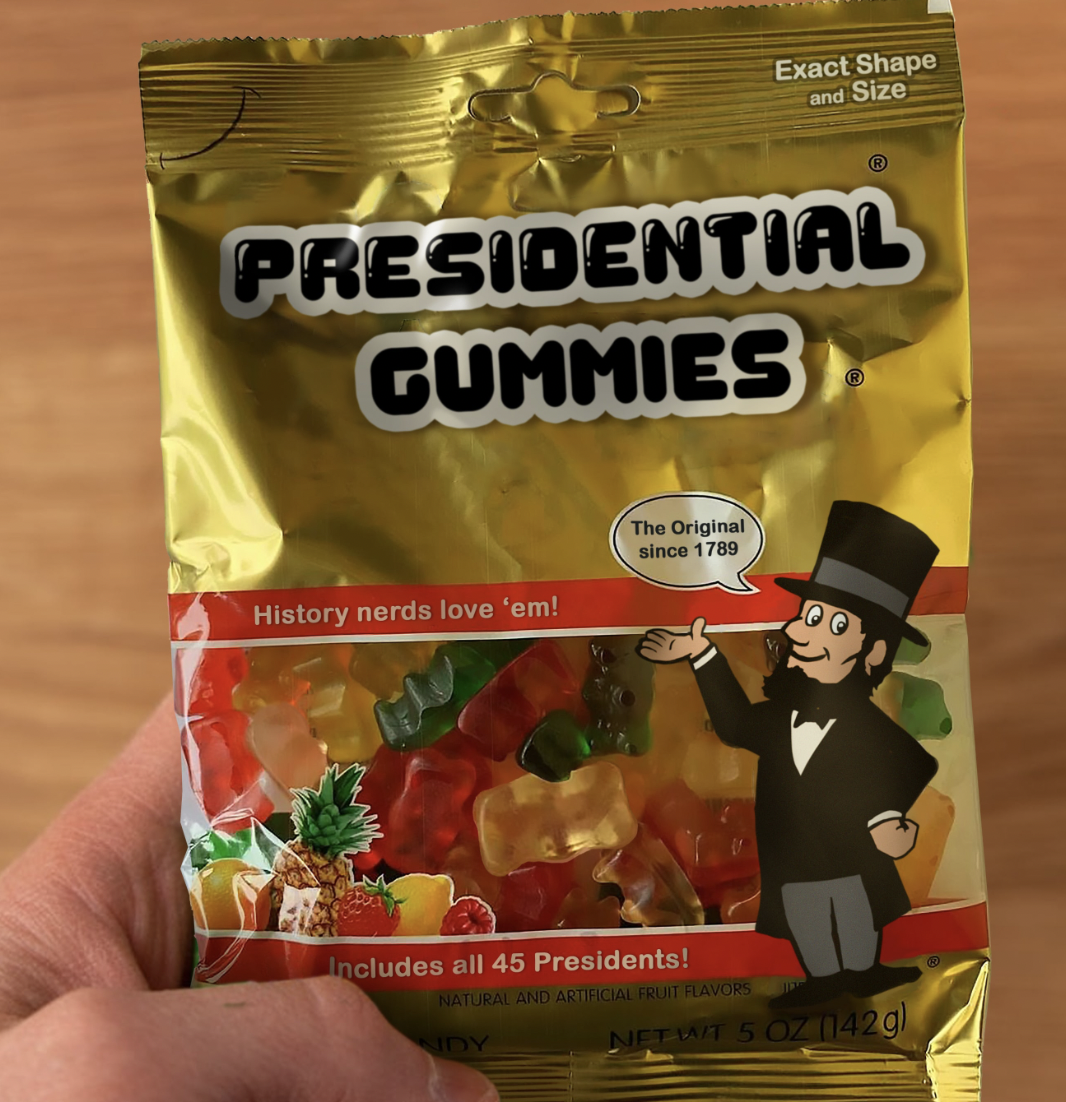
Limited edition of Presidential Gummies available from The History List.
The History List, creators of the annual History Camp, continues to launch a series of fun and engaging products to inspire Americans to explore and share their history. Today they’re releasing a limited supply of Presidential Gummies that are sure to turn children into history nerds. They also align with the “Doing History” theme for the 250th Commemoration by encouraging open conversations about what history is, the many ways it is done, and why it matters.
Made by Haribo, the German manufacturer of Goldbears® since 1922, these colorful gummies in flavors from pineapple to strawberry representing all the presidents are sure to delight (and become a collector’s item among history buffs). These Presidential Gummies and other cool history stuff are available online in The History List store.
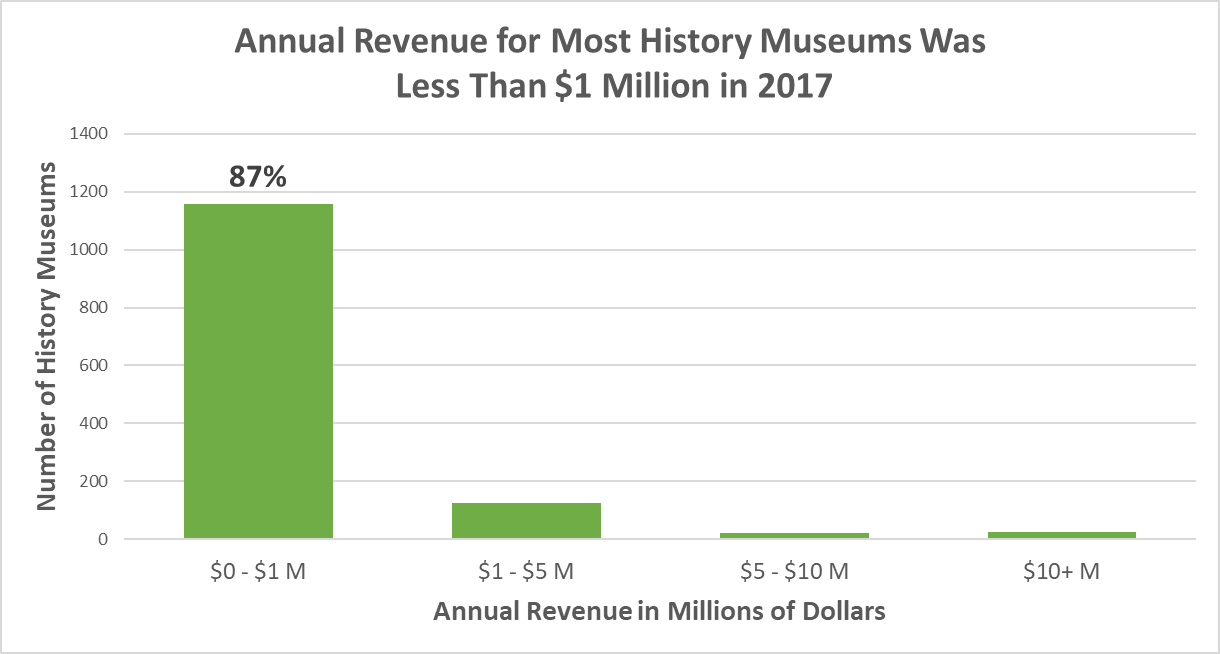
A financial review of more than 1,300 History Museums in 2017 reveals that nearly 90 percent operate on less than $1 million annually, and nearly half on less than $100,000 (see Figures 1 and 2). History museums are financially fragile, but an annual increase in revenue of $5,000 to $10,000 could have a tremendous impact on their capacity and impact. How might this be achieved? Hints of potential solutions are revealed in the changing revenue patterns of larger museums.
Figure 1. Annual revenue for most history museums was less than $1 million in 2017, the most complete recent data available. Source: Internal Revenue Service and National Center for Charitable Statistics.Figure 2. Annual revenue for most History Museums was less than $1 million in 2017, the most complete recent data available. Source: Internal Revenue Service and National Center for Charitable Statistics.
A closer look shows that most History Museums derive about 60-70 percent of their revenue from “unearned” sources (i.e., contributions, grants, investments, fundraising events, membership dues), but the mix changes according to size. Museums with less than $10 million in revenue received 4 to 6 percent of their income from investments, which doubled or tripled in the largest museums to 11 percent. While asking for support from people and foundations (i.e., contributions and grants) remained steady, there seems to be increased attention on making money from money (e.g., interest, dividends, sale of securities, drawing funds from endowments).