
This 10:00 video introduces the collection, artists, and setting for the National Museum of American Illustration in Newport, Rhode Island. It’s narrated by Judy and Lawrence Cutler, the husband and wife team that own and operate the museum; Whoopi Goldberg (yes, the comedian and actor); and Joanna Maxfield Parrish, granddaughter of Maxfield Parrish. This appears to be a 2009 production by Daybreak Productions.
Author Archives: Max van Balgooy

Museums and Historic Sites Climbing Out of Recession Slowly
 According to data from the U. S. Department of Commerce, museums, historic sites, and similar institutions are climbing out of the 2008 recession but it’s been slow and rocky. For 2009, quarterly revenues averaged $2.6 billon and for 2013 it grew to an average of $2.9 billion per quarter. The overall upward trend is slow (red line in chart) but each passing year has improved. Annual revenues have grown from 1 percent in 2010 to 7 percent in 2013 when compared to the previous year. On a quarterly basis, however, it is a very rocky road. Within a single year, revenues fluctuated 18 to 38 percent, suggesting that while revenues are looking better over the long run, in the short run Continue reading
Brown University and National Trust Provide Recommendations for Historic House Museums
The financial sustainability and social relevance of historic house museums continue to intrigue scholars, preservationists, organizations, and even pundits on National Public Radio (I was recently interviewed by them about this topic) and adding to the conversation are two recent publications by the John Nicholas Brown Center at Brown University and the National Trust for Historic Preservation.

Bedroom at Liberty Hall Museum, Kean University, New Jersey.
If historic house museums are historic sites that primarily educational (not commercial) in purpose, how would they be different if they were managed by educational institutions? “University-Affiliated Historic House Museums,” a report by the John Nicholas Brown Center at Brown University may provide some answers. Prepared for the 1772 Foundation by Hillary Brady, Steven Lubar, and Rebecca Soules, the report examines the issues facing historic house museums that are owned or operated by colleges and universities based on a survey of existing practices at ten sites. Offering recommendations for “new ways to make these museums more useful to the university community,” it concludes with a half dozen alternatives for the Liberty Hall Museum at Kean University, which might be applicable to sites that are not affiliated with universities (swap “campus” and “students” with “community” and “residents”). By the way, the Center is hosting an intriguing colloquium in May 2015 on “lost museums“.
 In 1949, Congress created the National Trust for Historic Preservation to Continue reading
Delaware Offering Lessons on Museum Management of the Wrong Kind IMHO
I’m a 1980s graduate of the University of Delaware, which is a great place to learn about museums because of its affiliation with Winterthur, Hagley Museum and Library, and Longwood Gardens. Now we’re all discovering it’s also a great place to learn how to mismanage a museum.

If you haven’t been following the story for the past year, the Delaware Art Museum in Wilmington is selling some of its collections in an effort to pay off a $20 million debt for the construction of a museum expansion in 2005 and refill its endowment. They first sold a painting by William Holman Hunt a few months ago and they’re getting ready to sell a couple more items soon, including a painting by Winslow Homer and a sculpture by Alexander Calder. Their actions were censured by the Association of Art Museum Directors (a group that’s typically reluctant to criticize its members), but the Delaware Art Museum doesn’t care. In “Museum Under Fire for Selling Its Art,” Deborah Solomon of the New York Times provides the latest painful details.
This case study isn’t finished (and it’ll be a doozy), but we’re learning plenty of lessons already:
1. People visit museums and historic sites to have a great experience with the collections, not Continue reading
Video: Art Splash at the Philadelphia Museum of Art
Jill Frechie produced this 2:00 video explaining Art Splash, a summer program for families at the Philadelphia Museum of Art. Emily Schreiner, associate curator of education, explains some of the 300 programs offered during the ten week period, which features a different object each week. Three hundred programs in ten weeks? I’m exhausted just thinking about it.
How a Classic Business Matrix Can Help Museums and Historic Site
 In the 1970s, Bruce Henderson at the Boston Consulting Group (BCG) introduced the “growth-share matrix” to help its clients better manage a portfolio of business units and products. The matrix facilitates management decisions by rating each product according to their share of the market and their potential for growth. Putting each product in one of the four quadrants of the matrix graphically showed which ones were the stars, cash cows, question marks, and pets (cute but worthless). More importantly, it showed the overall position and health of the company and suggested next steps. For example, “cash cows” should be maintained and used to invest in “stars” but “pets” should be abandoned (sorry for offending pet owners, but calling them “dogs” probably won’t make it any easier).
During the past 40 years, the BCG matrix has become a classic tool for business strategy and Harvard Business Review recently named it one of the frameworks that changed the world. Yet it is rarely used by museums and historic sites, who seem to favor the much more limited SWOT exercise. It may be because non-profits are unaware of the matrix but it’s more likely that “market share” and “market growth” are unfamiliar or impracticable concepts. I do like the idea of assessing our work in ways other than attendance and income, so I’ve revised the framework to make it more useful to museums and historic sites.

In this “mission-sustainability matrix,” Continue reading
Delaware’s Strategic Plan Meets AAM Standards
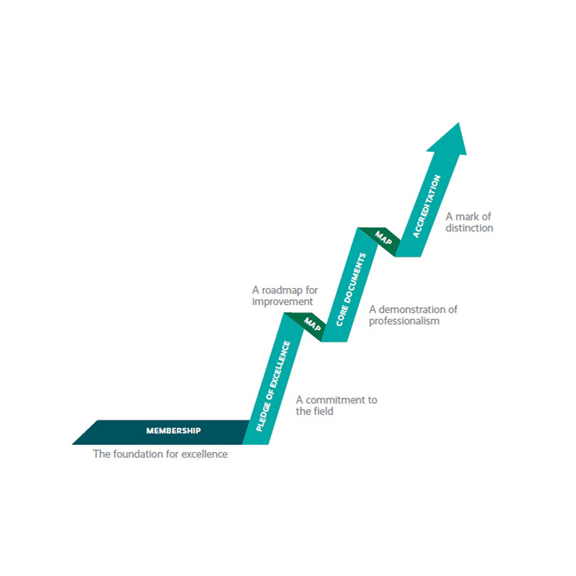
AAM’s “Continuum of Excellence.”
A couple years ago, the American Alliance of Museums introduced the Continuum of Excellence, a “multi-program structure [that] offers opportunities for various levels of assessment, feedback, and recognition that build on one another.” It’s a significant expansion of the Museum Assessment Program and Accreditation process because it now includes additional intermediate steps, including verification of five core documents, including a strategic plan.
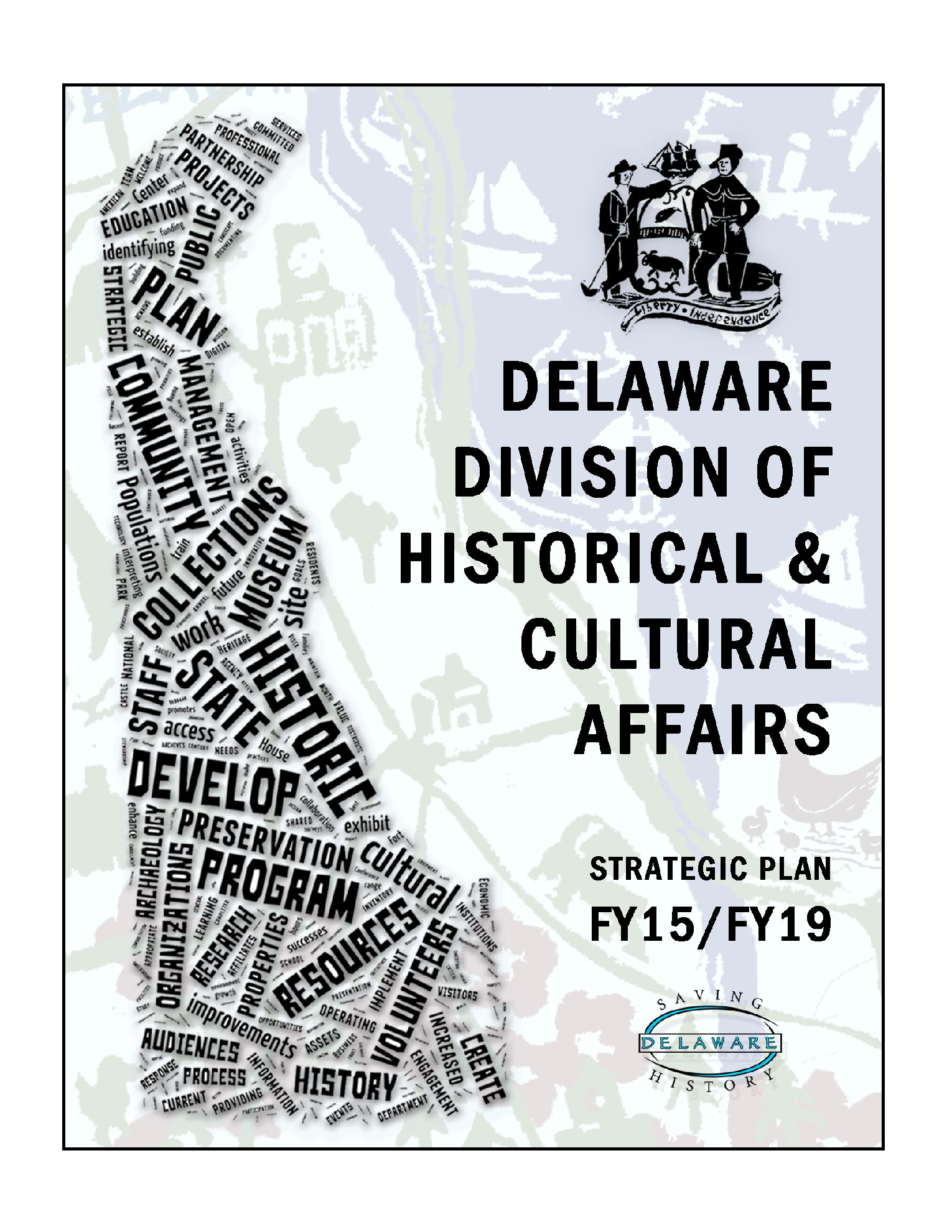 Last year I worked with the Historical and Cultural Affairs Division of the State of Delaware to prepare a strategic plan that would meet or exceed AAM’s standards for professional museums. The planning process was more complex than usual because it involved a state government agency that is responsible for over forty historic properties, five museums, a conference center, welcome center, historic preservation, and archaeology and has numerous local partners and affiliates. They also wanted a strong emphasis on team work and a heavy reliance on staff expertise, so the process included large and small group meetings, staff surveys, and community research to create a vision, core values, major audiences, goals, implementation, evaluation, and a budget within eight months. Whew!
I facilitated the meetings and provided general direction, but the staff wrote, revised, and developed the strategic plan from beginning to end while still working their regular jobs. I’m incredibly proud Continue reading
Video: Bens, the Legendary Deli
Cedric Conti produced this 2:00 video about “Bens, the Legendary Deli,” an exhibit currently on view at the McCord Museum in Montreal, Canada. Includes French subtitles! Bens Delicatessen, founded in 1908 by Benjamin Kravitz (1883-1956), closed in 2006 after nearly a century in business. The exhibition brings together some 100 objects, including posters, architectural plans, photos, counter stools, dishes, utensils, menus, recipes and testimonials that recount the history of this landmark, the very first of Montreal’s famous smoked meat restaurants.
Changing Attitudes About History one Grizzly at a Time
Politics and Prose, the famous independent bookstore in Washington DC, hosted a booksigning for Tim Grove, chief of museum learning at the Smithsonian Air and Space Museum, that attracted seventy-five listeners this past Saturday. It’s not often that museum folks share a stage that recently included Patrick Buchanan, Timothy Geithner, Lynn Sherr, and Michelle Obama. His talk will be aired on C-Span.
A self-professed history geek, Tim shares his love for history in A Grizzly in the Mail and Other Adventures in American History (University of Nebraska Press, 2014), a collection of stories from his years working at Colonial Williamsburg, Missouri Historical Society, National Portrait Gallery, and the National Museum of American History. Tim wants to improve the public image of history by demonstrating the fun of history and “help history haters change their minds.” To do this requires provoking a deeper thinking about historical programs and activities to better link past and present As he states in his book,
The staff at [Colonial] Williamsburg and other history sites wants visitors to “experience” history. What does this mean? One can visit Yosemite National Park and experience the beauty and grandeur of nature. One can go whitewater rafting and experience the rush of the river and the cold wetness of the water as it splashes the face. But experiencing history? Do you experience history when you walk the hallowed ground of a battlefield or visit a historical house? Experience in verb form implies action. What action is actually taking place?
Tim demonstrates that “action” through a wide assortment of stories, from conquering a high wheel bicycle and questioning the significance of Eli Whitney’s cotton gin to navigating the legacy of Lewis and Clark, and yes, unpacking a grizzly bear Continue reading
Video: We Are Museums 2014 (Warsaw, Poland)
This 3:45 video gives a quick overview of We Are Museums, a two-day international conference on innovation and creativity within museums. Hosted by the National Gallery of Art and the State Ethnographic Museum, it combines workshops, exhibitions, and presentations. Presenters included Seb Chan of the Cooper-Hewitt National Design Museum and Sarah Hromack of the Whitney Museum of American Art.
 Engaging Places