Category Archives: Community engagement

Building Membership Relies on Research

Curate Your Own Membership at the Whitney Museum of American Art

Curate Your Own Membership at the Whitney Museum of American Art

The November/December 2013 issue of Museum, the magazine of the American Alliance of Museums, includes two helpful articles on membership, which is typically the fundamental fundraising program for historic sites.

In “Join the Club,” Daniel Grant describes several museums that have successfully broken the traditional “give more/get more” membership structure.  The Whitney Museum of American Art nows offers a Curate Your Own Membership program, which includes Continue reading

AAM and NAI Announce Awards, but Few are Historic Sites

Walking Cinema of Gloucester HarborWalk

Walking Cinema of Gloucester HarborWalk

The American Alliance of Museums and the National Association for Interpretation announced their annual winners in various categories, from label writing to exhibits to publications to programs.  You’ll want to look at the entire list for inspiration, but I especially want to congratulate those people and organizations whose worked focused on historic sites, houses, and places (that’s the point of this blog).

The Media and Technology Professional Network of AAM presented Muse Awards for digital media to: Continue reading

HBR: The Truth About the Customer Experience

Harvard Business Review, September 2013

Harvard Business Review, September 2013

The September 2013 issue of Harvard Business Review features four articles on women in leadership, which will be of interest to many people who work at historic sites and museums.  The first is on the subtle gender bias that obstructs women’s access to leadership in even the most well-meaning organizations (and how to correct the problem), the second article describes companies who have successfully incorporated inclusivity, and the third reveals the way women make buying decisions differently in a business-to-business (B2B) setting from men.  The fourth article is a roundup of recent research on women in the workplace, such as women receive less criticism but also less challenging assignments.  Of course, the museum and historic site field is dominated by women, so I wonder what these statistics would look like for us.

There’s also a good article on “customer journey mapping.”  It’s a relatively new method of studying a customer’s buying experience by identifying all the places that a company interacts with a customer and evaluating each of these “touchpoints.”   By mapping the customer’s journey to buy a product from their initial search for information to its delivery and installation, a company can better understand the Continue reading

Video: Rembrandt Enlivens Shopping Mall

A painting by Rembrandt van Rijn, the Dutch master artist, comes to life in this video staged in a busy shopping mall.  Using the slogan, “Our Heroes are Back” and inspired by Rembrandt’s Night Watch (1642), it promotes the return of all the major artworks after a decade’s long renovation of the Rijksmuseum in Amsterdam.  It’s chaotic and confusing, so hang on to the end and it’ll come together.   Thanks to Cathy Fields for suggesting this video.

Snapshots of AASLH in Birmingham

This slideshow requires JavaScript.

I’ve just returned from three days in Birmingham, Alabama, where I attended the annual meeting of the American Association for State and Local History.  Lots of great sessions and I was often caught struggling to decide which one to attend.  Of course, it’s always great to meet colleagues from around the country but I was struck by how many graduate students attended.  Melissa Bingmann, who directs the public history program at West Virginia University, brought a dozen students because she believes it’s a more effective use of her limited funds–students hear more “guest” speakers, visit more museums and historic places, and learn more about the field than if they had stayed on campus all year.

This slideshow requires JavaScript.

Birmingham isn’t high on my list of tourist destinations, but the AASLH meeting gave me a chance to see Continue reading

AASLH Award Winners

Lee Wright at the History List created a Slideshare presentation of the 87 history projects that will be receiving awards today from the American Association for State and Local History at their annual meeting in Birmingham, Alabama.   You’ll see exhibits, books, websites, preservation projects, outdoor multimedia tours, and much, much more.  It’s an easy way to get ideas for your museum and historic site (perhaps your staff can watch it over lunch together?).

Lee also mentioned that he’ll be offering the “Make this Holiday Historic” at the History List again in December to promote events, gifts, and membership at historic sites and house museums but may include some tweaks to make it more engaging.  If you are interested in participating (I especially encourage sites that are in a city or region that’s a tourist destination), contact Lee@TheHistoryList.com.

Video: The Heart of the Matter

The American Academy of Arts and Sciences produced this 7-minute video to accompany its report, The Heart of the Matter: The Humanities and Social Sciences for a Vibrant, Competitive, and Secure Nation.   You’ll see lots of familiar names and faces along with many provocative and inspiring thoughts to bolster your day (and some sufficiently pithy to make great quotes in a fundraising letter).

We’ll be discussing the Heart of the Matter report and the state of history at the AASLH annual meeting this week, first at today’s CEO Forum chaired by Kent Whitworth of the Kentucky Historical Society, which will include presentations by Conny Graft and Pharabe Kolb and discussions facilitated by me.  Tomorrow, Tim Grove of the Smithsonian Institution moderates a general session with Conny Graft, Pharabe Kolb, and Kim Fortney.  I’ll be sharing the results of those meetings in the weeks that follow.

Video: History Lives in Alnwick Castle

This is a 0:30 television commercial promoting Alnwick Castle in England, which uses the slogan “Where History Lives.”  This historic site continues as the home of the Dukes of Northumberland, so along with tours of the castle and gardens, they offer a very wide range of activities, such as broomstick training (just like Harry Potter), archery (“one of England’s oldest skills”), and a theatrical behind-the-scenes adventure (called “The Lost Cellars”).  Historic sites rarely are able to produce advertising for television, so enjoy this rare treat.

Burma Shave Inspires Signs at St. Jones Reserve

This slideshow requires JavaScript.


St. Jones Reserve in Dover, Delaware is a 3,750-acre nature preserve on the edge of Delaware Bay dominated by salt marsh.  Deep inside is an environmental education, training, and research facility at the end of the long unpaved road–how do you ensure visitors that they’re on the right track and not getting lost in the countryside?

Education Coordinator Jennifer Holmes came up with a clever idea to install a series of signs along the entry road to Continue reading

A Clever Model of Engagement for Your Desk or Office

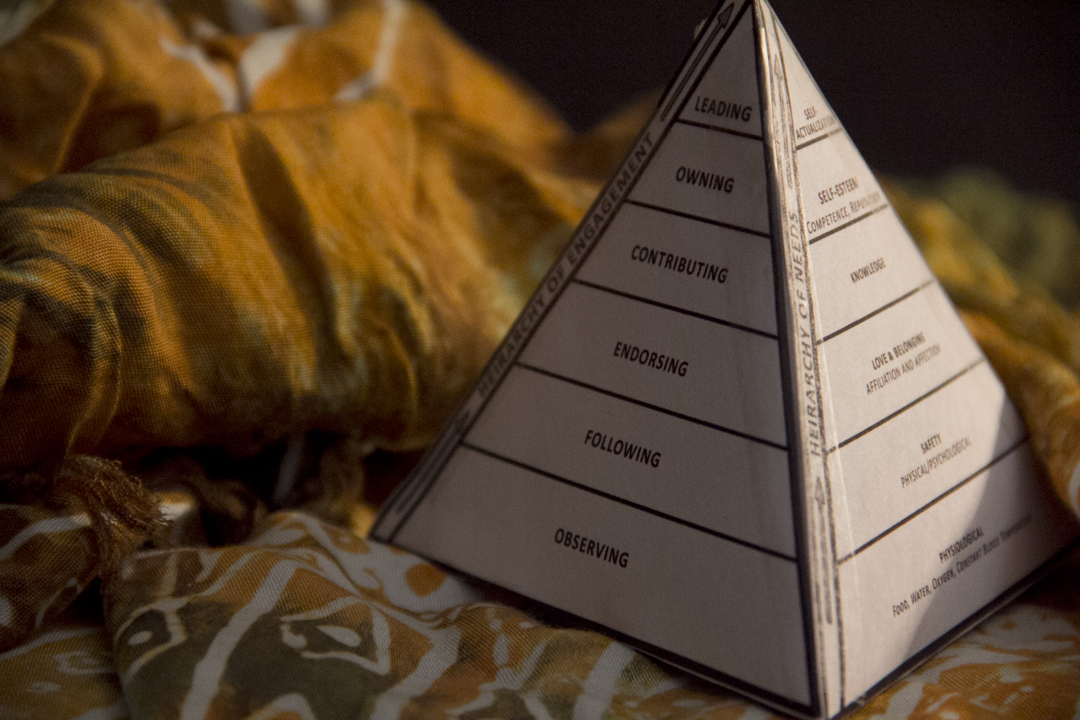
Travis Kirspel's Engagement PyramidI’ve been working on a strategic plan for the Division of Historical and Cultural Affairs for the State of Delaware for the past few months and after a recent meeting, I stopped by the office of Travis Kirspel, one of the planning team members and the Curator of Digital Assets.  A set of geometric solids in his bookcase caught my eye–I associate them with early science and cabinets of curiosity–and it turns out he created them.  He’s interested in community engagement, so he used his skills as a graduate of the Savannah College of Art and Design to develop a clever model that pulls together various theories into one object.  He graciously provided more details, as well as the blueprints so you can create a pyramid for your desk or office.

The Pyramid of Engagement:  A Psychological Model for Building Community Relationships by Travis Kirspel

It is said (albeit on Wikipedia) that the Egyptian pyramids were, well, pyramid-shaped as a nod to the “primordial mound” from which the earth was created. They have also been described as more like “resurrection machines” than “tombs” by design. Essentially, the deceased pharaohs’ souls became superhuman cannonballs launched through Continue reading