Category Archives: Governance and management

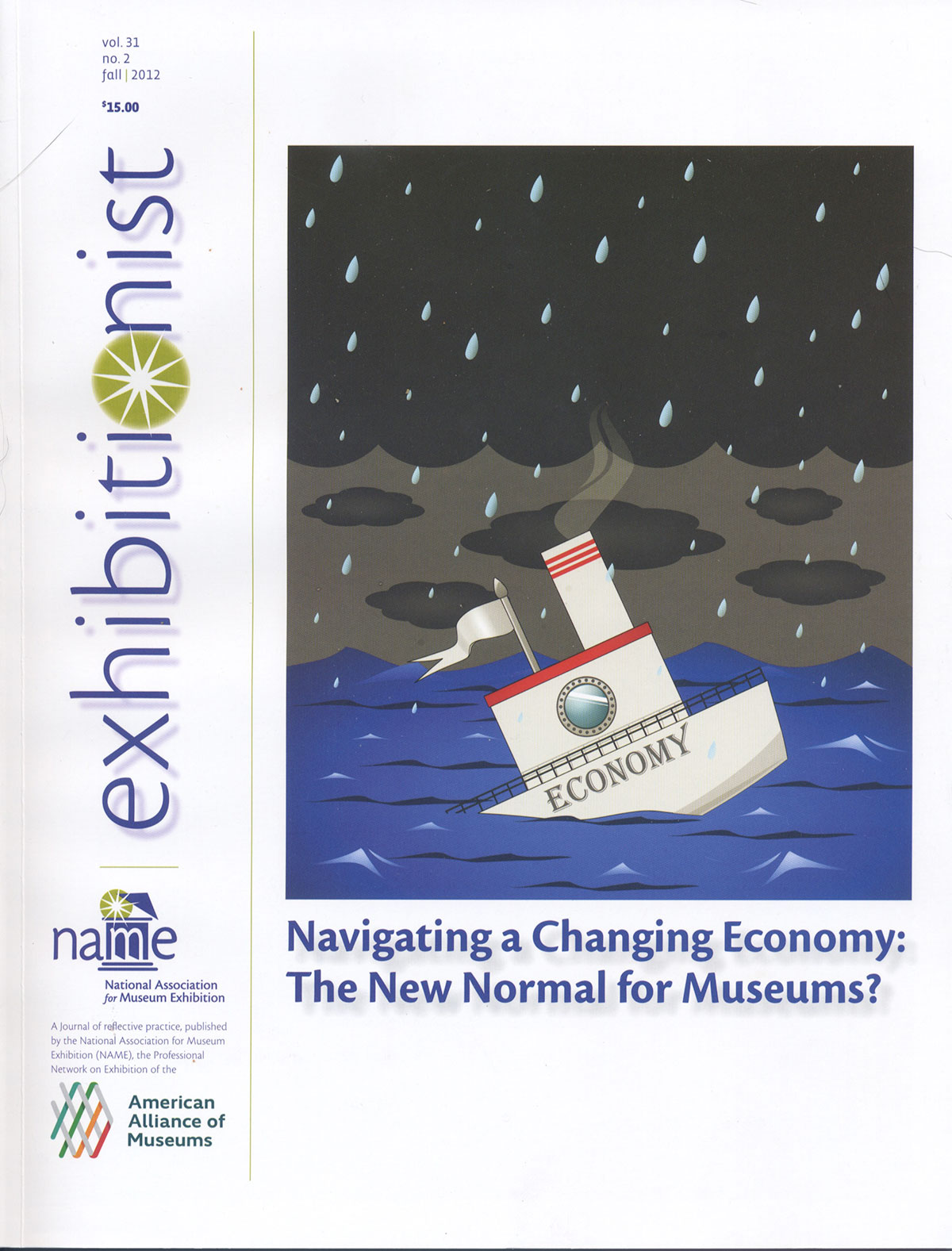
Navigating a Changing Economy: A New Normal for Museums?

Exhibitionist, Fall 2012

Exhibitionist, Fall 2012

The Exhibitionist, the journal of the National Association for Museum Exhibition (NAME), has devoted its fall 2012 issue to the longterm impact of the economic downturn on the museums.  Daniel Spock, director of the Minnesota History Center, and Marilyn Hoyt, a fundraising consultant, discuss the trends affecting exhibitions but whose lessons can apply to other museum departments.  Spock believes that museums may be, “moving into a period of permanent instability–a special challenge for museums which have traditionally been in the continuity business.”  Hoyt sees that museums are compensating by relying more on in-house resources and phasing projects, often with good side effects, including more prototyping of ideas and a fresh look at familiar collections.

Complementing these opening articles are: Continue reading

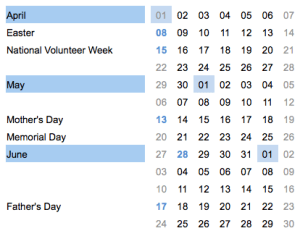
Compact Calendar for 2013

Detail from the Compact Calendar

Detail from the Compact Calendar

Happy New Year!

For those who plan events, programs, and activities months ahead of time, I’ve updated my Compact Calendar for 2013 based on a design by David Seah.  The entire year is listed on one page as a continuous series rather than broken out by months so you can quickly calculate time between dates and avoid getting messed up by months with five Mondays.  In addition, it includes major holidays to schedule towards or around them, as needed.  I’ll use the Compact Calendar to plot out all my events and deadlines for the year to ensure they don’t pile up too much in one place, and I’ll place a copy in a project file to have a handy calendar to determine milestones and coordinate tasks.  If the last three sentences didn’t make any sense, you probably don’t need this calendar (and if they do, this calendar will make your year happier!).

For more time and project organization ideas, visit David Seah’s blog (I use his emergent task planner as well).

What We Can Learn from America’s Biggest Non-profits?

Philanthropy 400 is the Chronicle of Philanthropy‘s annual list of the 400 groups that raised the most funds from private sources.  For 2011, these groups achieved a median 7.5-percent increase from last year, the third straight year of median gains for non-profits in the Chronicle‘s rankings.  That’s amazing considering the depths of the recession that affected most charities.  “Giving USA” said that charitable giving overall grew less than one percent last year.  About $1 out of every $4 donated by individuals, corporations, and foundations goes to these top 400, so what can we learn from them?

The lessons are a bit hard to uncover given the wide diversity of organizations represented on the list, primarily universities, social services, and health/medical,, followed closely by religious, youth, and education.  Topping the list are: Continue reading

Kat Imhoff named president of James Madison’s Montpelier

Kat Imhoff at James Madison’s Montpelier.

The Montpelier Foundation has appointed Katherine L. “Kat” Imhoff as president effective January 1, 2013.  The Foundation manages James Madison’s Montpelier, where Madison was born, developed his ideas for the Constitution, and retired after his presidency.  Imhoff returns to Virginia after a successful five-year tenure as State Director for The Nature Conservancy in Montana, where she led the organization’s Montana Legacy Project – the purchase of more than 300,000 acres for nearly $500 million – representing the largest conservation project ever undertaken by The Nature Conservancy.

“Montpelier is a place for making authentic, tangible connections with the past that can inspire us to build on James Madison’s legacy of constitutional self-government,” said Gregory May, Chairman of The Montpelier Foundation. “Kat Imhoff is a respected preservationist with demonstrated ability to generate support for visionary advances like those Montpelier now is prepared to undertake.”

Before she went to Montana, Imhoff was Continue reading

AASLH and AAM Align Efforts to Raise Standards and Practices

The American Association for State and Local History (AASLH) and the American Alliance of Museums (AAM) recently announced they will work together to raise awareness of national museum standards and align their assessment programs in order to streamline application and self-study processes.  The agreement outlines ways in which applicants of AAM’s Museum Assessment Program (MAP) will benefit after completing AASLH’s StEPs program, in other words,  AASLH and AAM have linked StEPs with MAP.  If you understand that sentence, you’ve been working in this field a long time.

What’s this mean for historic sites?  Both StEPs and MAP are great programs for improving your organization’s work, but they’re very different from each other.  StEPs allows you to Continue reading

Is Your Historic Site Unsure About Next Steps?

In this uncertain environment, many organizations are unsure about the direction to pursue for their historic site or house museum.  Through a self-study process and a personal assessment by an external professional colleague, the Museum Assessment Program (MAP) offers a thoughtful and proven approach to refine your operations, programs, and collections.  I’ve participated in several MAPs and clever organizations have used it to confirm a strategy, refine a project, resolve a vexing issue, support a funding proposal, or move to the next level of operations.  I can’t think of a better program available, except if you’re accredited by AAM, you have a large professional staff, or if you’re able to afford a large team of experts.  Really.  To stay sharp, every historic site and house museum in America needs to go through this program every decade and in between, they should be tackling a section of AASLH’s Standards and Excellence Program.  Really. If you’re not sure, call the director of the historic sites that participated this year:  Montpelier Mansion (Maryland), Old Barracks Museum (New Jersey), Louis Armstrong House (New York), Seward House (New York), Stewart House (Ohio), French Legation Museum (Texas), Poplar Forest (Virginia), and Pabst Mansion (Wisconsin).

To participate, your organization needs to meet some basic requirements (such as be open to the public at least 90 days a year), Continue reading

AASLH Meeting in Salt Lake City Today

I’m currently at the annual meeting of the American Association for State and Local History in Salt Lake City, Utah, not only enjoying the camaraderie of friends and colleagues, but also attending a board meeting, moderating two sessions, and speaking at a  breakfast of historic house museum and visitor research leaders.  If you are attending, I’d love to meet you so please say hello (as a reader of this blog, you have the advantage!) or stop by:

  • Historic House Museums and Visitor Voices Breakfast on Friday, October 5 at 7 am, when Conny Graft and I will be discussing the perception gap between visitors and historic sites.
  • Re-imaging Historic Sites:  Three Roads to the Same Destination on Friday, October 5 at 10:45 am.  I’ll be joined by visitor research consultant Conny Graft, preservation architect Barbara Campagna, and house museum director Gwendolen Raley.
  • Meshing Mission and Community:  Identifying Strategies for Engagement on Saturday, October 6 at 9:00 am.  I’ll be joined by Deborah Schwartz of the Brooklyn Historical Society and Lorraine McConaghy of the Museum of History and Industry.

When I return, I’ll have lots to share so look for those posts in the coming weeks.

Highlights from the Latest Journal of Travel Research

I doubt many people read the Journal of Travel Research (yes, there are such things!) but I’ve been referring to it in preparation for a presentation at the Historic House Museum Consortium of Washington, DC.  Looking at the September 2012 issue of the Journal of Travel Research, I thought I’d share some of the highlights from articles that might interest historic sites and house museums:

  • In “GPS as a Method for Assessing Spatial and Temporal Use Distributions of Nature-Based Tourists,” Jeffery Hallo et al examine the use of GPS devices to study visitor behavior in national parks (an idea that can be easily be applied to large historic sites).  This research typically has to be done either by asking visitors to recall their experiences in a survey or by asking visitors to record their own behavior in diaries–both cumbersome and highly subjective methods.  GPS provides a better way to study human behavior, but so far the inaccuracy and cost has been major hurdles.  A test of three of the newest GPS devices, however, shows that these hurdles have been overcome by Continue reading

HBO CEO named Mt. Vernon CEO; A Step Backwards IMHO

George Washington’s Mount Vernon

Today, Curtis G. Viebranz becomes the president and chief executive officer of George Washington’s Mount Vernon.  Unfortunately, this decision by the Mount Vernon Ladies’ Association is a step backward for its mission, history, education, preservation, and ironically, women, too.  Viebranz succeeds James C. Rees III, who retired in June.  Here’s an excerpt from the official announcement:

Viebranz brings to Mount Vernon more than twenty years of experience at major multinational Internet and cable enterprises, including a successful tenure as president of HBO International, the global arm of Time Warner’s Home Box Office unit. Prior to that, as Time Warner turned its attention to digital distribution strategies, Viebranz was tapped to serve as the first president of Time Inc. Multimedia. During his seventeen-year career at Time Warner and its predecessor company, Time Inc., Viebranz built an impressive resume, also serving as president of Time Inc. Europe and HBO Video.

After departing Time Warner, Viebranz helped to launch Continue reading

AASLH Workshops for Historic Sites

The American Association for State and Local History offers a wide range of educational workshops and professional training that is particularly helpful for staff and volunteers for work at historic sites and house museums–if you know where to look.  I’ve previously mentioned the sessions during its annual meeting but people often forget that it also has half-day and day-long workshops before and after the annual meeting to explore topics in depth.  What most people don’t know is that you can register for just these workshops; you don’t have to attend the annual meeting–a great advantage for local folks!

This year, AASLH is offering 14 workshops, including: