Category Archives: Governance and management

What Sites Can Learn from the Olympics

The summer Olympic games in London are now over and if you were watching, I bet you not only reveled in the athletic competition, but you also contemplated the logistics and expenses.  Those of us who work at historic sites don’t experience events like most other people.  Sure, we like the music, food, and tours, but we also look at the placement of signs, calculate ratios between attendance and restrooms, check out the store for items we can sell, and mentally map out visitor circulation and note the bottlenecks.  Or is that just me?

The Olympics is just another special event, although it’s huge and involves a cast of thousands and decades of planning.  The designers and planners of this event are the best of the best, so what can historic sites, at a much smaller scale, learn from their experience?  One of the most valuable lessons is that Continue reading

Making Mission and Vision Visible: Put it by the Coffee Pot

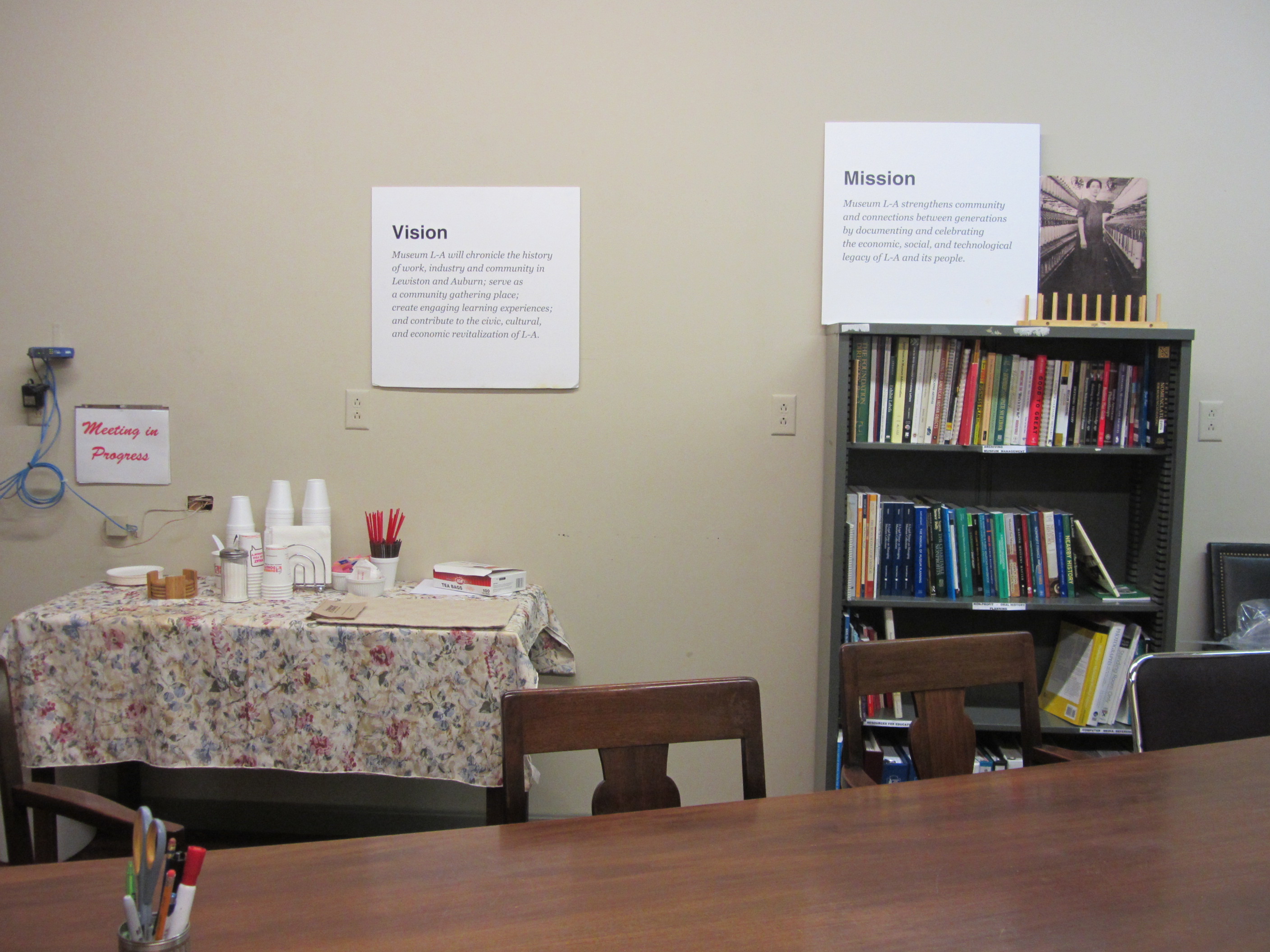
A recent visit to Museum L-A in Maine, a local history museum serving the communities of Lewiston and Auburn, revealed a clever way to keep the mission and vision visible and prominent.  They were posted on large boards in the conference room above the refreshments–whenever a group met, they couldn’t miss these reminders of the organization’s purpose and direction.

Their mission and vision were developed through a community-wide facilitated process led by E. Verner Johnson and they came up with statements that go far beyond the typical “collect, preserve, and educate”:

Mission

Museum L-A strengthens community and connections between generations by documenting and celebrating the economic, social, and technological legacy of L-A and its people.

Vision

Museum L-A chronicles the history of work, industry and community in Lewiston and Auburn; serves as a community gathering place; creates engaging learning experiences; and contributes to the civic, cultural, and economic revitalization of L-A.

For more details, see their strategic plan highlights on their website.  I was pretty impressed with this local history museum, so you’ll find a post or two about it in the future.

Put Your Organization to the Rorschach Test

This slideshow requires JavaScript.

If you’re finding that your organization is in a rut and you no longer feel as inspired about its work, it might be useful to look at it in a new way by creating a “word cloud” of key documents, such as a strategic plan, mission and vision statements, interpretive themes, or visitor evaluation.  A word cloud is a visual presentation of the most frequently used words, sized by frequency.  For example, if you use the word “history” ten times more than “preservation” in your strategic plan, “history” shows up much larger than “preservation” in the word cloud.  The word cloud allows you to look at your organization from a different perspective: words jump out at you and prompt questions about what’s being emphasized (and what’s not).

As examples, in the slide show above I’ve assembled word clouds from the first few paragraphs of the About section of the websites (which often includes the mission or vision statements) of the following historic sites:

I’ve used word clouds in strategic planning sessions to Continue reading

AASLH Council Meets in Maine

This slideshow requires JavaScript.

This past Saturday, the Council (aka board) of the American Association for State and Local History met in Maine for one of their three regular meetings each year.  It’s been a tough few months due to the discovery of embezzlement and fraud within the organization, so this meeting had been preceded by nearly a dozen additional meetings of the Council and several committees by conference call to deal with various aspects related to the situation, potential threats to the organization, and improvements to our current financial management by reviewing and revising various policies, procedures, and practices.  This meeting adopted revised financial policies and procedures; adopted revised codes of ethics for board, staff, and organization; adopted a revised conflict of interest policy for board and staff; and discussed how the by-laws may need to revise the finance and audit committee responsibilities as well reconsider how Council members are elected to ensure we have sufficient people on board with financial skills.  We also began working more strategically, looking longterm to identify priorities so we can preserve those programs that matter most to members and most effectively fulfill the mission.  History News and the annual meeting/conference rose to the top as expected, but Continue reading

Sold! Frank Lloyd Wright Home and Studio in Oak Park

Frank Lloyd Wright Home and Studio, Oak Park, Illinois

On Monday, the National Trust for Historic Preservation sold Frank Lloyd Wright’s Home and Studio in Oak Park, Illinois but don’t worry, it’ll still be preserved and open to the public.  It was acquired by the Frank Lloyd Wright Preservation Trust, who has been operating and managing the site for nearly four decades and I suspect will be there for many more.  In the 1970s, the FLWPT was a fledging organization that was attempting to save the Prairie-style home and studio of Frank Lloyd Wright, which had become badly deteriorated and cut up into a half dozen apartments by a private owner.  It didn’t have the ability to purchase the property when it came up for sale, so they partnered with the National Trust to buy the property.  The FLWPT would eventually repay the National Trust for its half of the $260,000 purchase price but in the meantime, the National Trust would hold the title and lease it to the FLWPT at a nominal price.  The success of this venture prompted these two organizations to partner on the preservation of the Robie House, a Frank Lloyd Wright masterpiece which is owned by the University of Chicago but was badly maintained (another example of a university mistreating historic places!).  With the sale of the Home and Studio, the Robie House partnership is also concluded and the FLWPT will work directly with the University.

I’m not sure what the change in relationship means, but just a few days ago, the Robie House and Frank Lloyd Wright Home and Studio were National Trust Historic Sites, two of 29 historic places sprinkled across the United States.  It’s a ragtag collection that by itself makes no interpretive sense, doesn’t adequately represent American history or culture, isn’t connected by ownership (some NTHS are owned by others) or management (most NTHS are operated by other non-profits), and wasn’t formed to achieve a specific strategy or vision (they were mostly added as opportunities arose, donors made offers, or presidents were seduced).   But with this transition, I hope it sparks some discussion around two important national issues for historic sites: Continue reading

Let’s Give SWOT a REST

A SWOT analysis (a listing of strengths, weaknesses, opportunities, and threats) is a common exercise in business planning and reached the shores of the non-profit world decades ago.  Some of you probably have experienced a SWOT analysis at your site as part of your strategic or long-range planning.  The staff and board gathers around a flipchart to list  your organization’s internal strengths and weaknesses, and then your external opportunities and threats.  Sometimes there’s a bit of confusion over definitions (what’s a threat?) or where an item should be listed (is this a strength or opportunity?).  You might feel a bit of competition to mention a particularly incisive opportunity or are sweating because you can’t name a strength (all the good ones have already been mentioned!).  Eventually, the list might be prioritized and some items consolidated so it can be typed up and included in the strategic plan as a basis for decision-making.

Despite its popularity, I’ve come to the conclusion that we need to give SWOT a rest:

  • The analysis depends heavily on the people participating and it’ll always be biased in that direction.  If you conduct a SWOT exercise with board members who really aren’t involved with the organization, the analysis will probably be superficial and light.  Stock the group with lots of educators, the results will lean towards education.  There are no surprises here–people talk about what they know.  The problem is that the bias is typically not recognized and you wind up building a plan on a foundation that’s skewed or weak.
  • It’s often long on strengths and even longer on Continue reading

Are Your Metrics Just Skin-Deep?

I’ve long been a fan of developing clear measures of success or metrics in planning.  Too often, though, boards and staff at historic sites only use total attendance or the financial bottom line to judge their success.  Certainly, having no visitors is not a good sign, but is a large number of visitors a mark of success?  Not necessarily, because high attendance may be due many factors, including some that may have nothing to do with advancing your mission in a significant manner, such as weddings rentals or dog walkers or corporate retreats.  I’m not knocking those activities and they may be an essential part of your programming, however, what I’ve most often heard at board meetings are conversations like this:

Board chair:  I heard we did well last month.  What was our attendance?

Director:  We had 2,500 visitors in March, double what we had in February.

Boardmembers (in unison):  Wow, that’s great! 

Director:  And looking at the guestbook, we had people from 14 different states and 3 foreign countries, including Latvia.

Board chair:  This must be a record for us.  Okay, let’s have the financial report–looks like the bottom line is positive.  Is there a motion to accept?

Don’t assume this only happens at the local historic house museum–it happens at the big ones as well.  As I’ve often said, Continue reading

OAH Report Claims History is Imperiled at National Parks

The Organization of American Historians recently completed an evaluation of the “state of history” at the National Park Service.  Four prominent historians–Anne Mitchell Whisnant, Marla Miller, Gary Nash, and David Thelen–led the study, which was based on more than 500 staff responses to an online survey, interviews with current and former staff, site visits, discussions at national meetings, and a review of past studies and reports.

Their analysis revealed that much good work is going on in such areas as reinterpreting slavery and the Civil War, negotiating civic engagement, sharing authority, developing interdisciplinary partnerships, encouraging conversations about history through new media, and collaborating with historians in colleges and universities.  These are presented through a dozen profiles of projects at such National Parks as Manzanar, the Olmsted Center for Landscape Preservation, San Antonio Missions, Harpers Ferry, and the Martin Van Buren National Historic Site.

Although they discovered that good work is being done in a few places, it is not “flowering on the whole” due to several intertwined issues.  Most significant is the report’s contention that, “the agency as a whole needs to recommit to history as one of its core purposes, and to configure a top-flight program of historical research, preservation, education, and interpretation so as to foster effective and integrated stewardship of historic and cultural resources and places and to encourage robust, place-based visitor engagement with history.”  These concerns are presented as a dozen findings, and from my observations, many also reflect what’s happening at historic sites outside of the National Parks.  For example:

  1. The History/Interpretation Divide.  The intellectually artificial, yet bureaucratically real, divide between history and interpretation constrains NPS historians, compromises history practice in the agency, and hobbles effective history interpretation. The NPS should find and take every opportunity to reintegrate professional history practice and interpretation. [In museums, this is comparable to the tensions found between curators and educators, where those who conduct research are often separated from those who teach.]
  2. The Importance of Leadership for History.  Without visionary, visible, and respected leadership at the top, and Continue reading

Failed Organizational Culture at Goldman Sachs Suggests Remedies for Non-Profits

Greg Smith’s public departure from Goldman Sachs after a dozen years is one of the hottest pages of the New York Times today and while I tend to ignore the personnel matters of Wall Street (oh, another tycoon getting/losing/complaining about a bonus that’s more than the value of my house), reading his statement startled me.  So many of his concerns about the organization’s culture are shared by me and many of my colleagues in the museum and historic preservation fields:

1.  The overriding pursuit of money that’s out of balance with mission or ethics.  Smith describes a staff meeting at Goldman Sachs:

Today, many of these leaders display a Goldman Sachs culture quotient of exactly zero percent. I attend derivatives sales meetings where not one single minute is spent asking questions about how we can help clients. It’s purely about how we can make the most possible money off of them. If you were an alien from Mars and sat in on one of these meetings, you would believe that a client’s success or progress was not part of the thought process at all.

Gosh, if this bothers someone at a financial investment firm, shouldn’t the lack of discussion about fulfilling mission and vision really bother the board and staff at a non-profit organization?  And yet most meetings Continue reading

Why We Have Curators and Collections Managers

Times are tough and many museums and historic sites wonder about the value of keeping curators and collections managers on the payroll.  What do they do besides sit in their offices all day?  Well, boardmembers and CEOs, they keep an eye on your most valuable assets.  The University of California Berkeley, that fine institution of learning, provides a useful lesson on what happens when you don’t have curators or collections managers involved in managing your artifacts.  According to the New York Times:

Everybody misplaces something sometime. But it is not easy for the University of California, Berkeley, to explain how it lost a 22-foot-long carved panel by a celebrated African-American sculptor, or how, three years ago, it mistakenly sold this work, valued at more than a million dollars, for $150 plus tax. The university’s embarrassing loss eventually enabled the Huntington Library, Art Collections and Botanical Gardens, a large museum and research center in San Marino, Calif., to acquire its first major work by an African-American artist.

Fortunately, there’s a happy ending to this tale for the object, the artist, and the museum–but the university has egg on its face. First, for not recognizing and properly caring for a significant work of art and secondly for disposing of it for so little money. I’m not surprised. Most colleges and universities are notorious for treating their historic sites and museum collections poorly (have we forgotten about the University of Southern California’s long mistreatment of Frank Lloyd Wright’s Freeman House or Cal Poly Pomona’s neglect of Richard Neutra’s VDL House?).

For the complete story, see “Berkeley’s Artwork Loss Is a Museum’s Gain” by Carol Pogash in the New York Times (February 20, 2012) and Huntington Library Acquires Sargent Johnson Monumental Depression-Era Sculpture in Black Artist News (June 22, 2011).