Category Archives: Historic preservation

Bold Ideas, Thin Evidence: Reading the Jenrette Report with Caution and Curiosity

The Jenrette Foundation’s State of American Historic Preservation Education (September 2025) lands like a wake-up call for our field. At more than 25 pages, it’s not just a summary of trends in preservation education—it’s a challenge to rethink what we mean by “historic preservation” altogether. Although the report focuses on universities and training programs, its insights are strikingly relevant for leaders at historic sites and house museums.

At its core, the report argues that historic preservation is due for a rebranding—not a new slogan, but a new mindset. “Preservation isn’t about old buildings,” the authors write, “it’s about shared futures.” That’s a phrase that will resonate with anyone who’s struggled to convince visitors, funders, or policymakers that historic sites matter. For years, preservationists have known that saving a place is just the start; what matters is how that place connects to people, stories, and community life. The Jenrette report gives that idea institutional weight, calling for preservation to be seen as a civic, cultural, and economic force—an engine for workforce development, sustainability, and belonging.

Continue reading
Warning: Objects in Museums May Be More Complicated Than They Appear

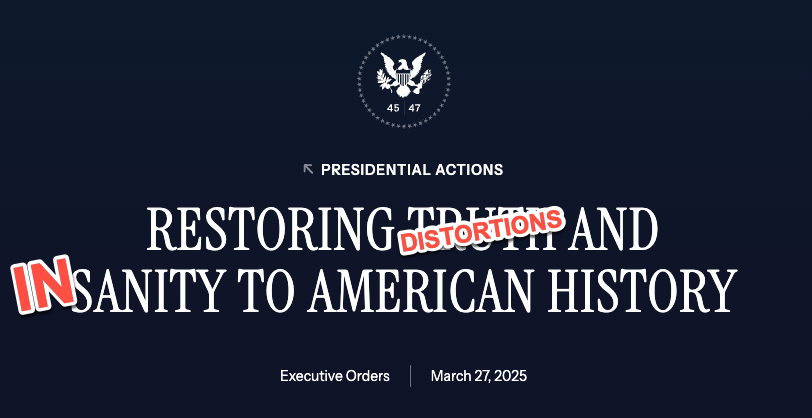
Today, the White House issued an executive order titled “Restoring Truth and Sanity to American History”, which aims to reshape the presentation of history within federal institutions—particularly the Smithsonian. The directive calls for the removal of “divisive or anti-American ideology,” restoration of monuments that have been “improperly removed,” and new restrictions on federally funded exhibits that “degrade shared American values.” While some may see this as a return to patriotic education, as a historian and museum professional, I see troubling implications for our field.

The Illusion of a Single Truth

At the heart of the order is the assertion that a “true” version of American history must be restored. But history is not a static set of facts—it is a discipline grounded in evidence, interpretation, and debate. Historical understanding evolves as new sources emerge, as questions shift, and as voices long excluded are brought into the conversation. There is no single, timeless narrative to return to—only a continuing effort to make sense of the past as honestly and inclusively as possible.

Independence Under Threat

The Smithsonian Institution, like many of our most trusted public history institutions, relies on scholarly rigor and curatorial independence. By assigning Vice President JD Vance a role in overseeing content and linking congressional appropriations to ideological compliance, this executive order politicizes museum interpretation and undercuts professional standards. When history is shaped by political power instead of evidence, public trust erodes.

Continue reading

Preserving History or Playing Politics? Marco Rubio Takes Over National Archives

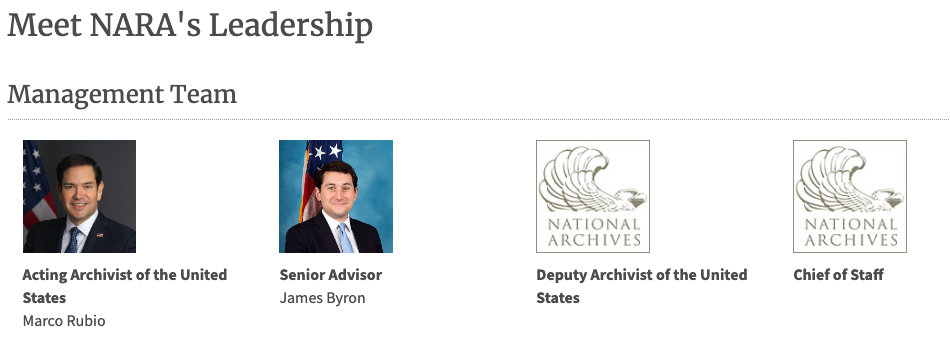
In a significant reshuffling of federal leadership, President Donald Trump has appointed Secretary of State Marco Rubio as the acting Archivist of the United States. This move follows the abrupt dismissal of Colleen Shogan, the former head of the National Archives and Records Administration (NARA), earlier this month. The decision has raised concerns about the potential politicization of an agency traditionally known for its nonpartisan role in preserving the nation’s historical records.

The National Archives has recently been at the center of political tensions, particularly concerning its involvement in the Justice Department’s investigation into President Trump’s handling of classified documents post-presidency. The agency’s referral led to an FBI search of Trump’s Mar-a-Lago estate, culminating in a federal indictment that was later dismissed. In the wake of these events, several senior staff members at NARA have resigned or been terminated, further intensifying debates about the agency’s future direction and independence.

To delve deeper into these developments, the podcast 1A hosted a discussion today titled “The National Archives and the Trump Administration.” The episode explores the implications of Secretary Rubio’s appointment, the recent upheavals within NARA, and what these changes mean for the preservation of America’s historical records. Listeners can access the episode on WAMU’s website.

As the situation continues to evolve, stakeholders and observers alike are closely monitoring how these leadership changes will impact the National Archives’ mission to safeguard the nation’s documentary heritage.

Sources

Gerstein, Josh and Kyle Cheney, “Trump Fires National Archives Chief,” Politico,(February 7, 2025).

 Swenson, Ali and Gary Fields, “The National Archives Is Nonpartisan but Has Found Itself Targeted by Trump,” Associated Press (February 26, 2025).

Beyond the Mill: Clarke County Historical Association’s Model for Modern Historical Programming

The Burwell-Morgan Mill in Berryville, Virginia, which hosts the Art in the Mill shows in fall and spring.

On a recent road trip through the Shenandoah Valley, we passed through the small but charming village of Millwood (south of Berryville, Virginia). With its historic church, a corner gas station turned into a post office, a hip country store, and an 18th-century stone grist mill, it feels like you’ve stepped back into mid-century America. The mill, dating back to the 1780s, ceased operations in 1943, but thankfully the Clarke County Historical Association (CCHA) stepped in to preserve this important piece of local history. They restored and reopened the mill as a museum, offering milling demonstrations that continue to connect the community with its past—a business that, while no longer economically viable, resonates deeply with those of us who value local landmarks.

Fast forward 80 years, and the CCHA not only continues to produce flour at the mill but has expanded its offerings in creative and impactful ways for a county with 15,000 residents. Today, their mission—”to help preserve the historic resources and records of Clarke County and to foster their use, understanding, and enjoyment through stewardship and education”—may sound familiar, but their approach is anything but ordinary. Their programming stands out as a model for how historical societies can evolve, attract diverse audiences, and ensure long-term sustainability. Here’s a preview of some of the exciting events and initiatives they have planned for this fall:

Continue reading

On the Road: Newport Summer School

We’re now at the midpoint of the Newport Summer School and by the end of each day, we all share sore feet and stiff backs—except for Richard Guy Wilson, the director of the program. He may be in his 80s, but he has a bottomless reserve of energy.

Participating in the course are a wide range of interests. We have a couple people who lead historic preservation organizations and a couple more who are in graduate school and getting ready to enter the field. We have a handful who work with historic sites, including Edith Wharton’s The Mount, National Park Service, and Lisbon Cathedral. A couple of interior designers and a few who don’t work in the field but love the art and architecture of the 19th century. Ages stretch from early 20s to late 60s.

The diversity of interests and experiences makes for fun conversations and as several noted, can feel comfortable “nerding out” about a preservation issue or an architectural feature. But I’ve also discovered the value of the program—and it varies. Everyone wants to learn about 19th century architecture in Newport, which has an extraordinary collection by some of America’s best architects and interior designers. The combination of illustrated lectures and field sessions allows us to see a lot in a very short time. For graduate students, it creates a foundation of knowledge that will inform their studies and careers. For mid-career professionals, it provides comparisons for our projects and communities, broadening our perspectives. Perhaps more importantly, it also “feeds our soul,” providing a much needed break from the demands of the office while refreshing our passions.

Today we head north to Providence, starting earlier and returning later than usual, so I expect another exhausting day. But it will be worth it.

Demystifying Spending Patterns in Small Museums

In the world of small museums, location and audience significantly influence expenses, rendering a one-size-fits-all approach ineffective. However, gaining insight into the various types of expenses museums incur can shed light on common challenges and their causes. The non-profit financial Form 990 categorizes expenses into five areas, providing a framework for understanding spending patterns. Our goal is to simplify the concept of museum spending and guide museums toward prudent budget management by exploring these key expense categories.

Continue reading

Untangling the “Other” Revenue Stream

In the colorful tapestry of history-focused organizations, every thread of revenue has a role to play in the success of the organization. Perhaps the most unique collection of these threads is the “Other” revenue category. This singular “Other” thread houses a miscellany of revenue sources that don’t fit into the categories of “Investment Income”, “Program Service Revenue”, and “Contributions and Grants”. At first glance, this classification may appear insignificant, yet it often proves to be a silent contributor that underpins the fiscal health of History-Focused Organizations [Museums (NTEE A50), History Museums (A54), History Organizations (A80), and Historical Societies & Historic Preservation (A82)].

Understanding this “Other” revenue can be like deciphering an ancient dialect. It is made no easier by the fact that IRS Form 990 at times uses the terms revenue and income interchangeably. While some categories of this revenue such as royalties and inventory sales may be familiar, “miscellaneous” often contains difficult to parse odds and ends such as third-party events, insurance proceeds, ATM fees, and revenue from hosting satellite towers. Most often this miscellaneous revenue is unspecified and simply named “miscellaneous” or “other” which can make it difficult to get the full picture of a particular institution’s revenue sources. We advise limiting the classification of your total revenue as “miscellaneous” to no more than 1%. While judicious use of this category can help define your other revenue streams more clearly, overuse could lead to a lack of clarity about a significant portion of your revenue. It is crucial to maintain a comprehensive understanding of your financial situation.

Continue reading

Historic House Museum Summit This Week

This small selection of historic sites operated by The National Society of The Colonial Dames reveals the enormous diversity of house museums and historic sites in the United States.

In 2007, I helped organize the Forum on Historic Site Stewardship in the 21st Century, which resulted in an influential issue of Forum Journal that laid out the major challenges and opportunities, including the need for financial sustainability, a willingness to change in response to the needs of the community, and a balance between the needs of buildings, landscapes, collections, and the visiting public. It also recognized that museum standards may not be the best practices for historic sites and that the profession “must develop new measures, beyond attendance, that document the quality of visitor engagement at sites and the extent of community outreach beyond the bounds of historic sites.”

So what has happened in the 16 years that followed? We’ll find out this week as the American Association for State and Local History hosts a virtual summit on the Sustainability, Relevance, and the Future of Historic House Museums on July 11-12. Sessions will address measuring the impact of house museums, broadening interpretation, care of buildings and landscapes, and the evolution of mission statements.

Continue reading

Impact, Sustainability, and Non-Profit Programs

For small non-profit organizations operating on less than a million dollars annually, programs are often the beating heart of the operation. The best programs balance mission and financial sustainability to serve their audiences. Program revenue (admissions, events, and membership dues) can be a vital means of maintaining financial stability and growth. For History-Focused Organizations [Museums (NTEE A50), History Museums (A54), History Organizations (A80), and Historical Societies & Historic Preservation (A82)] as overall revenue grows, so does the share of program revenue. This means as your organization grows, so should the prominence of your programs as a true revenue driver (see figure 1 below).

As small history-focused organizations expand, it’s crucial to manage their programs wisely to increase income while keeping the mission in mind. For small groups, program decisions can be very personal, often influenced by board or staff interests. Taking a strategic approach to these decisions can boost the organization’s growth and success.

Continue reading

How can History-Focused Organizations Invest in Stability?

Figure 1. History-Focused Organizations command large portions of the museum field’s revenue and institutions. Source: Internal Revenue Services and National Center for Charitable Statistics.

Over the past year, Engaging Places has been looking over individual segments of the museum field. While these segments are unique in specific ways, as demonstrated by the data, several of them do share a common theme and mission: an overall goal to promote history. These four segments are History Museums (A54), History Organizations (A80), Historical Societies & Historic Preservation (A82), as well as the broad Museums (A50) category. By combining these segments we can focus on the history-centric portion of the museum field that makes up close to half of its revenue and consists of a whopping 89% of its institutions (see Figure 1). This block of museums is incredibly dominant within the field and a major focus of Engaging Places’ work. For ease of reference, we will be referring to them as History-Focused Organizations.

It is important to remember that as an aggregate these History-Focused Organizations still trend small. Over 90% operate on less than $1 million in revenue annually, with contributions and grants bringing in over half of that vital revenue. For these smaller museums, financial security is a constant and essential priority. While many of these History-Focused Organizations are unable to achieve large pools of investment to stabilize operations, unlike some of their larger counterparts, they can develop practices to move them in this direction. 

Continue reading