Category Archives: Historical interpretation

Should Tour Guides be Tested and Certified?

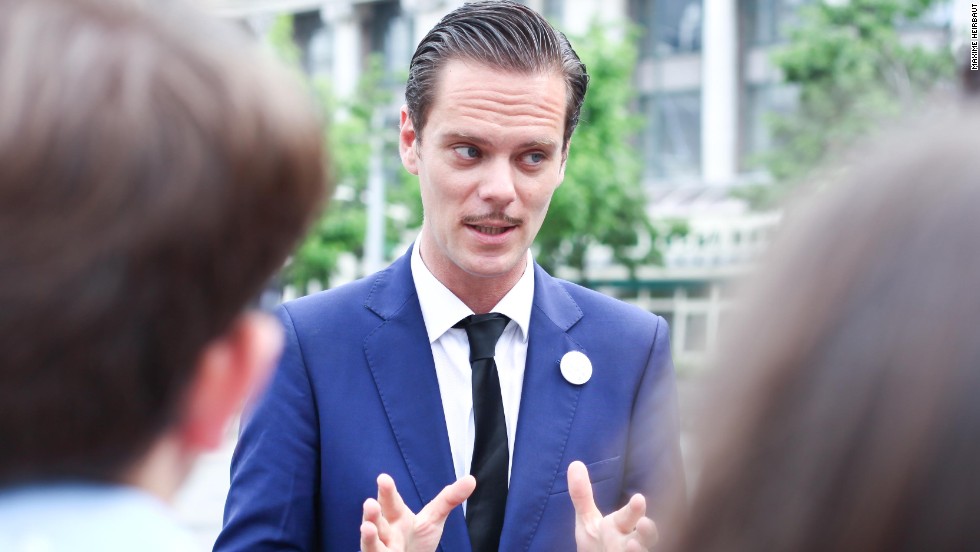
tour-guide-antwerpAt the end of last month, the California Tour Guide Act (AB 836) died in committee in the California State Capitol. If it had passed, it would have established a “tour guide certification program” through the California Travel and Tourism Commission to test and certify persons who “practice tour guiding for compensation” (it would exempt guides who work at museums and amusement parks). The bill’s authors wanted to ensure that tourists “get the most of their visit and return to the Golden State.” It’s also a big business. According to the California Travel Association, the travel industry generated $106.4 billion in revenue from visitors and contributed $6.6 billion in state and local taxes in 2012. In 2013, California hosted nearly 16 million international visitors and is expected to grow at over 5 percent annually through 2016. To support this volume of visitors, nearly one million people work in the travel and tourism industry, including 3,000 tour guides.

We can debate various aspects of the proposed law, such as the $700,000 annual cost to manage the program or the need for a criminal background check, but I was more intrigued by the requirement that tour guides must have completed a “curriculum in California tour guiding and related subjects,” including “tour guide safety and California geography, history, and culture.”  How is that defined?  How is that evaluated?  The proposed law left the standards to Continue reading

Researching the Interpretation of Slavery in Louisiana

Research Trip 2015 MapJames Madison’s Montpelier is in the midst of expanding its interpretation of slavery thanks to a generous gift from David Rubenstein.  To explore potential interpretive techniques and content that could be adopted, we conducted a three-day research trip to visit a wide range of sites in Louisiana. Staff had visited most of the sites in Virginia, and so we sought a location that most of us had not visited but had a large concentration of historic sites that interpreted African American history before emancipation. Because the experience helped us question assumptions, think more deeply about outcomes, and expand our catalog of ideas, I’m sharing our itinerary with you to encourage you to visit. Our research trip started with two days to make a big loop through Baton Rouge and New Iberia to visit several historic sites and finished with a day in New Orleans. In future blog posts, I hope to discuss some of the sites in more detail.

Day 1: Whitney Plantation, Laura Plantation, and Oak Alley.  Our initial plans also included Evergreen Plantation but the timing didn’t work out, even though these sites are within ten miles of each other.

Day 2: West Baton Rouge Museum in Port Allen (near Baton Rouge) and Continue reading

Historic House Workshops for the New Year

Historic House Museum Workshop, Charleston, South Carolina, 2015

Historic House Museum Workshop, Charleston, South Carolina, 2015

If want some time to plan and evaluate what’s happening at your historic site or house museum, one of the best ways is through a workshop. Of course, a long weekend of reflection in the Rockies or Virgin Islands might be more relaxing, but a workshop with colleagues discussing the potential solutions to the challenges facing historic sites will be more effective.

AASLH is offering two workshops this year just for house museums and historic sites, and I’ll be part of both of them:

April 4: Reinventing the Historic House Museum at the Campbell House in St. Louis, Missouri

This one-day symposium is designed to offer current thinking, practical information, and solutions to the challenges facing historic sites. The historic house museum in America is not dead nor are most of them dying. The field, however, needs to take time to reflect and renew as the world around our historic sites continues to change. The symposium will include presentations, discussion, a boxed lunch, historic site visit, and a brainstorming workshop at the historic house museum to try out the new ideas proposed during the symposium. Workshop led by Ken Turino (Historic New England) and Max van Balgooy (Engaging Places). (There may be a second Reinventing workshop offered this year.)

April 28: Historic House Museum Issues and Operations at Brucemore in Cedar Rapids, Iowa

Why are historic houses necessary to their communities? How are historic house museums unique? This workshop focuses on the special needs, management, and interpretation of historic houses. With a focus on historic house museums, topics covered include collections care, types of research appropriate for historic house museums, exhibition development, interpretive tours, volunteers, and building and landscape maintenance. Workshop led by George McDaniel (Drayton Hall) and Max van Balgooy (Engaging Places).

Can’t attend these workshops but are still looking for a shot in the arm? Join one of the quarterly Historic House Calls. Every call explores a different topic with an expert, and they’ve previously discussed deaccessioning, tours, interpreting race, and environmental sustainability.

AASLH has nearly two dozens way to sharpen your skills with some of your smartest colleagues in the history field and you’ll find a continually updated list on their calendar of events.

Reinventing Historic Houses in National Parks

This slideshow requires JavaScript.

Earlier this week I led a workshop on reinventing historic house museums at two great National Parks—Marsh-Billings-Rockefeller in Vermont and Saint-Gaudens in New Hampshire—with Ken Turino of Historic New England. The National Park Service and the American Association for State and Local History co-sponsored this workshop to help their staff rethink the tours of the historic houses at these two sites, especially for visitors under 35 years of age. Using such tools as the Five Forces and a Double-Bottom Line Matrix along with a smorgasbord of ideas from other sites, we explored possible processes and projects that could improve and enhance their tours.  Our goal wasn’t to provide solutions but to raise many useful questions, including: Continue reading

Creating a 21st Century House Museum in San Francisco

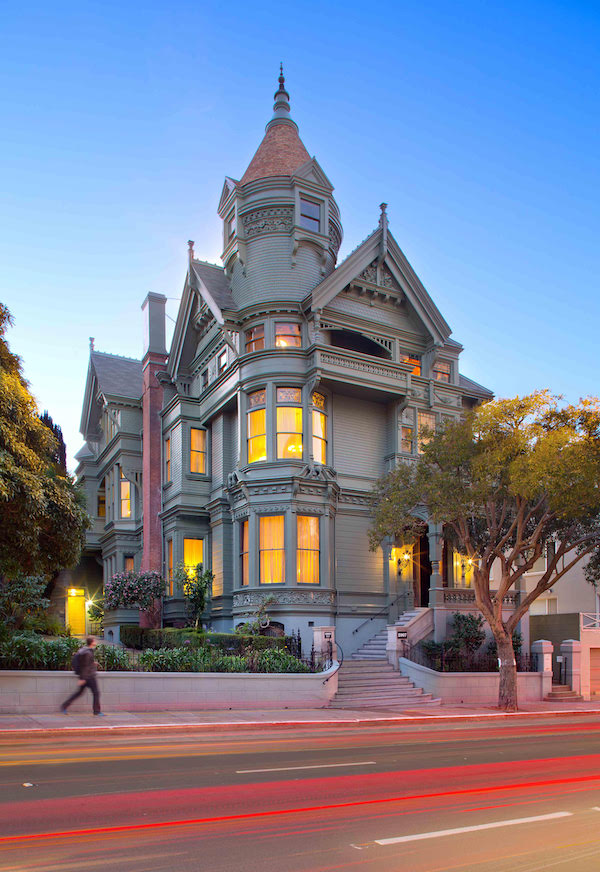
Haas-Lilienthal House, San Francisco.

Haas-Lilienthal House, San Francisco. Courtesy of San Francisco Heritage.

Over the past two years, I’ve been working with San Francisco Heritage to explore how the Haas-Lilienthal House, the 1887 Queen Anne house it owns and operates in the Pacific Heights neighborhood, can engage the public and advance its citywide mission in ways that are both environmentally and financially sustainable.

Just as the Haas-Lilienthal House was rocked by a tremendous earthquake in 1906, so are historic sites today, although in a different manner. The economic downturn that began in 2008 threatens many preservation organizations, house museums, and historic sites, even those that have large endowments and attendance. But the change is bigger than the latest economic recession. Surveys over the past thirty years by the National Endowment for the Arts show that visitation rates at historic sites have fallen from 37 percent in 1982 to 25 percent in 2008, and that rate of decline has only accelerated in the last decade. The Haas-Lilienthal House is experiencing a long and steady decline in attendance—it’s fallen by more than 50 percent over the past thirty years. Historic sites not alone, however: concerts, dance performances, craft fairs, and sporting events have all seen similar declines in attendance.

As a result, many historic preservation organizations around the country are questioning the value of owning historic property. Guided tours and public programs do not generate sufficient revenue to properly maintain historic sites, so unloading them seems to be the only solution. But there are also significant disadvantages.

When a preservation organization owns an historic building, it instantly conveys credibility. (Would you trust a surgeon who has never held a scalpel?) Secondly, by owning and caring for an historic property, Continue reading

Unconference in DC Poised to Transform Museums


Openlab is convening an unconference, talks, and a planning workshop in Washington, DC on December 1-2 to “to accelerate the speed and impact of transformational change in the GLAM (gallery, library, archive, and museum) sector” in order to “to increase and disseminate knowledge; to encourage civic dialogue and engagement; and to support individuals in their right to access and participate in culture.”  The brain child of Michael Peter Edson of the Smithsonian, much of OpenLab’s work seems to be focused on using digital technologies to solve age-old questions, such as “what needs to change in galleries, libraries, archives, and museums?” and “what is missing in the current funding and support landscape for GLAMs and the humanities?”  It’s all a bit nebulous and unclear, but that’s the core nature of an unconference. Nevertheless, it’s one of many concurrent efforts to increase the impact of museums in society (and yes, we’re still in the fragmented stage).

The first day on December 1 (today) is the unconference and a series of Ignite talks from 2-7 pm in Arlington, Virginia that’s free and open to the public.  The second day, however, Continue reading

President Lincoln’s Cottage Tackles Immigration

This slideshow requires JavaScript.

President Lincoln’s Cottage, the presidential summer retreat just a few miles north of the US Capitol, recently opened an exhibit in their visitor education center the compares immigration issues in the 19th century to the present day.  Titled, “American by Belief,” the introductory label reads:

The United States of America is, and always has been, a nation of immigrants. Abraham Lincoln recognized immigrants as one of America’s greatest resources and its best hope for the future. He believed America, in return, owed immigrants the full realization of its founding promises and a fair chance to succeed.

Our world is different than Lincoln’s. But what continues to bring immigrants here would look familiar to him: an opportunity to rise higher, improve themselves, live safely under the rule of law, become citizens, and count themselves as American by right of belief.

This is a small temporary exhibit, perhaps 200 square feet at most, and primarily consists of panels featuring text and images (no historic objects).  In the center of the room is a map of the world made of pegs, which visitors can use to link places associated with them using colored rubber bands (this looks cool but I’m not sure Continue reading

Taliesin West releases Preservation Master Plan

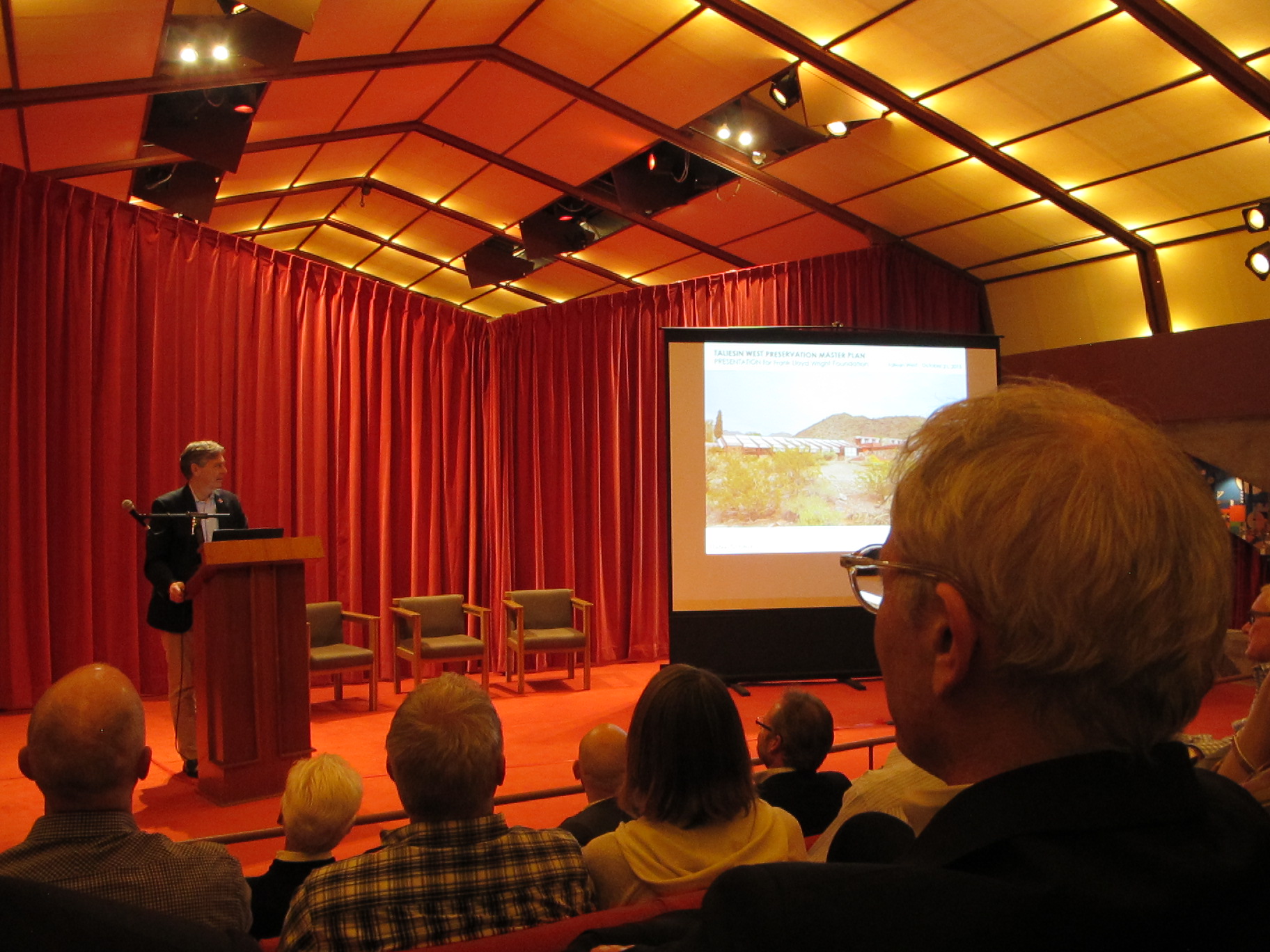
Gunny Harboe discussing the Preservation Master Plan for Taliesin West.

Gunny Harboe discussing the Preservation Master Plan for Taliesin West.

The Frank Lloyd Wright Foundation recently released the Preservation Master Plan for Taliesin West, a National Historic Landmark, which was established in 1937 as Frank Lloyd Wright’s winter home and studio, and the campus of the Frank Lloyd Wright School of Architecture. As part of the Bruce Brooks Pfeiffer lecture series, T. Gunny Harboe, preservation architect and founder of Chicago-based Harboe Architects, and the plan’s primary author, will present the major points of the Taliesin West plan on Monday, November 16 at 6:30 p.m. at the Museum of Modern Art in New York City.  The lecture is free and reservations are not required.

I had an opportunity to use with the Preservation Master Plan as part of the interpretive planning work I’m doing at Taliesin West and it was immensely helpful in clarifying the significance and integrity of the many buildings at the site through a set of tiered levels: Continue reading

AASLH Annual Meeting Provokes Historical Thinking

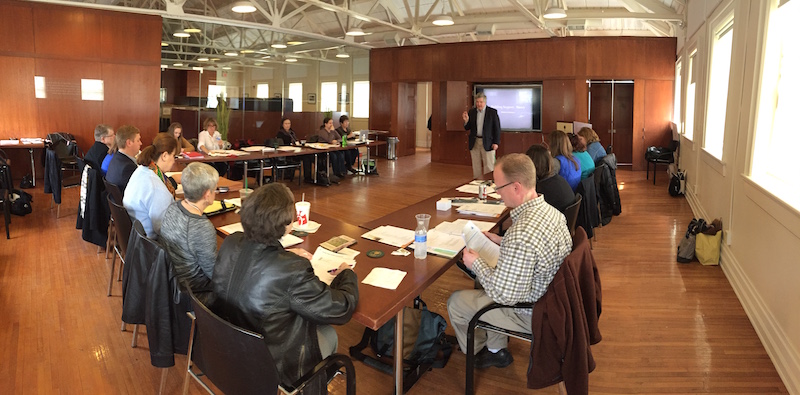
Tim Grove facilitating a lively conversation about historical thinking at the AASLH Annual Meeting in 2015.

Tim Grove facilitating a lively conversation about historical thinking at the AASLH Annual Meeting in 2015.

The annual meeting of the American Association for State and Local History always offers a good mix of educational sessions, social events, and opportunities to visit museums and historic sites around the country.  This year, Sam Wineburg, a Stanford University professor and author of Historical Thinking and Other Unnatural Acts (2001), prompted an ongoing discussion with his plenary address on the first day of the annual meeting.  Through his research on students and scholars, he showed that the analysis of historical documents is a sophisticated skill that isn’t apparent to most people (and I can confidently say this also applies to objects, buildings, and landscapes).  He went on to argue that teaching people to think historically isn’t about teaching history but making them better citizens.  John Dichtl, president of AASLH, discusses this further on the AASLH blog.

These ideas were pursued the next day at a packed session facilitated by Tim Grove of the National Air and Space Museum.  Using excerpts from Wineburg’s book, Tim encouraged a lively dialogue that allowed me to report out 15 Tweets, including:

  • Historical thinking: multiple perspectives; analysis of sources; context; and based on evidence.
  • Are we underestimating visitors if we don’t give them oppty to debate ideas & issues at museums/historic sites?
  • Debates always happen, but history gets flattened over time. Build multiple perspectives, uncertainty, & questions into exhibits.
  • Asking good provocative questions is a skill. Learn more at the Right Question Institute.
  • Challenge for marketing & communications staff about handling provocative topics in social media era.
  • Are museums & sites imposing their ideology on visitors? Have we become arrogant? Do we need to learn about visitor interests?

which resulted in 31 favorites and 20 retweets.  Just to be clear, these ideas didn’t come from me but from the persons gathered in the room.  I could have tweeted out many more but I couldn’t listen and type them out quickly at the same time.

If you weren’t able to attend, there’s next year in Detroit.  In the meantime, enjoy these snaps from the recent meeting in Louisville (and thanks to everyone at the Kentucky Historical Society for being such gracious hosts).

This slideshow requires JavaScript.

Wireless Audio Guides and Digital Donor Board at MIM

Last week I visited the huge Musical Instrument Museum (MIM) in Phoenix, Arizona and spent four hours just walking through the exhibits.  Whenever I visit a historic site or museum, the first thing I often do is just walk through the entire place to get an overall sense of its organization, design, and content, rarely stopping to read labels or watch videos.  At MIM it took four hours.  Thank goodness for the cafe.  I haven’t seen so many guitars, violins, drums, or bagpipes in my life, but I guess that’s the point.

Along the way I spotted a couple unusual interpretive and fundraising techniques that caught my eye that might interest you:

This slideshow requires JavaScript.

1.  MIM has the usual big donor walls in the lobby but next to the exit door, they have a colorful digital version for current donors along with an eye-catching donation box.  The big touch screen is divided into two sections: the top half has announcements for upcoming events and volunteer opportunities and the bottom half has a scrolling list of donors for the last twelve months.  Because it’s digital, it can be easily updated (but of course, requires someone with IT skills for maintenance).  A navigation bar lets you choose the donor category by size of gift from $250 to $5 million+.  Next to the digital display is a donation box featuring the shiny silver bell of a sousaphone with the message, “Blown Away? Join Our Band of Donors” and a window so you can see your money fall inside.  I bet this encourages kids to drop their change (or encourages kids to tell their parents to drop a dollar).  Clever eh?  And notice there’s nothing else around it–no clutter of chairs, signs, or plants to keep visitors focused on support as they leave the museum.

This slideshow requires JavaScript.

2.  Interpretation at MIM relies heavily on wireless headsets that are automatically activated as you approach an exhibit.  The headsets consist of a pair of light headphones connected to a Sennheiser GuidePORT device, which is slightly larger and heavier than the old classic iPods.  The device controls volume, holds a rechargeable battery, and contains the antennae that receives the audio in the exhibit.  Most of the exhibits have a monitor showing a series of short videos of musical performances or a demonstration of their manufacture.  The videos cycle continuously and when the visitor comes within about ten feet, the headset connects to the audio. When you finish watching a video, you can take a couple steps, and watch a different video on another monitor without touching the device or punching in a number.  The exhibits can be packed tightly with video screens without worries about sound bleed and turning the exhibit galleries into a cacophony of sounds.  However, it wasn’t perfect.  About five percent of the time it wouldn’t connect to the video and I had to watch it in silence (and when it’s a musical performance, a silent video isn’t very helpful).  Secondly, visitors (especially kids) occasionally dropped their devices. Every time I heard the smack on floor, I cringed.  The admission desk provides lanyards to hang the audio system around your neck, but not all visitors use them. Sigh.