Category Archives: Historical interpretation

Campbell House using Simple and Durable Interpretive Tools

This slideshow requires JavaScript.

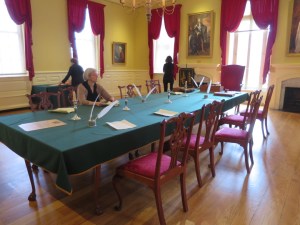
When I recently visited the Campbell House Museum in St. Louis, I was really impressed by their use historic images and documents throughout the tours.  It wasn’t just that they were integrating lots of different historic materials into the tours (that’s always a good practice), but they looked great.  In the entry hall, a couple 16″x20″ historic maps on the wall put the house in a historical context.  In the parlor, a stand held an assortment of historic photos on lightweight boards, which the docent passed around so that visitors could examine them more closely.

They were clearly modern so there was no confusion you were handling something historic and the docents could easily use them because they were so simple and light.  They were easy to examine because the matte surface reduced glare from the sun and lights. But what really surprised me is that they were more than ten years old—they looked brand new!  No edges were peeling and the images hadn’t been worn out or bent by the constant handling.  Even better, they were cheap to produce—about $8-10 per square foot by a local sign maker. These are so much better than laminated or framed interpretive tools I’ve seen and used elsewhere.

If you’re interested in creating these for your site: Continue reading

St. Louis’ new Blues Museum Needs More Artifacts (and Music)

National Blues Museum, St. Louis, Missouri.

National Blues Museum, St. Louis, Missouri.

In April, I had a chance to visit the newly opened National Blues Museum in St. Louis, Missouri while I was in town to lead a workshop with Ken Turino of Historic New England.  As the “only museum dedicated exclusively to preserving and honoring the national and international story of the Blues and its impact on American culture in the United States,” its mission is “to be the premier entertainment and educational resource focusing on the Blues as the foundation of American music.”  Those are pretty bold claims and we’ll have to give them some time to see if they can achieve them.  In the meantime, I wanted to share my initial reactions to the primary permanent exhibit designed by Gallagher & Associates of Silver Spring, Maryland (near my hometown!), who also designed exhibits for Mount Vernon, Gettysburg Visitor Center, and Jamestown Settlement Museum.

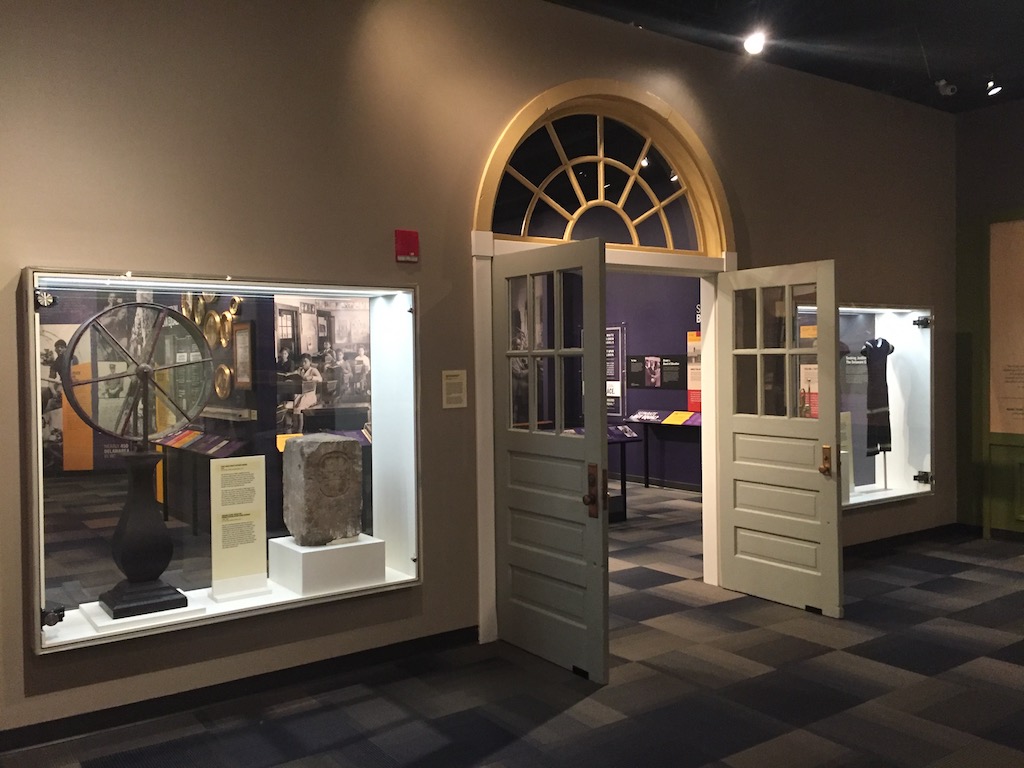
Housed in a former historic department store near the city’s downtown convention center, the bold use of panels filled with text, images, video, textures, and colors as well as a strong horizontal lines that pull you through each space, make it a compelling and attractive design. Indeed, it’s so effective that it didn’t strike me until about halfway through that the exhibit feels two-dimensional and there are hardly Continue reading

History Relevance Campaign meets at Smithsonian

I’ll be at an all-day workshop today at the Smithsonian’s National Museum of American History to discuss the work of the History Relevance Campaign with representatives of two dozen national organizations, including the Library of Congress, National Archives, National Endowment for the Humanities, National Park Service, American Historical Association, American Alliance of Museums, National Coalition for History, National History Day, National Humanities Alliance, and National Governors Association.  We’ll use our work on the values of history, impact project, and research on popular attitudes towards history to discuss where the campaign should go next and how they might get more involved (most of these organizations have already endorsed the values statement).  I’m not sure what the results will be but you can follow along on Twitter at #historyrelevance.

Interpreting Slavery at Historic Sites Workshop on May 25

George Mason's Gunston Hall, Virginia.

George Mason’s Gunston Hall, Virginia.

George Mason’s Gunston Hall in Virginia will become a hands-on laboratory to explore how to create a comprehensive and conscientious interpretation of slavery at an historic site at a one-day workshop on Wednesday, May 25, 2016 from 9:30 am to 6:30 pm (right before the AAM annual meeting).  You’ll learn how to better connect and extend your site’s interpretation of its history of slavery and help staff and volunteers achieve a greater understanding of difficult knowledge and complicated emotions.  Registration is $90 and includes morning refreshments, lunch, and a post-workshop reception.  For more details and to register, visit http://bit.ly/SlaveryWorkshop.

The workshop will be led by Kristin Gallas, co-editor of Interpreting Slavery at Museums and Historic Sites and includes presentations by Continue reading

Latest National Research on Technology in the K-12 Education (with Tips for Historic Sites)

"From Pixel to Print," the 2015 report on the use of technology in K-12 education.

“From Pixel to Print,” the 2015 report on the use of technology in K-12 education.

Project Tomorrow, a nonprofit organization focused on education, just released a national study on the use of technology by teachers and students called, “From Print to Pixel: The Role of Videos, Games, Animations, and Simulations within K-12 Education.”  For the past thirteen years, Project Tomorrow has provided these annual “Speak Up” research reports to help schools and elected officials (and I’m including museums and historic sites) better understand the trends in technology in the K-12 education field. This year’s report incorporates responses from 415,686 K-12 students, 38,613 teachers and librarians, 4,536 administrators, 40,218 parents and 6,623 community members representing over 7,600 schools and 2,600 districts in the United States and around the world.


From “Print to Pixel” highlighted these major findings: Continue reading

Challenges Facing Historic House Museums: A Report from the Field

AASLH Historic House Management Workshop at Brucemore in 2016.

AASLH Historic House Management Workshop at Brucemore in 2016.

At the annual AASLH workshop on historic house museum management, we always start by asking participants about the biggest or most important challenge they are facing at their historic site.  For the participants, the exercise allows them to get to know each other beyond a name by recognizing the issues they may have in common.  As the instructors, It’s an opportunity for George McDaniel and me to ensure we address their concerns.  For AASLH, it’s a way of keeping a finger on the pulse on what’s happening in the field.  At the end of the workshop, we review the list and provide some time for participants to develop a plan to address their issue.  As a reminder, they also fill out self-addressed postcards with a message to themselves, which I’ll mail to them in six months.

So that you can keep your finger on the pulse of the field, here’s the list of issues and challenges from the Cedar Rapids workshop at Brucemore, which included participants from Iowa, Minnesota, Nebraska, and Illinois: Continue reading

Video: Detour’s High-Tech Audio Tours Come to Museums

Groupon founder Andrew Mason guides Casey Newton of Verge through the San Francisco Museum of Modern Art using the latest version of Detour, a location-based outdoor audio tour app that now works indoors as well.  Through your smartphone, Detour knows your location in the museum and presents the artworks in that specific gallery along with the associated audio recordings so you can wander (giving you the right information in the right place), as well as 15-30 minute “walks”.  Parts of this Verge video are silly and the background music too loud, but it looks like smartphone technology now has the capability to be used at historic sites for self-guided tours of the buildings, landscape, and neighborhood in a way that’s more flexible and responsive to visitor interests.

The video below is a better explanation of Detour’s ability to “automatically guide you as you walk, almost like you’re there with a real person”.  It debuted last year with ten Detours of San Francisco (including architecture) at $4.99.

Tackling Challenges for Historic Sites in St. Louis

This slideshow requires JavaScript.

Last week, Ken Turino of Historic New England and I gave a one-day workshop on reinventing historic house museum in St. Louis, Missouri for the American Association for State and Local History.  It was a sold-out workshop with more than 50 people participating, mostly from the St. Louis region, so it was a great opportunity to meet so many of our colleagues, including a couple places who were starting new house museums (glad to have people learning about this specialized field before they open the doors!).  A big thanks to Andy Hahn at the Campbell House for hosting the workshop and to the St. Louis Public Library for allowing us to meet at the historic Central Library.

Ken and I continue to refine the workshop based on the evaluations we receive from the participants, and one of the elements we added to the beginning of the workshop is asking, “What is the biggest challenge facing your house museum?” and “What needs to be reinvented at your historic site?”  Here are some of the responses we received: Continue reading

Video: “Every Student Succeeds Act” Overview

In this 3:38 video, Education Week’s Alyson Klein provides an overview of the changes brought by the Every Student Succeeds Act (ESSA), which replaces No Child Left Behind (NCLB) in the 2017-18 school year.  Responsibilities for performance, curriculum, and testing shift from the federal government to the states.  For museums and historic sites, that means that your local school district may be adopting new standards of learning, which could prompt you to revise your school programs.  States are required to adopt “challenging” academic standards, which could be Common Core but it isn’t required.  For more details, take a look at Education Week’s written summary or the analysis in The Atlantic.


Looking for Exhibit Ideas? Check Out These Online Files

Exhibit Files 2016Looking for an idea for an upcoming exhibit? Need some alternatives for an interactive activity? Want to know if anyone else has installed an outdoor exhibit at a bus station? You’ll want to explore “Exhibit Files,” a free online collection of exhibition records and reviews for exhibit designers and interpretive planners.  The Association of Science-Technology Centers launched this website in 2007 with funding from the National Science Foundation, but despite those affiliations, you’ll find plenty of files related to history, including a case study of Lewis & Clark (the national Bicentennial exhibition); a review of Terror House in Budapest by Daniel Spock of the Minnesota Historical Society; and a case study of a low-tech document-based interactive exhibit at the Missouri State Archives. Because most exhibit techniques can be used with any subject, you can adapt many ideas for your specific needs. The files can be searched by title, date, tag, or topic (such as history or architecture).   And if you have an exhibit experience to share or you’re looking to solve a problem, you can join for free and become one of the nearly 3,000 members.