Category Archives: Historical interpretation

WebWise 2012: Learning and Participation on the Move

WebWise 2012 in Baltimore.

It’s been a couple weeks since the WebWise conference in Baltimore, but the information hasn’t gone stale yet.  It’s still cutting edge and thought-provoking because most of the projects discussed are still underdevelopment and it’s unclear if they’ll succeed or not.  However, they do provide a glimpse of current and potentially future practices in the use of technology for historic sites. The webcast videos are now available except for LeVar Burton’s presentation, which is waiting for broadcast permission. Heritage Preservation will be using portions of the webcasts to create webinars that will be available later this summer including, “Crowdsourcing in Public History” and “Oral History in the Digital Age.”

The first panel session, History Places and Spaces:  Learning and Participation on the Move, was moderated by Nancy Proctor and looked at the ways that mobile technologies (that is, technologies that are aware of your location) can provide new and better experiences for visitors.

Rob Stein at the Indianapolis Museum of Art opened the session by stating that the field already recognizes that location should be a required element in basic content but the challenge is the proliferation of software and hardware platforms.  Every digital device (website, cellphone, tablet) seems to be in a unique format and requires special treatment.  To overcome this, Stein suggested we rethink Continue reading →

NEH Announces Recent Awards

The National Endowment for the Humanities recently announced the awards for the applications submitted in August 2011 (yes, 2011) for the “America’s Historical and Cultural Organizations” grant program.  Out of the 25 major grants awards (I’m not including the small NEH on the Road grants), about a third are related to historic places including:

El Presidio de Santa Barbara State Historic Park Visitor Center Plan

  • Santa Barbara Trust for Historic Preservation, Santa Barbara, CA
  • Award: Outright; $40,000
  • Planning for interpretive exhibitions and programs in a newly constructed visitor center about the history of Santa Barbara.

Impressions of a Lost World

  • Pocumtuck Valley Memorial Association, Deerfield, MA
  • Award: Outright; $40,000
  • Planning for a website, mobile applications, hand-held digital and print tours, public programs, and educational materials about the early nineteenth-century discovery of dinosaur tracks in the Connecticut River Valley and the impact of this discovery on American thought and culture.

Continue reading →

Interpreting African American History if You’re NOT African American

Session on Interpreting African American history and culture, AASLH annual meeting, 2012

Last September, I had the privilege of moderating a session on interpreting African American history at historic sites in a room filled with some of the smartest people in the field during the annual meeting of the American Association for State and Local History.  The panelists–George McDaniel, Pam Green, David Young, and Tanya Bowers–gave outstanding opening remarks but even more engaging was the discussion that followed with the audience.  Because African American history can be a sensitive topic and to demonstrate a way to confront these issues among a group of strangers, I used a technique drawn from Great Tours (page 117).  Each person in the audience was given a 3×5 card and was asked to anonymously complete the sentence, “I would feel more comfortable talking about African American culture and history if…”  Among the responses I received were: Continue reading →

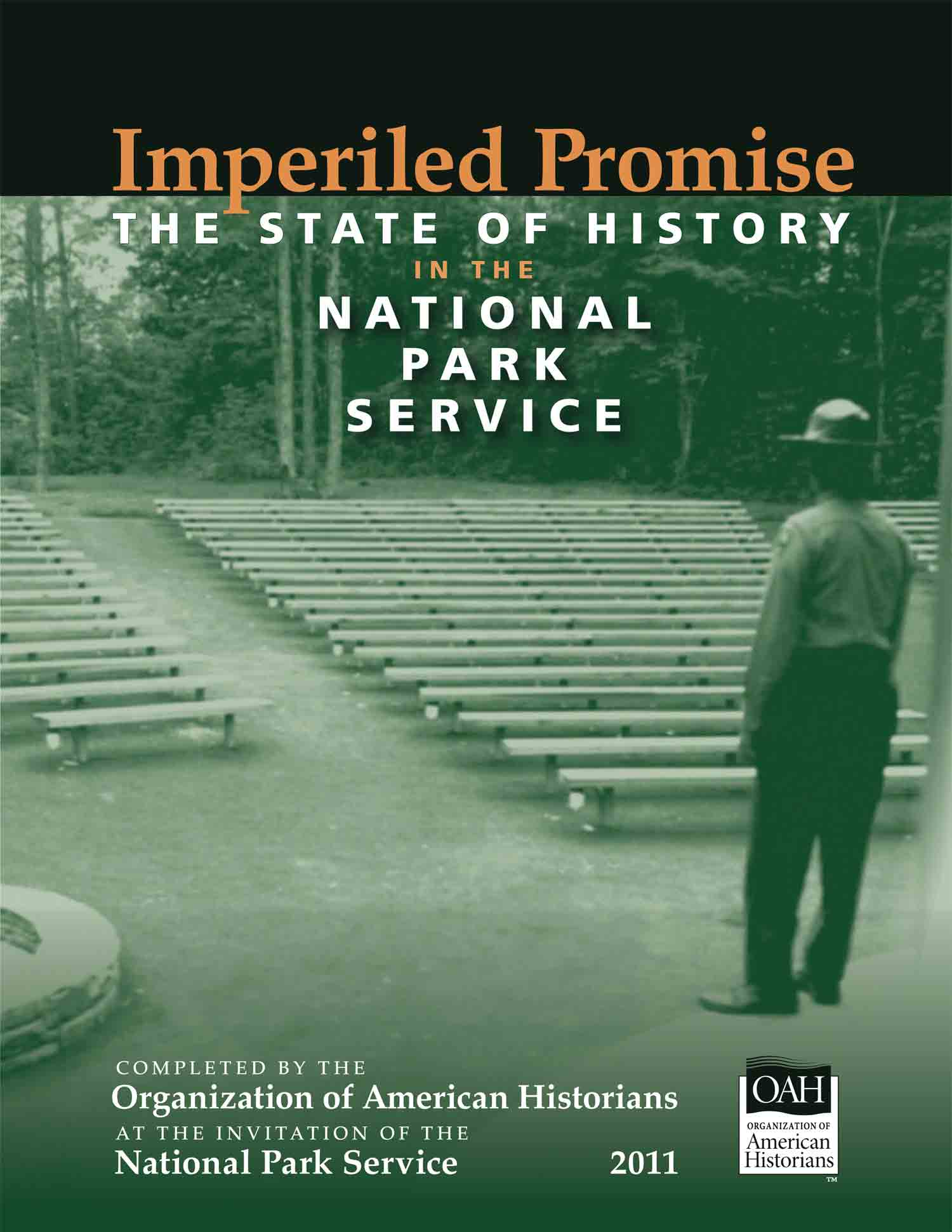
OAH Report Claims History is Imperiled at National Parks

The Organization of American Historians recently completed an evaluation of the “state of history” at the National Park Service.  Four prominent historians–Anne Mitchell Whisnant, Marla Miller, Gary Nash, and David Thelen–led the study, which was based on more than 500 staff responses to an online survey, interviews with current and former staff, site visits, discussions at national meetings, and a review of past studies and reports.

Their analysis revealed that much good work is going on in such areas as reinterpreting slavery and the Civil War, negotiating civic engagement, sharing authority, developing interdisciplinary partnerships, encouraging conversations about history through new media, and collaborating with historians in colleges and universities.  These are presented through a dozen profiles of projects at such National Parks as Manzanar, the Olmsted Center for Landscape Preservation, San Antonio Missions, Harpers Ferry, and the Martin Van Buren National Historic Site.

Although they discovered that good work is being done in a few places, it is not “flowering on the whole” due to several intertwined issues.  Most significant is the report’s contention that, “the agency as a whole needs to recommit to history as one of its core purposes, and to configure a top-flight program of historical research, preservation, education, and interpretation so as to foster effective and integrated stewardship of historic and cultural resources and places and to encourage robust, place-based visitor engagement with history.”  These concerns are presented as a dozen findings, and from my observations, many also reflect what’s happening at historic sites outside of the National Parks.  For example:

  1. The History/Interpretation Divide.  The intellectually artificial, yet bureaucratically real, divide between history and interpretation constrains NPS historians, compromises history practice in the agency, and hobbles effective history interpretation. The NPS should find and take every opportunity to reintegrate professional history practice and interpretation. [In museums, this is comparable to the tensions found between curators and educators, where those who conduct research are often separated from those who teach.]
  2. The Importance of Leadership for History.  Without visionary, visible, and respected leadership at the top, and Continue reading →

Teaching History Without Textbooks? Stanford Proves It’s Possible.

In 2008, Stanford University introduced “Reading Like a Historian,” a non-traditional history curriculum to five schools in the San Francisco Unified School District.  According to Sam Wineburg, who directs the Stanford History Education Group and has been a longtime proponent of revising the teaching of history, “We need to break the stranglehold of the textbook by introducing students to the variety of voices they encounter in the past through primary sources.”  It seems this new curriculum is doing that and more, as recently reported in Futurity:

There are no orderly rows of desks in Valerie Ziegler’s 11th-grade history class—students sit in groups of three or four at small tables around the room. There also is no lectern because there are no lectures. And perhaps most striking, there are no textbooks.

These students at Abraham Lincoln High School in San Francisco learn about the Vietnam War, women’s suffrage, civil rights, the Great Depression, and other major events in U.S. history by analyzing journal writings, memoirs, speeches, songs, photographs, illustrations, and other documents of the era.

“I always tell my students they’re historians-in-training, so the work we do in here is that of a historian,” Ziegler says.

That sounds like fun, but does it have any impact? Continue reading →

Historian Named One of the the Year’s Top Tech Innovators

The Chronicle of Higher Education just named Dr. Daniel Cohen one of academia’s top Tech Innovators for 2012 for his innovative approaches to employing digital tools in research and teaching.  Is he a computer scientist, business professor, or cognitive psychologist?  Nope, he’s an historian of 19th century science and religion, not a typical place where you’d expect to find someone on technology’s cutting edge. Nice to turn the tables on those who believe history is just about the past and has little to offer the future.  Think again.

Dan Cohen is an associate professor in the Department of History and Art History and director of Roy Rosenzweig Center for History and New Media at George Mason University in Virginia. He is the co-author of Digital History: A Guide to Gathering, Preserving, and Presenting the Past on the Web (University of Pennsylvania Press, 2005), author of Equations from God: Pure Mathematics and Victorian Faith (Johns Hopkins University Press, 2007), and has published articles and book chapters on the history of mathematics and religion, the teaching of history, and the future of history in a digital age in journals such as the Journal of American History, the Chronicle of Higher Education, and Rethinking History.  If that isn’t enough, he is an inaugural recipient of the American Council of Learned Societies’ Digital Innovation Fellowship.

To learn more about the work being done by Cohen and others at the center to preserve history through the use of digital media, read “Presenting and Preserving the Past Through Digital Media” in Mason Research and “A Digital Humanist Puts New Tools in the Hands of Scholars” in the Chronicle of Higher Education.

WebWise Attracts 400 Museums, Libraries, and Research Orgs

This slideshow requires JavaScript.

This week I was fortunate to spend two days in Baltimore with 400 persons representing museums, libraries, archives, and research organizations from 40 states at WebWise, the annual conference hosted by the Institute of Museum and Library Services.  This is always one of my favorite conferences and despite a rapid sell-out, I was able to snag a seat.

There seems to be a growing number of history museums and historic sites attending WebWise, and perhaps that’s due to increased recognition that digital technologies are no longer a fad but an essential part of a successful organization (indeed, one of the presenters remarked that staff with technology in their titles are rising up to senior levels with more frequency).  Among the history organizations represented this year are the American Continue reading →

KCET Launches Online Neighborhood Field Guides

The Highland Park Field Guide by KCET.

KCET, a public television station based in Los Angeles, has been working for the last few years on Departures, a project designed to engage “community residents, non-profit organizations, schools and students, in the creation and procurement of relevant and relatable content.”  Included in this work are a series of online interactive field guides to various neighborhoods in their region, and most recently launched is one on the historic community of Highland Park (which features the Lummis House, Heritage Square, and the Southwest Museum).  Given that KCET is one of the major public tv stations in the nation, the field guides are beautifully produced and include lots of video.

According to Kelly Simpson, associate producer of the KCET Departures, “The Highland Park Field Guide was produced in partnership with the Highland Park Heritage Trust and the North Figueroa Association. In six categories (with two more coming soon) we feature fun, informative and adventurous activities for Continue reading →

Field Trip: Homestead Museum in California

This slideshow requires JavaScript.

Last week I had a chance to visit with my colleagues at the Workman and Temple Family Homestead Museum in the City of Industry, California.  I was the assistant director there a decade ago and it continues to be a special place to me (if you haven’t visited, it has great architecture and a great story).  After a generous lunch with the staff, director Karen Graham Wade and some of her staff took me to see the Workman House, the earliest house on the site.  It’s undergoing extensive interior rehabilitation to make it more suitable and attractive as an exhibit gallery.  It’s part of a major effort to respond to the changing interests of their visitors by increasing the self-guided experiences.  They are also reducing the number of days per week the Homestead Museum will be open for walk-in public tours and  increasing the number of days they’ll be open for tours by appointment and for other activities.  At La Casa Nueva, the second house on site, they are Continue reading →

A Great Conference for Historic Sites Coming Up in April

The Organization of American Historians and the National Council on Public History are combining their annual meetings this year and this double-header is creating a really interesting conference for people who are working to preserve and interpret historic places.  Here are just a few sessions that caught my eye (and just a few–there are more than 200 sessions offered over five days):

  • Museum and Makers:  Intersections of Public History and Technology Buffs from Steam Trains to Steampunk
  • Museums, Historic Sites, and the University:  Public History Projects and Partnerships in the American Indian Great Lakes
  • The Witness Tree Project:  Using Historic Landscapes to Explore History and Memory
  • Toward a Reinterpretation of the Indian Wars at National Historic Sites and Parks
  • Closing Up Shop:  Strategies for Partners and Communities When Historic Sites Close Continue reading →