Category Archives: History

Join Today’s Museum People Call on Interpreting Christmas at Museums!

Are you ready to explore how the holiday season can transform your museum? Today at 12 pm Central Time (1 pm Eastern), the Illinois Association of Museums is hosting its monthly “Museum People Call”, and this month’s topic is Christmas at Museums and Historic Sites!

I’ll be joined by Ken Turino, my co-editor of the new AASLH book series Interpreting Christmas at Museums and Historic Sites, to discuss how your organization can leverage the holiday season to its fullest potential.

We’ll cover key topics to help you:

  • Leverage the holiday season to attract visitors and engage your community.
  • Increase financial stability through creative programming, gift shop sales, and end-of-year giving campaigns.
  • Enhance cultural sensitivity and inclusivity, ensuring your holiday interpretation is meaningful and welcoming to diverse audiences.

Whether your site has a long history of holiday programming or you’re just starting to explore the possibilities, this session will offer practical tips and inspiring ideas to align holiday traditions with your mission.

🎄 Join Us on Zoom 🎄
Click here to join the meeting
Meeting ID: 861 3328 4346

Let’s come together to make the holiday season brighter, more inclusive, and impactful for your museum and its visitors. We look forward to seeing you there!

PS. On Wednesday, December 25, the Gilded Age and Progressive Era podcast will release an interview about the Interpreting Christmas book with me, Ken, and Lenora Henson, formerly director of the Theodore Roosevelt Inaugural Historic Site in Buffalo, New York.

Learning Outcomes for the Semiquincentennial

In a previous post, I offered a detailed guide on using the “Verbs for Significant Learning Outcomes” framework. However, I find that many people benefit from concrete examples, particularly when it comes to the deeper learning experiences—the “yellow” ones related to the human dimension, caring, and learning how to learn.

As a case study, let’s use the “Unfinished Revolutions” theme from the Making History at 250: The Field Guide for the Semiquincentennial:

In the United States, the fight for liberty, equality, and justice has a long and complex history. Through formal politics, grassroots organizing, boycott, protest, litigation, war, and a wide range of other mass and individual actions, people have continually challenged America to live up to our highest ideals—often drawing on ideas expressed in our founding documents. Before, during, and after the Revolution, people have fought for their rights to life, liberty, and the pursuit of happiness and worked tirelessly to secure the blessings of liberty for themselves and their posterity. This history is not a consistent march of progress, but a complex story full of both advancements and setbacks. These stories reveal the ways the Revolution began before 1776 and reverberates through to the present.

Examples of Outcomes

Some potential outcomes for adults during a two-hour visit to a history museum or historic site based on the Unfinished Revolutions theme are:

Foundational Knowledge

1. Visitors will identify three key figures and three pivotal events in U.S. history that significantly contributed to the fight for liberty, equality, and justice.

2. Visitors will describe two core principles from the U.S. founding documents and their influence on major social justice movements.

3. Visitors will define and contextualize three essential terms related to equality and fairness, such as civil rights, freedom, and suffrage.

Application

Continue reading

Demystifying Spending Patterns in Small Museums

In the world of small museums, location and audience significantly influence expenses, rendering a one-size-fits-all approach ineffective. However, gaining insight into the various types of expenses museums incur can shed light on common challenges and their causes. The non-profit financial Form 990 categorizes expenses into five areas, providing a framework for understanding spending patterns. Our goal is to simplify the concept of museum spending and guide museums toward prudent budget management by exploring these key expense categories.

Continue reading

Untangling the “Other” Revenue Stream

In the colorful tapestry of history-focused organizations, every thread of revenue has a role to play in the success of the organization. Perhaps the most unique collection of these threads is the “Other” revenue category. This singular “Other” thread houses a miscellany of revenue sources that don’t fit into the categories of “Investment Income”, “Program Service Revenue”, and “Contributions and Grants”. At first glance, this classification may appear insignificant, yet it often proves to be a silent contributor that underpins the fiscal health of History-Focused Organizations [Museums (NTEE A50), History Museums (A54), History Organizations (A80), and Historical Societies & Historic Preservation (A82)].

Understanding this “Other” revenue can be like deciphering an ancient dialect. It is made no easier by the fact that IRS Form 990 at times uses the terms revenue and income interchangeably. While some categories of this revenue such as royalties and inventory sales may be familiar, “miscellaneous” often contains difficult to parse odds and ends such as third-party events, insurance proceeds, ATM fees, and revenue from hosting satellite towers. Most often this miscellaneous revenue is unspecified and simply named “miscellaneous” or “other” which can make it difficult to get the full picture of a particular institution’s revenue sources. We advise limiting the classification of your total revenue as “miscellaneous” to no more than 1%. While judicious use of this category can help define your other revenue streams more clearly, overuse could lead to a lack of clarity about a significant portion of your revenue. It is crucial to maintain a comprehensive understanding of your financial situation.

Continue reading

Impact, Sustainability, and Non-Profit Programs

For small non-profit organizations operating on less than a million dollars annually, programs are often the beating heart of the operation. The best programs balance mission and financial sustainability to serve their audiences. Program revenue (admissions, events, and membership dues) can be a vital means of maintaining financial stability and growth. For History-Focused Organizations [Museums (NTEE A50), History Museums (A54), History Organizations (A80), and Historical Societies & Historic Preservation (A82)] as overall revenue grows, so does the share of program revenue. This means as your organization grows, so should the prominence of your programs as a true revenue driver (see figure 1 below).

As small history-focused organizations expand, it’s crucial to manage their programs wisely to increase income while keeping the mission in mind. For small groups, program decisions can be very personal, often influenced by board or staff interests. Taking a strategic approach to these decisions can boost the organization’s growth and success.

Continue reading

New NEH Interpretive Planning Grant for Small Organizations

Scholars reviewing the archives at the Haas-Lilienthal House.

The National Endowment for the Humanities, a federal granting agency, recently announced a special grant program to support interpretive planning at small organizations for up to $25,000, no match required.

What does “small” mean? You need to meet at least two of the following:

  • Annual operating expenses of less than $1,000,000
  • Located in a community with less than 300,000 residents
  • A staff of less than 50 people
  • Rely primarily on volunteers or part-time staff.
  • A mission to interpret under-told stories or serving a non-traditional audience

Hmm…that describes most history organizations in the US, so if you’re reading this post, you’re probably eligible.

Now, what will it support? Nearly anything that improves or enhances the interpretation of your collection, site, or community, such as:

  • help you think creatively about the hidden strengths of your collections or historic site
  • generate new ideas for engaging with the community
  • train staff and volunteers on interpretive methods and techniques
  • develop a framework for developing public programs
  • creating interpretive plans for exhibitions, tours, or school programs
  • visiting other historic sites or museums to sharpen skills and knowledge
  • evaluating existing tours or exhibitions
  • testing new programs for their ability to engage new audiences
  • conducting historical research to support new interpretive themes

Projects must include at least one scholar from a humanities discipline (e.g., history) or one consultant specializing in interpretation to the public (Engaging Places can help you with this), as well as at least one expert on your local community. 

Applications are due June 28, 2023 for one to two year projects beginning between March 1 and May 1, 2024. You will need all of that time to prepare an application and NEH will read draft applications submitted by May 24. Remember to register in advance with the System for Award Management (SAM) and Grants.gov—those are steps you cannot do at the last minute.

For more details, scan the overview or jump right to the 35-page grant application instructions (officially called a Notice of Funding Opportunity).

What Drives Revenue at History-Focused Organizations?

If a well-managed museum has robust programming, a large endowment, and a profitable gift shop, should they still rely on contributions and grants? Often regarded as a fundraising burden to reduce or eliminate, instead we might want to consider these revenue sources as one of the best ways to sustain and expand an institution. Sixty-six percent of History-Focused Organizations [Museums (NTEE A50), History Museums (A54), History Organizations (A80), and Historical Societies & Historic Preservation (A82)] depend on contributions and grants for at least half of their annual revenue and nearly forty percent rely on contributions and grants for more than three-quarters of their revenue (see Figure 1 below).

To maximize revenue, museums must navigate fundraising in the present and future. Understanding the donor and engagement pyramids simplifies fundraising and ensures focus. Small history-focused organizations, in particular, must invest their limited bandwidth strategically to achieve success.

Continue reading

How can History-Focused Organizations Invest in Stability?

Figure 1. History-Focused Organizations command large portions of the museum field’s revenue and institutions. Source: Internal Revenue Services and National Center for Charitable Statistics.

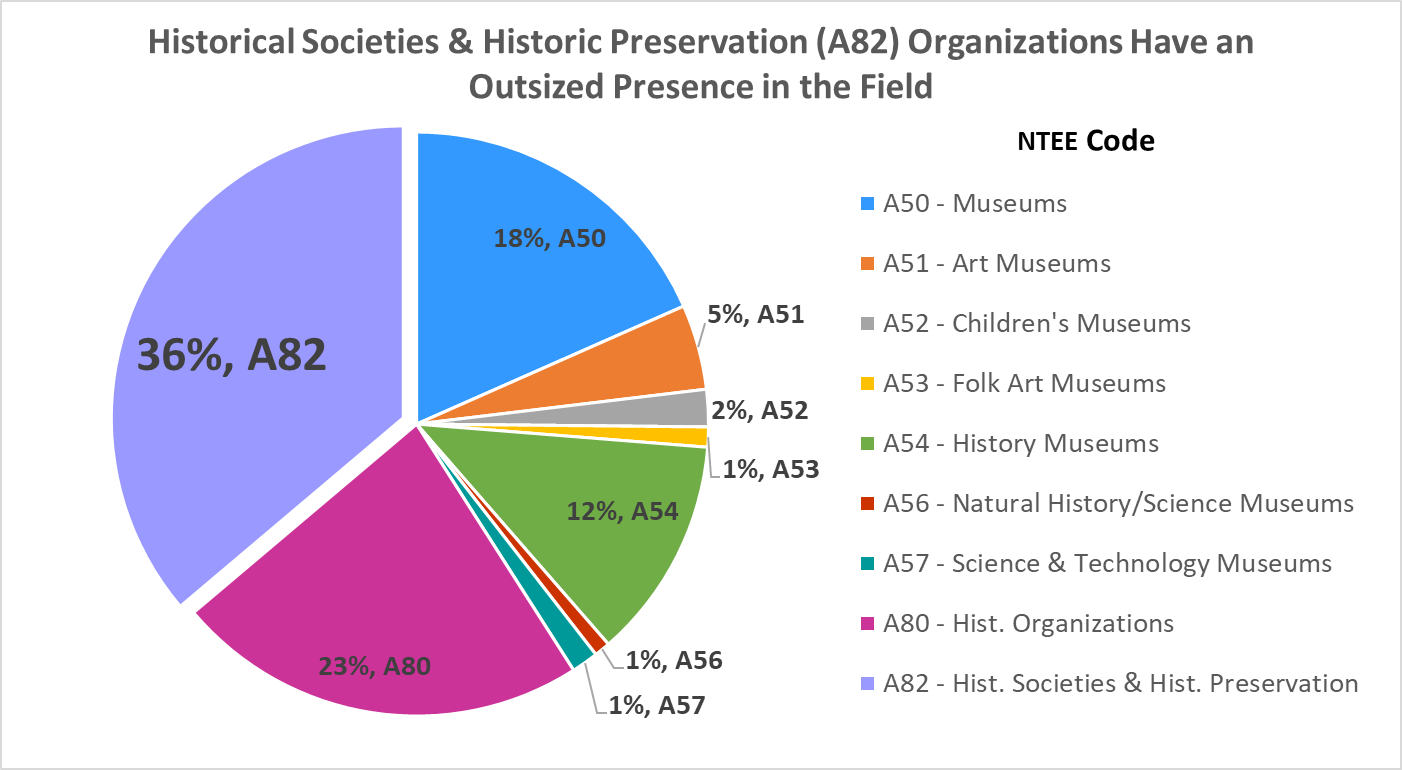
Over the past year, Engaging Places has been looking over individual segments of the museum field. While these segments are unique in specific ways, as demonstrated by the data, several of them do share a common theme and mission: an overall goal to promote history. These four segments are History Museums (A54), History Organizations (A80), Historical Societies & Historic Preservation (A82), as well as the broad Museums (A50) category. By combining these segments we can focus on the history-centric portion of the museum field that makes up close to half of its revenue and consists of a whopping 89% of its institutions (see Figure 1). This block of museums is incredibly dominant within the field and a major focus of Engaging Places’ work. For ease of reference, we will be referring to them as History-Focused Organizations.

It is important to remember that as an aggregate these History-Focused Organizations still trend small. Over 90% operate on less than $1 million in revenue annually, with contributions and grants bringing in over half of that vital revenue. For these smaller museums, financial security is a constant and essential priority. While many of these History-Focused Organizations are unable to achieve large pools of investment to stabilize operations, unlike some of their larger counterparts, they can develop practices to move them in this direction. 

Continue reading

Should Local History and Historic Preservation Dominate the Museum Field?

Figure 1. Historical Societies & Historic Preservation (A82) organizations have an outsized presence in the field. Source: Internal Revenue Service and National Center for Charitable Statistics.

Of all the organizations in the United States devoted to arts, culture, and humanities, Historical Societies & Historic Preservation (NTEE A82) organizations have an outsized presence.   More than a third of all organizations “sponsor activities which celebrate, memorialize and sometimes recreate important events in history such as battles, treaties, speeches, centennials, independence days, catastrophes that had an important impact or other similar occasions.” “Historical society,” “historical association,” “heritage society,” “preservation,” and “restoration” are in the name of nearly 80 percent of institutions in this category.  They are also focused on local history—only one in twenty institutions appear to have a geographic scope larger than the county level.

While preserving and interpreting local history is their primary interest, these organizations are the smallest by revenue.  More than 90 percent operate with less than $1 million in revenue annually and have a median revenue near $64,000 (yes, the median is $64,000 annually for all A82 organizations for 2011-2017—half of these organizations operate with less than this amount).  Only Historical Organizations (A80) produce similar financials, albeit with slightly higher figures.

Continue reading

HLI Seminar Returned in New Format, New Season

The Class of 2022 celebrating their graduation from the HLI Seminar.

The History Leadership Institute, AASLH’s professional development program for mid-career history professionals, introduced its long-running Seminar in a new format in June.

In 1959, the Seminar began as an effort to train newly graduated history students and directors of history museums in the unique skills of managing museums, historic sites, and archives in a six-week program held at Colonial Williamsburg, During the decades that followed, the Seminar has continually changed to meet the needs of the field and explore new and emerging practices.

Continue reading