For small non-profit organizations operating on less than a million dollars annually, programs are often the beating heart of the operation. The best programs balance mission and financial sustainability to serve their audiences. Program revenue (admissions, events, and membership dues) can be a vital means of maintaining financial stability and growth. For History-Focused Organizations [Museums (NTEE A50), History Museums (A54), History Organizations (A80), and Historical Societies & Historic Preservation (A82)] as overall revenue grows, so does the share of program revenue. This means as your organization grows, so should the prominence of your programs as a true revenue driver (see figure 1 below).
As small history-focused organizations expand, it’s crucial to manage their programs wisely to increase income while keeping the mission in mind. For small groups, program decisions can be very personal, often influenced by board or staff interests. Taking a strategic approach to these decisions can boost the organization’s growth and success.
Scholars reviewing the archives at the Haas-Lilienthal House.
The National Endowment for the Humanities, a federal granting agency, recently announced a special grant program to support interpretive planning at small organizations for up to $25,000, no match required.
What does “small” mean? You need to meet at least two of the following:
Annual operating expenses of less than $1,000,000
Located in a community with less than 300,000 residents
A staff of less than 50 people
Rely primarily on volunteers or part-time staff.
A mission to interpret under-told stories or serving a non-traditional audience
Hmm…that describes most history organizations in the US, so if you’re reading this post, you’re probably eligible.
Now, what will it support? Nearly anything that improves or enhances the interpretation of your collection, site, or community, such as:
help you think creatively about the hidden strengths of your collections or historic site
generate new ideas for engaging with the community
train staff and volunteers on interpretive methods and techniques
develop a framework for developing public programs
creating interpretive plans for exhibitions, tours, or school programs
visiting other historic sites or museums to sharpen skills and knowledge
evaluating existing tours or exhibitions
testing new programs for their ability to engage new audiences
conducting historical research to support new interpretive themes
Projects must include at least one scholar from a humanities discipline (e.g., history) or one consultant specializing in interpretation to the public (Engaging Places can help you with this), as well as at least one expert on your local community.
Applications are due June 28, 2023 for one to two year projects beginning between March 1 and May 1, 2024. You will need all of that time to prepare an application and NEH will read draft applications submitted by May 24. Remember to register in advance with the System for Award Management (SAM) and Grants.gov—those are steps you cannot do at the last minute.
If a well-managed museum has robust programming, a large endowment, and a profitable gift shop, should they still rely on contributions and grants? Often regarded as a fundraising burden to reduce or eliminate, instead we might want to consider these revenue sources as one of the best ways to sustain and expand an institution. Sixty-six percent of History-Focused Organizations [Museums (NTEE A50), History Museums (A54), History Organizations (A80), and Historical Societies & Historic Preservation (A82)] depend on contributions and grants for at least half of their annual revenue and nearly forty percent rely on contributions and grants for more than three-quarters of their revenue (see Figure 1 below).
To maximize revenue, museums must navigate fundraising in the present and future. Understanding the donor and engagement pyramids simplifies fundraising and ensures focus. Small history-focused organizations, in particular, must invest their limited bandwidth strategically to achieve success.
Figure 1. History-Focused Organizations command large portions of the museum field’s revenue and institutions. Source: Internal Revenue Services and National Center for Charitable Statistics.
Over the past year, Engaging Places has been looking over individual segments of the museum field. While these segments are unique in specific ways, as demonstrated by the data, several of them do share a common theme and mission: an overall goal to promote history. These four segments are History Museums (A54), History Organizations (A80), Historical Societies & Historic Preservation (A82), as well as the broad Museums (A50) category. By combining these segments we can focus on the history-centric portion of the museum field that makes up close to half of its revenue and consists of a whopping 89% of its institutions (see Figure 1). This block of museums is incredibly dominant within the field and a major focus of Engaging Places’ work. For ease of reference, we will be referring to them as History-Focused Organizations.
It is important to remember that as an aggregate these History-Focused Organizations still trend small. Over 90% operate on less than $1 million in revenue annually, with contributions and grants bringing in over half of that vital revenue. For these smaller museums, financial security is a constant and essential priority. While many of these History-Focused Organizations are unable to achieve large pools of investment to stabilize operations, unlike some of their larger counterparts, they can develop practices to move them in this direction.
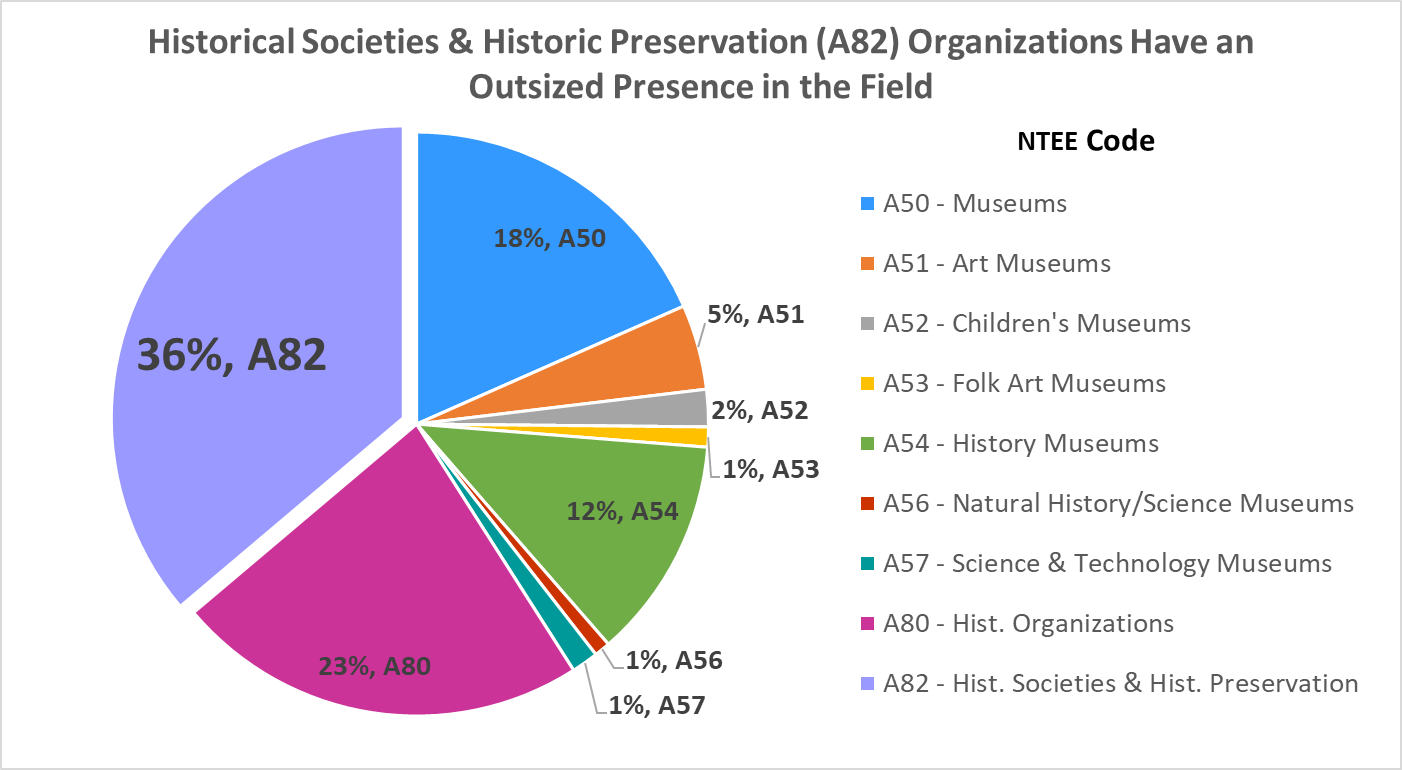
Figure 1. Historical Societies & Historic Preservation (A82) organizations have an outsized presence in the field. Source: Internal Revenue Service and National Center for Charitable Statistics.
Of all the organizations in the United States devoted to arts, culture, and humanities, Historical Societies & Historic Preservation (NTEE A82) organizations have an outsized presence. More than a third of all organizations “sponsor activities which celebrate, memorialize and sometimes recreate important events in history such as battles, treaties, speeches, centennials, independence days, catastrophes that had an important impact or other similar occasions.” “Historical society,” “historical association,” “heritage society,” “preservation,” and “restoration” are in the name of nearly 80 percent of institutions in this category. They are also focused on local history—only one in twenty institutions appear to have a geographic scope larger than the county level.
While preserving and interpreting local history is their primary interest, these organizations are the smallest by revenue. More than 90 percent operate with less than $1 million in revenue annually and have a median revenue near $64,000 (yes, the median is $64,000 annually for all A82 organizations for 2011-2017—half of these organizations operate with less than this amount). Only Historical Organizations (A80) produce similar financials, albeit with slightly higher figures.
The Class of 2022 celebrating their graduation from the HLI Seminar.
The History Leadership Institute, AASLH’s professional development program for mid-career history professionals, introduced its long-running Seminar in a new format in June.
In 1959, the Seminar began as an effort to train newly graduated history students and directors of history museums in the unique skills of managing museums, historic sites, and archives in a six-week program held at Colonial Williamsburg, During the decades that followed, the Seminar has continually changed to meet the needs of the field and explore new and emerging practices.
Limited edition of Presidential Gummies available from The History List.
The History List, creators of the annual History Camp, continues to launch a series of fun and engaging products to inspire Americans to explore and share their history. Today they’re releasing a limited supply of Presidential Gummies that are sure to turn children into history nerds. They also align with the “Doing History” theme for the 250th Commemoration by encouraging open conversations about what history is, the many ways it is done, and why it matters.
Made by Haribo, the German manufacturer of Goldbears® since 1922, these colorful gummies in flavors from pineapple to strawberry representing all the presidents are sure to delight (and become a collector’s item among history buffs). These Presidential Gummies and other cool history stuff are available online in The History List store.
As part of a project to develop a new framework for AASLH‘s professional development/continuing education program, I plotted history organizations onto a map of the United States using a subset of IMLS’s database of museums. That’s a big category that includes history museums, historical societies, historic preservation organizations, historic house museums, and general museums that include history as a major topic and while there is some discussion about the comprehensiveness of the IMLS database, it’s the best information we have available and for my project, more than sufficient to get a sense of the big picture.
As you’ll see in the map below, history organizations are mostly located in the eastern half of the US. Start at the southern tip of Texas and draw an imaginary line due north and the lion’s share is on the right side of the map.
History organizations in the United States. Red is the location of historical societies and historic preservation organizations; green is history museums and house museums; and blue is general museums. Data source: IMLS, 2018. Map: Engaging Places.
That’s probably something we all suspected but now can visualize it better. When I’ve shown this map to a few people, they concluded that it’s because there’s much more history in the East. But take a look at the heat map below while recalling the US history timeline, and you’ll come to a different conclusion. Continue reading →
Workshop with Brock Jobe during the Program in New England Studies.
This summer Historic New England is offering its Program in New England Studies (PINES), an intensive week-long exploration of New England decorative arts and architecture from Monday, June 17 to Saturday, June 22, 2019. This biennial program explores New England history and culture from the seventeenth century to the Colonial Revival through workshops, lectures, and visits to Historic New England properties, other museums, and private homes and collections. Highlights include the restored Quincy House Museum, the recently opened museum and study center at the Eustis Estate, and a champagne reception on the terrace of Beauport, the Sleeper-McCann House on Gloucester Harbor.
Registration is $1,600 and includes all lectures, admissions, transportation to special visits and excursions, daily breakfast and lunch, evening receptions, and various service charges. Participation is limited to 24 museum professionals, museum board members, collectors, and graduate students and will next be offered in 2021. Multiple scholarships are available for mid-career museum professionals and graduate students in the fields of architecture, decorative arts, material culture, or public history. At least one scholarship is available for a candidate from diverse cultural backgrounds. All are encouraged to apply. For more information, visit HistoricNewEngland.org or contact Ken Turino, Manager of Community Engagement and Exhibitions, at 617-994-5958.
This 1:30 video features a video projected on a table showing scholars at work behind-the-scenes as part of a small exhibition on research and conservation at the Huntington Library, Art Collections, and Botanical Gardens in San Marino, California. It was installed a few years ago in the former board room of the historic library building and is another example of the expanded ways that video is being used in exhibitions (it’s not just a tv monitor anymore).
You may notice that there’s no one in the exhibition. I do deliberately take photos of exhibitions without people so that the entire design can be seen, however, I also take them with people to show how they interact with the content. In this instance, it was a busy day but very few people wandered in and when they did, it was a quick glance and then back out–despite the cleverness of the video projection. I can perhaps guess at the reasons—located off to the side, uninteresting topic, and passive experience—but it could also be a lost opportunity to do something more intriguing and distinctive.
Look again at the video. What’s distinctive about the exhibition?Continue reading →