One of the most common challenges for nonprofit organizations—whether museums, historic sites, or community groups—is understanding who does what when it comes to decision-making, planning, and day-to-day operations.
Board members sometimes worry they are getting too involved in management or don’t know enough about what’s going on. Staff members, on the other hand, can feel their authority is being questioned when board members step into operational details. Yet when everyone understands their distinct responsibilities, organizations thrive.
We would never expect a new volunteer to suddenly step into a historic house and deliver a flawless tour. They need orientation, resources, and time to develop their skills before they feel confident leading visitors.
As museums continue to evolve, so do the tools we use to connect with our audiences. Projection mapping is creating new opportunities to bring stories and objects to life. Although it’s been used for decades, it is increasingly adopted by museums and historic sites. I’m excited to share my new video, now available on YouTube, where I explore some fascinating projection mapping experiences in museums that I encountered while on the road this past year.
In this video, I take you through the basics of projection mapping, explaining how it works and offering real-world examples of its use in museums and historic sites in England, Italy, and the United States. From the virtual ledger of servants at Kensington Palace to the immersive storytelling at the Capitoline Museums in Rome, projection mapping is proving to be a versatile tool for creating memorable and educational museum experiences.
Whether you’re familiar with projection mapping from iconic attractions like the Haunted Mansion at Disneyland, or this concept is new to you, the video is designed to inspire museum professionals to think creatively about how to integrate this technology into exhibitions, tours, and programs. I’ll also show how more advanced applications, like the complex presentations at the Handel Hendrix House, are pushing the boundaries of how we engage with historical spaces and objects.
Projection mapping is about more than just projecting images—it’s about creating interactive, immersive environments that deepen the visitor’s connection with museum collections.
Check out the video now and see how your museum can harness the power of projection mapping to enhance visitor engagement and interpretation. Just be aware that it’s a handcrafted video that took me two days to edit and narrate, but it’s a topic better explained in a video than in text.
During my recent visit to several London museums, I was struck by the growing emphasis on decolonization. As a museum professional, I’ve been following this movement for some time, but seeing these efforts firsthand inspired me to reflect on the challenges and progress being made. Some London museums are actively re-examining their collections and narratives, working to address the complex legacies of colonialism in tangible ways, and both Royal Collections and the National Trust have staff members specifically focused on this issue. But others have a long way to go.
If you’re not familiar with decolonization, it’s the process of rethinking and revising interpretations that have historically favored the perspective of a dominant power, such as an imperial empire over a colonized nation (like Great Britain and India). However, decolonization goes beyond the empire-colony dynamic, addressing any situation where one perspective is elevated due to power imbalances. For instance, terms like “prehistory” suggest a time without history, labeling settlers as “pioneers” overlooks the people who were already living in those areas, and describing conquering armies bringing “civilization” implies they were superior to the existing cultures. Words shape our perceptions and carry significant consequences, influencing relationships across race, gender, and other social divides. Decolonization helps us recognize and correct these biases, leading to more inclusive and accurate narratives.
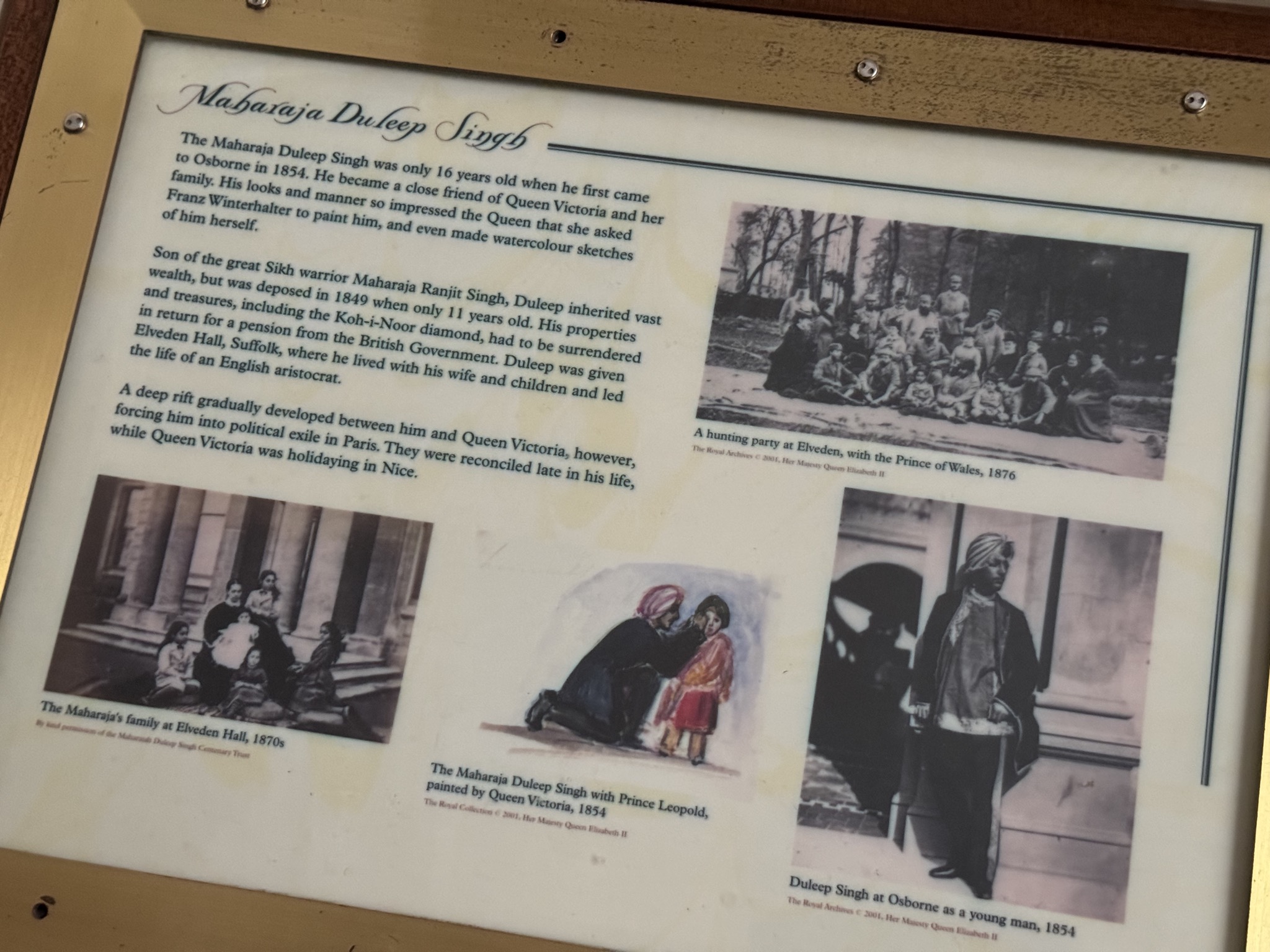
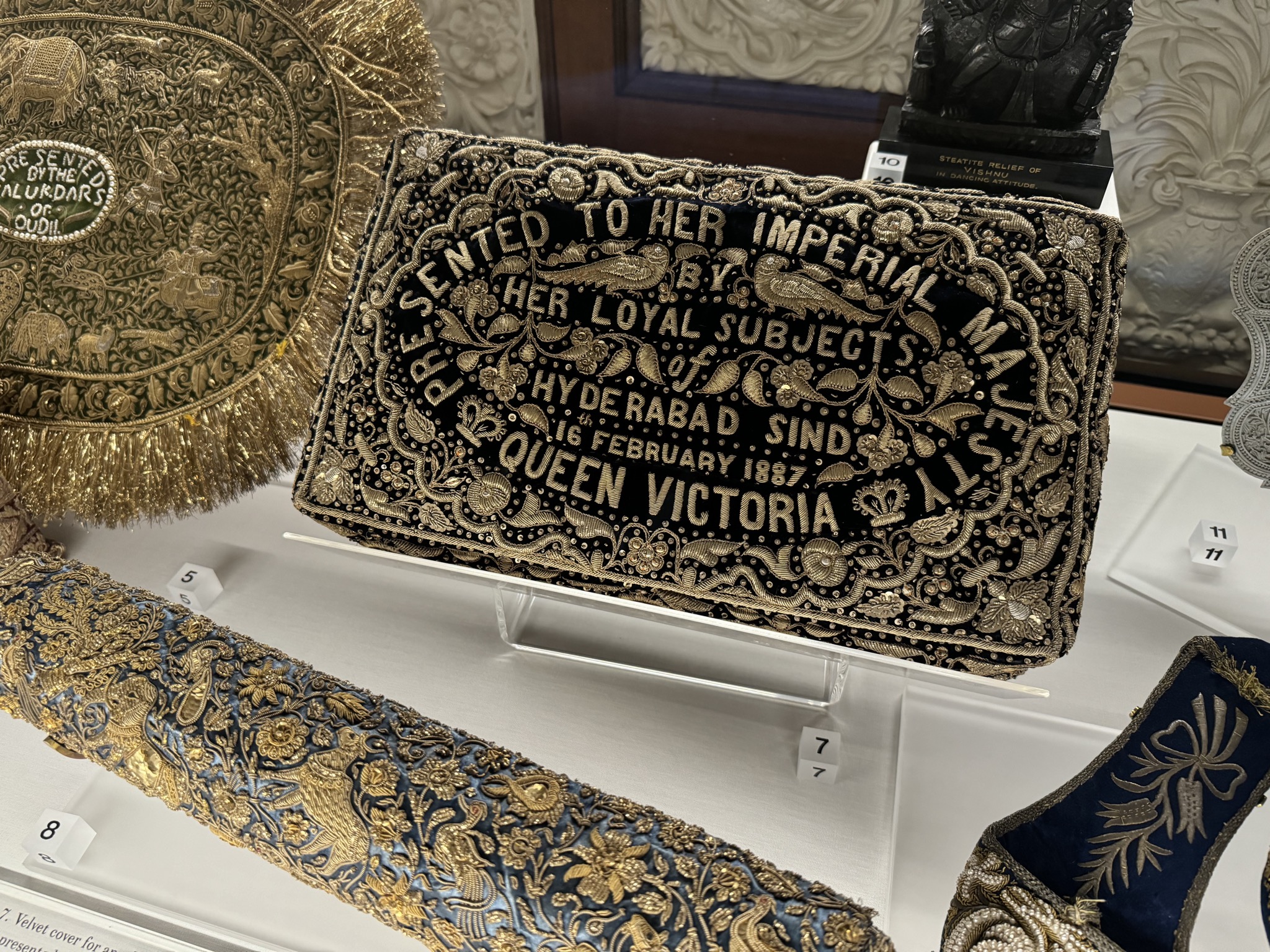
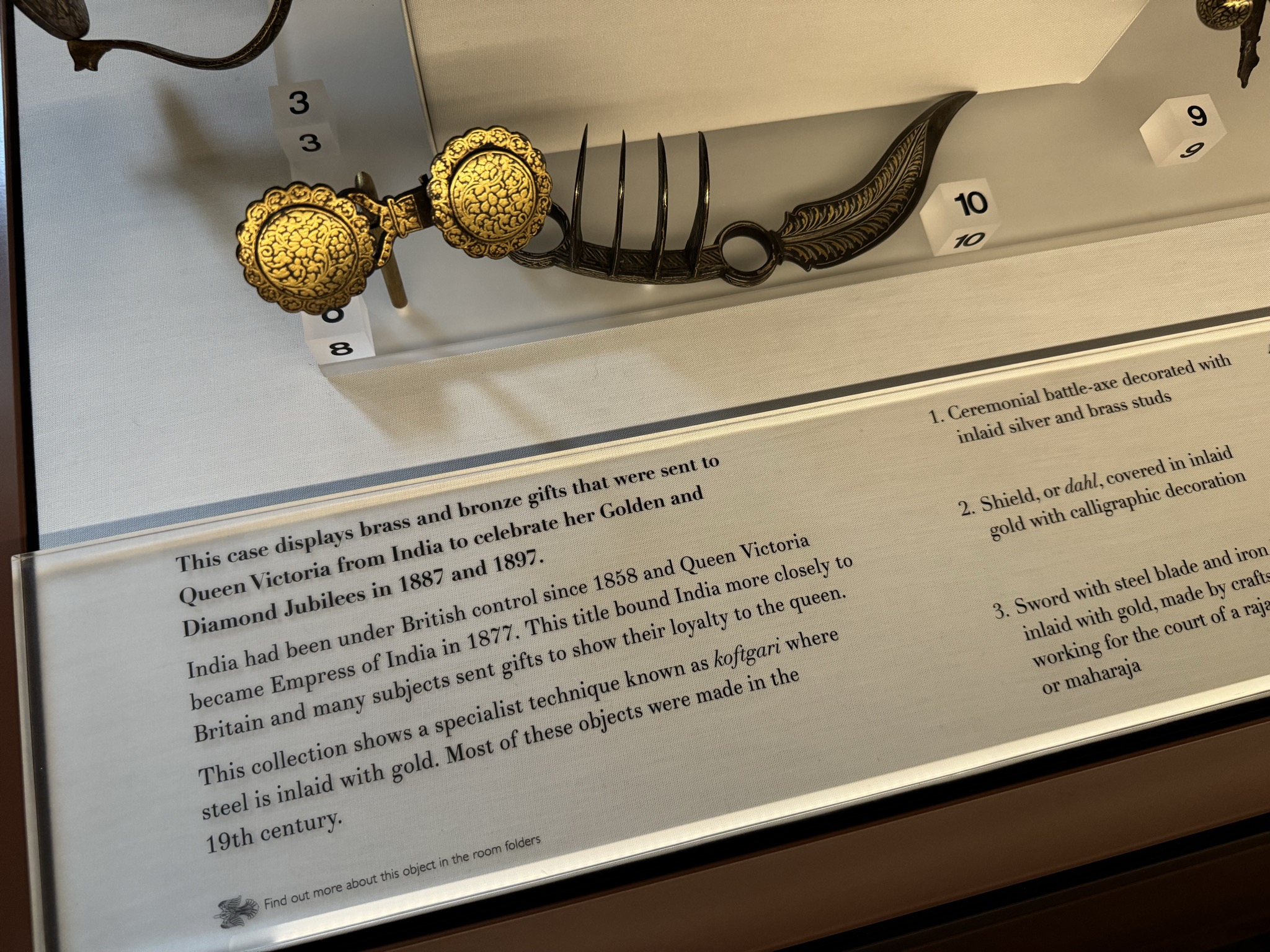
For an example of a museum waiting to undertake a re-examination of its exhibitions, consider Osborne House (operated by English Heritage), the country palace of Queen Victoria and Prince Albert. The displays in and around the Durbar Room discuss Britain’s relationship with India. The exhibitions include a panel about Maharaja Duleep Singh and that “his properties and treasures, including the Koh-i-Noor diamond, had to be surrendered in return for a pension from the British Government” and feature gifts sent from India to Queen Victoria to “show their loyalty to the queen.” The history is far more complex and this exhibition emphasizes only the British perspective and continues a mythology of India’s grateful subservience to the Queen.
1. Re-examining Collections
Many London museums are conducting in-depth reviews of their collections to identify items acquired during the colonial era. This process includes acknowledging the contexts in which objects were collected, often under unequal power dynamics. They are being more transparent about the provenance of key objects but contested ownership isn’t addressed publicly. Some examples:
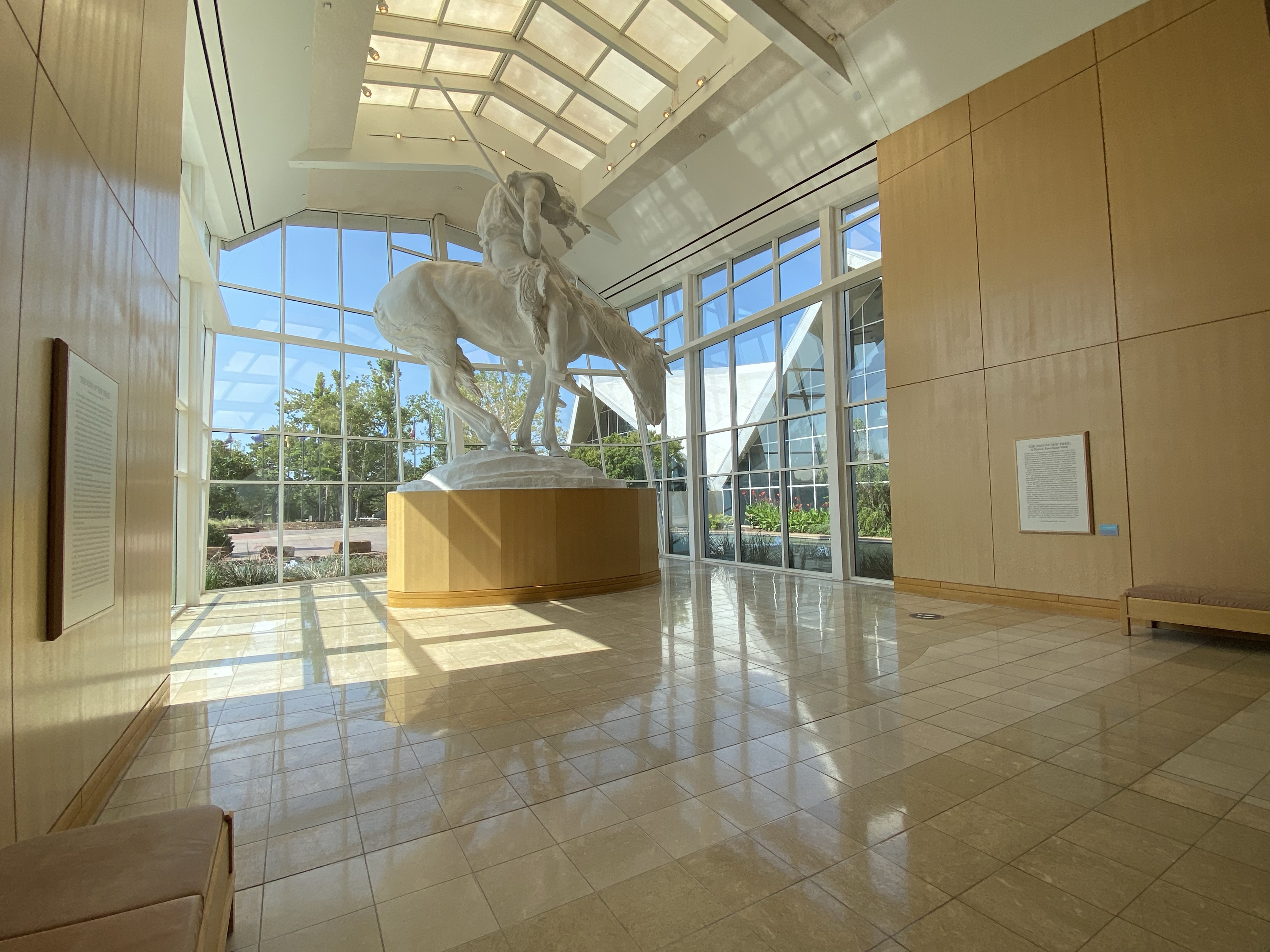
Entrance hall, National Cowboy and Western Heritage Museum, Oklahoma City.
At the National Cowboy and Western Heritage Museum in Oklahoma City, a monumental bright white sculpture of an Indian slouched on a horse fills the end of the entrance hall. James Earle Fraser created “The End of the Trail” for the 1915 Panama-Pacific International Exposition in San Francisco, earning him a Gold Medal. It also became a popular image that signaled the end of a free people.
The Museum acquired the plaster statue from Tulare County (California) Historical Society, where it sat outside in a city park deteriorating for nearly 50 years. Now the restored statue is the centerpiece of this large museum and they’ve used this one object to hit a triple with visitors, to borrow a phrase from baseball.
Along with a typical label describing the sculpture’s creation, acquisition, and significance, it includes a Native American View in a second label of equal length by Dr. R. David Edmunds, a Cherokee. He states that the sculpture represents the popular view of “a nineteenth century Indian warrior defeated and bound for oblivion—frozen in time. By the 1890s, Native Americans knew their trail had become steep and rocky, but they believed it would continue.” The label continues to discuss the challenges and opportunities faced by Native Americans in the 20th century and that “being Indian has never been cast in stone. Today, Native Americans proudly ride forward on a trail into the future.”
Labels for “The End of The Trail” by James Earle Fraser, National Cowboy and Western Heritage Museum, Oklahoma City.
The use of labels to provide multiple perspectives is not uncommon in art museums, but I haven’t seen it used enough in history museums. They are ideal places to show that events, places, and eras are experienced differently by different people. It’s an easy way to enrich interpretation without the need to create entirely new exhibitions or special events on women, African Americans, or Native Americans.
No photography allowed in the exhibits at the National Archives?
Last weekend I went to see “Spirited Republic,” a temporary exhibit at the National Archives about the history of alcohol in the United States. I’m interested in the history of food and knew the Archives would dig up some interesting materials. It was a worthwhile visit but ugh, right at the entrance is a sign declaring “no photography.” This isn’t unusual for temporary exhibits because they may contain materials that are protected by copyright or have objects on loan. In this exhibit, however, everything was drawn from the collections of the Archives or had fallen out of copyright. If I went around the building to the Research Room, I could retrieve any of the items on display and make photographs without question. Secondly, most of the items are historic governmental or administrative documents, which don’t encourage selfies or other distractions. Photographs would most likely be taken by people who were really interested in the subject and wanted an image for reference. If they’re worried about light damage, people can be warned not to take flash photos (and studies by conservators show that flash photography has to reach excessive levels to cause significant damage, so this is usually an unfounded concern). If they’re worried about security, everyone has already been screened in the usual DC way and guards are posted throughout the exhibit. Finally, photography is one of the only areas of creative activity that’s growing in the US (bucking the declines in sewing, painting, pottery, or music according to studies by the National Endowment for the Arts) and the Archives has a rich trove of content for inspiration (and it helps publicize their exhibits and collections). The “no photography” makes absolutely no sense at the National Archives. Instead, the National Archives should assume that photography will be allowed unless there are specific and legitimate reasons not to do so. Just follow the same rules as in your Research Rooms.
Prohibitions on photography isn’t the only stumbling block to public access and historical interpretation at the National Archives–I’m sensing a growing use of Continue reading →
Jane Addams Hull-House Museum by Brandon Bartoszek
The May 2015 issue of the Public Historian was just released and provides a dozen articles related to historic house museums. Lisa Junkin Lopez, associate director of the Jane Addams Hull-House Museum and guest editor of this special issue, provides the criteria that helped her select the articles and her vision of historic house museums:
Though a number of sites have turned to revenue-generating activities like weddings and farmers’ markets to stay afloat, rigorous historical content has not necessarily been quashed in favor of parlor room cocktail hours and heirloom tomato beds. Many sites have recommitted to the project of excavating their own histories, digging deeper to find relevance with contemporary audiences and identifying new methods for engagement along the way.
The individual essays are case studies of various projects at historic house museums, but many question and even break the basic assumptions of museum practices and historic preservation standards. This shift will need to be watched because Continue reading →
On April 26-29, 2015, the Preservation Society of Newport County (aka the Newport Mansions) is hosting a symposium on the cultural connections between the North and South from the Colonial Period to the Gilded Age as seen through furnishings, silver, textiles, painting, architecture, and interiors. Scholars include:
Daniel Kurt Ackerman, Associate Curator, Museum of Early Southern Decorative Arts
Brandy Culp, Curator, Historic Charleston Foundation
Caryne Eskridge, Project Manager & Research Coordinator, The Classical Institute of the South
Stephen Harrison, Curator of Decorative Art & Design, Cleveland Museum of Art
Brock Jobe, Professor of American Decorative Arts, Winterthur Museum, Garden & Library
Alexandra Kirtley, The Montgomery Garvan Associate Curator of American Decorative Arts, Philadelphia Museum of Art
Registration is $600 and includes an opening reception at Rosecliff (1902) and dinner in the Great Hall at the Breakers (1895). Scholarships are available to undergraduate and graduate students, as well as arts and humanities professionals. To register or for more information, contact symposium@NewportMansions.org or call 401-847-1000 x 160. Tell them that you heard about it from Engaging Places and you’ll receive a 10% discount!
For the past fifteen years, George McDaniel and I have taught a two-day workshop on the management of historic house museums for the American Association for State and Local History. We cover a wide range of topics from fundraising to interpretation to disaster response to collections management–we really need a week, especially if there’s a lot of discussion. That was certainly our experience last week in Charleston, South Carolina (and thanks to our hosts, the Historic Charleston Foundation!), where our discussions were so rich that I wasn’t able to complete most of my presentations. That’s okay because the workshop is for the participants and as long as they find a topic that’s worth exploring, I’ll stay with them. Indeed, George and I often find that we’re not instructors but facilitators, raising ideas and questions to provoke thoughtful discussions to help participants improve the management of their historic sites.
At the core of workshop is each participant’s “burning question.” They share their biggest concern or issue at the start of the class and at the end, they describe how they might address it when they return to their site. It’s not only a way to make the workshop more relevant to the participants, but it also gives us a glimpse into the issues facing historic house museums around the country. This year the questions included: Continue reading →
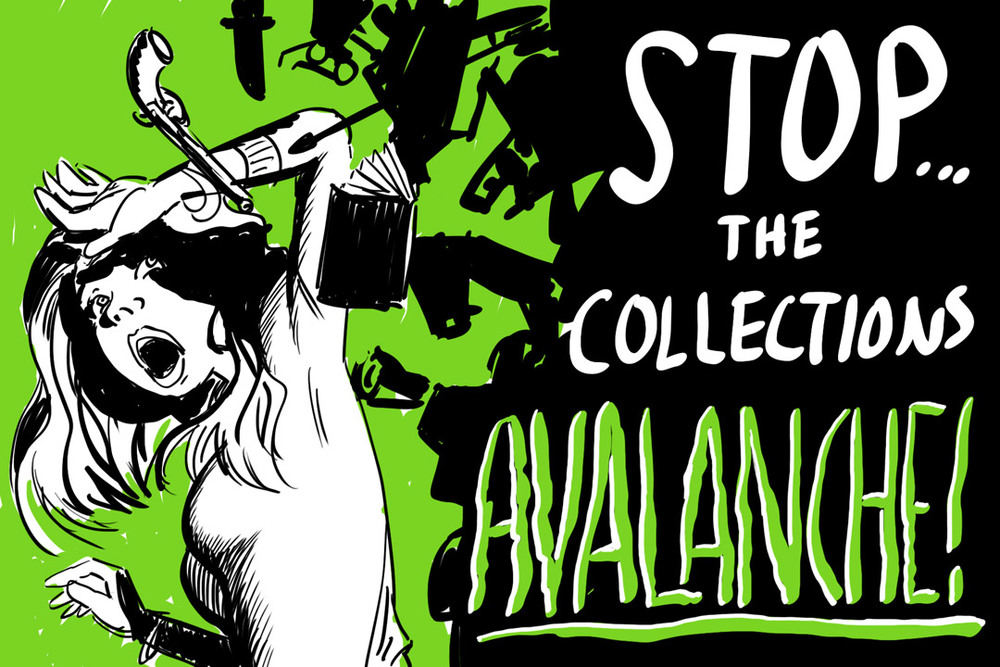
The annual meeting of the American Association for State and Local History always covers a diverse range of topics, but collections management is certain to be among this. This year in St. Paul was no exception and three very different projects caught my attention.
“Deteriora and the Agents of Destruction” by the Indiana Historical Society.
In a poster session, Tamara Hemmerlein shared Deteriora and the Agents of Destruction, a publication of the Indiana Historical Society. Presented as a “living graphic novel,” it informs readers about the various ways to preserve collections from light damage, pests, dust, and mishandling (represented by such villians as Ultra Violet, Mass-O-Frass, and Miss Handler) and includes links for additional information. I’m not sure of the intended audience, but it’s a lot more fun than reading a collections management policy.
This 2:53 video features Alan Jutzi discussing his work as the chief curator of rare books at the Huntington Library. It’s one of five videos comprising “Behind the Scenes: Staff and Researchers at the Huntington Library,” which gives visitors a peek into the inner workings of a library that is normally off public view. The videos focus on day-to-day processes—and personalities—of a conservator, curator, archivist, page, and “reader” (the Huntington’s term for a scholar/researcher). Visitors to the Huntington can view them on iPads in “The Library Today,” an education display in a room adjacent to main exhibit, “Remarkable Works, Remarkable Times.” Yes, it’s missing an educator but it does help explain the work of some of the people at a research library. Is this something that would help the public, donors, and supporters better understand the work you do? You’ll find more details about the videos in Jennifer Watts’ post on the Huntington blog.




 Engaging Places