Category Archives: Resources

Back to AASLH in 2024: Proposing Sessions, Supporting Colleagues, and Visiting the Clotilda

It’s been several years since I attended an AASLH annual meeting due to the pandemic and conflicts with my teaching schedule, but I plan to be in Mobile, Alabama in September 2024 (I’m hoping to see the Clotilda–National Geographic called it the best museum that opened in 2023!). Professional conferences are one of the best ways to mentally stand above your daily work and compare what you’re doing with the rest of the field. You can compare experiences, solve problems, share solutions, and be inspired. Plus I can share meals with some of my colleagues (and meet new ones!).

I’ll not only be attending but hope to lead a session or two to support the good work happening at history organizations around the country. It’s a terrific way to work with others to address a hot topic, provide different perspectives on a common issue, and yes, shape the future of the field–so I hope you’ll join me in proposing a session to support your colleagues.

AASLH has moved beyond the traditional three-panelists-and-a-moderator format to include roundtable discussions, in-depth workshops, debates, and a series of quick presentations to allow more variety, so if you have an idea for an educational session, there’s probably an interesting way to present it. I’m having a hard time choosing!

Like most conferences, a committee reviews proposals to assemble the program. Because this is a national conference, they’re looking for sessions that address issues that are affecting history organizations nationally, offer a national perspective on a topic through a geographically diverse session, or relate to the conference theme. Avoid “show and tell” sessions about a program or event that’s unique to your organization and can’t be easily duplicated by others (plus they tend to be really boring self-congratulatory panels). Finally, the attendees want results to justify the time and money they’ve spent at the conference. What will they learn? It’s got to be more than “understand” and “appreciate”–that’s far too vague. By the end of the session, what will they specifically know, what will they be able to do, and how will they feel (e.g., more confident, less confused)?

AASLH is accepting proposals until December 20, 2023. Because proposals are prepared online, it may be difficult to know what information they are seeking, so I’ve attached a one-page summary of the core questions to answer.
Untangling the “Other” Revenue Stream

In the colorful tapestry of history-focused organizations, every thread of revenue has a role to play in the success of the organization. Perhaps the most unique collection of these threads is the “Other” revenue category. This singular “Other” thread houses a miscellany of revenue sources that don’t fit into the categories of “Investment Income”, “Program Service Revenue”, and “Contributions and Grants”. At first glance, this classification may appear insignificant, yet it often proves to be a silent contributor that underpins the fiscal health of History-Focused Organizations [Museums (NTEE A50), History Museums (A54), History Organizations (A80), and Historical Societies & Historic Preservation (A82)].

Understanding this “Other” revenue can be like deciphering an ancient dialect. It is made no easier by the fact that IRS Form 990 at times uses the terms revenue and income interchangeably. While some categories of this revenue such as royalties and inventory sales may be familiar, “miscellaneous” often contains difficult to parse odds and ends such as third-party events, insurance proceeds, ATM fees, and revenue from hosting satellite towers. Most often this miscellaneous revenue is unspecified and simply named “miscellaneous” or “other” which can make it difficult to get the full picture of a particular institution’s revenue sources. We advise limiting the classification of your total revenue as “miscellaneous” to no more than 1%. While judicious use of this category can help define your other revenue streams more clearly, overuse could lead to a lack of clarity about a significant portion of your revenue. It is crucial to maintain a comprehensive understanding of your financial situation.

Continue reading →

Impact, Sustainability, and Non-Profit Programs

For small non-profit organizations operating on less than a million dollars annually, programs are often the beating heart of the operation. The best programs balance mission and financial sustainability to serve their audiences. Program revenue (admissions, events, and membership dues) can be a vital means of maintaining financial stability and growth. For History-Focused Organizations [Museums (NTEE A50), History Museums (A54), History Organizations (A80), and Historical Societies & Historic Preservation (A82)] as overall revenue grows, so does the share of program revenue. This means as your organization grows, so should the prominence of your programs as a true revenue driver (see figure 1 below).

As small history-focused organizations expand, it’s crucial to manage their programs wisely to increase income while keeping the mission in mind. For small groups, program decisions can be very personal, often influenced by board or staff interests. Taking a strategic approach to these decisions can boost the organization’s growth and success.

Continue reading →

What Drives Revenue at History-Focused Organizations?

If a well-managed museum has robust programming, a large endowment, and a profitable gift shop, should they still rely on contributions and grants? Often regarded as a fundraising burden to reduce or eliminate, instead we might want to consider these revenue sources as one of the best ways to sustain and expand an institution. Sixty-six percent of History-Focused Organizations [Museums (NTEE A50), History Museums (A54), History Organizations (A80), and Historical Societies & Historic Preservation (A82)] depend on contributions and grants for at least half of their annual revenue and nearly forty percent rely on contributions and grants for more than three-quarters of their revenue (see Figure 1 below).

To maximize revenue, museums must navigate fundraising in the present and future. Understanding the donor and engagement pyramids simplifies fundraising and ensures focus. Small history-focused organizations, in particular, must invest their limited bandwidth strategically to achieve success.

Continue reading →

How can History-Focused Organizations Invest in Stability?

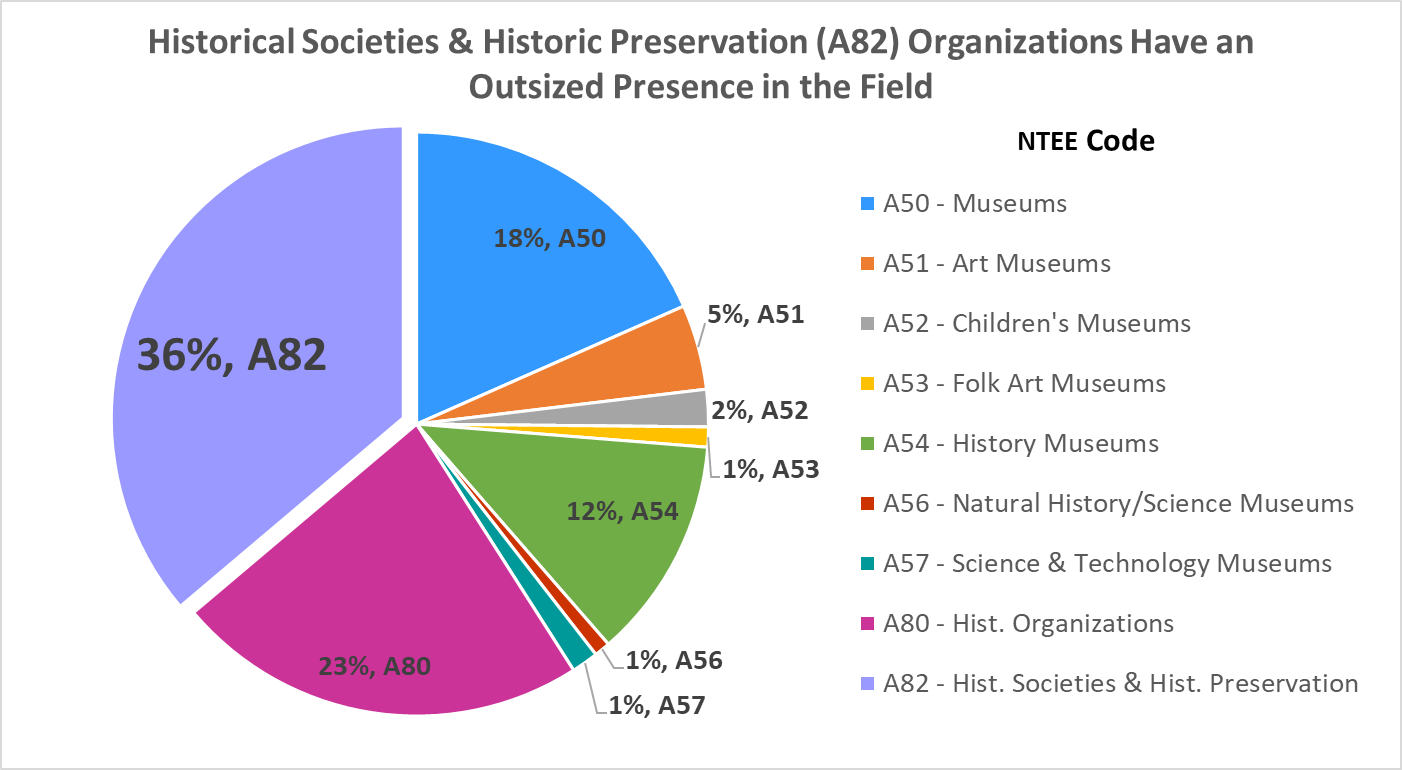
Figure 1. History-Focused Organizations command large portions of the museum field’s revenue and institutions. Source: Internal Revenue Services and National Center for Charitable Statistics.

Over the past year, Engaging Places has been looking over individual segments of the museum field. While these segments are unique in specific ways, as demonstrated by the data, several of them do share a common theme and mission: an overall goal to promote history. These four segments are History Museums (A54), History Organizations (A80), Historical Societies & Historic Preservation (A82), as well as the broad Museums (A50) category. By combining these segments we can focus on the history-centric portion of the museum field that makes up close to half of its revenue and consists of a whopping 89% of its institutions (see Figure 1). This block of museums is incredibly dominant within the field and a major focus of Engaging Places’ work. For ease of reference, we will be referring to them as History-Focused Organizations.

It is important to remember that as an aggregate these History-Focused Organizations still trend small. Over 90% operate on less than $1 million in revenue annually, with contributions and grants bringing in over half of that vital revenue. For these smaller museums, financial security is a constant and essential priority. While many of these History-Focused Organizations are unable to achieve large pools of investment to stabilize operations, unlike some of their larger counterparts, they can develop practices to move them in this direction. 

Continue reading →

Should Local History and Historic Preservation Dominate the Museum Field?

Figure 1. Historical Societies & Historic Preservation (A82) organizations have an outsized presence in the field. Source: Internal Revenue Service and National Center for Charitable Statistics.

Of all the organizations in the United States devoted to arts, culture, and humanities, Historical Societies & Historic Preservation (NTEE A82) organizations have an outsized presence.   More than a third of all organizations “sponsor activities which celebrate, memorialize and sometimes recreate important events in history such as battles, treaties, speeches, centennials, independence days, catastrophes that had an important impact or other similar occasions.” “Historical society,” “historical association,” “heritage society,” “preservation,” and “restoration” are in the name of nearly 80 percent of institutions in this category.  They are also focused on local history—only one in twenty institutions appear to have a geographic scope larger than the county level.

While preserving and interpreting local history is their primary interest, these organizations are the smallest by revenue.  More than 90 percent operate with less than $1 million in revenue annually and have a median revenue near $64,000 (yes, the median is $64,000 annually for all A82 organizations for 2011-2017—half of these organizations operate with less than this amount).  Only Historical Organizations (A80) produce similar financials, albeit with slightly higher figures.

Continue reading →

Nearly 50% of History Museums Operate on Less Than $100,000

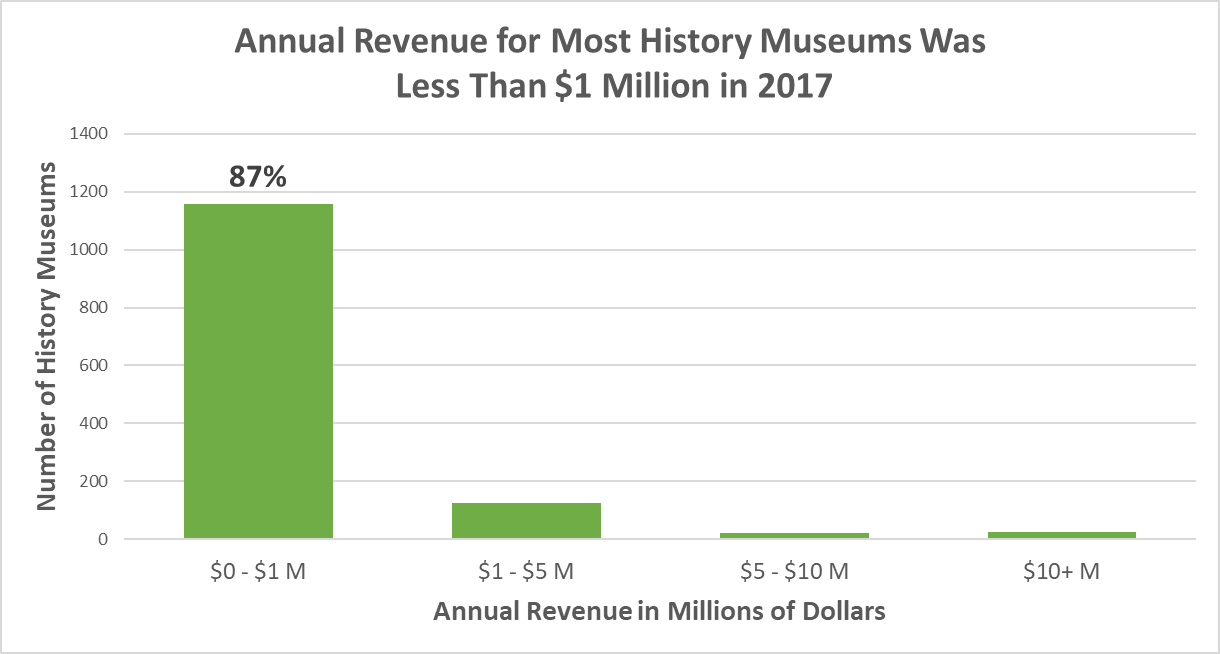
A financial review of more than 1,300 History Museums in 2017 reveals that nearly 90 percent operate on less than $1 million annually, and nearly half on less than $100,000 (see Figures 1 and 2). History museums are financially fragile, but an annual increase in revenue of $5,000 to $10,000 could have a tremendous impact on their capacity and impact. How might this be achieved?  Hints of potential solutions are revealed in the changing revenue patterns of larger museums.  

Figure 1. Annual revenue for most history museums was less than $1 million in 2017, the most complete recent data available.  Source: Internal Revenue Service and National Center for Charitable Statistics.
Figure 2. Annual revenue for most History Museums was less than $1 million in 2017, the most complete recent data available.  Source: Internal Revenue Service and National Center for Charitable Statistics.

A closer look shows that most History Museums derive about 60-70 percent of their revenue from “unearned” sources (i.e., contributions, grants, investments, fundraising events, membership dues), but the mix changes according to size.  Museums with less than $10 million in revenue received 4 to 6 percent of their income from investments, which doubled or tripled in the largest museums to 11 percent. While asking for support from people and foundations (i.e., contributions and grants) remained steady, there seems to be increased attention on making money from money (e.g., interest, dividends, sale of securities, drawing funds from endowments). 

Continue reading →

Resources for Transitioning Museum Programs to Online

Attending George Washington University’s online workshop to prepare for teaching online this fall.

George Washington University (GW), where I teach in the Museum Studies Program, recently decided to move all of its courses online this fall. To prepare, I completed an intensive three-day course to create effective online courses, which introduced the latest research on the factors that make online courses effective and wide (and overwhelming) range of teaching tools that are available.

I’m incredibly fortunate that GW is supporting the faculty with lots of resources and training this summer, which required the Libraries and Academic Innovation staff to move quickly to prepare videos, workshops, and materials faster than I ever would for a student course. Many of the ideas that I gathered could easily be adapted by museums and historic sites as they shift their programming, so I wanted to share them with you. Some don’t require any costly software applications or learning management systems, but just some new planning approaches:

Continue reading →

Museums and Historic Sites Have Mixed Response to COVID-19

With concerns about the COVID-19 virus increasing, schools have moved to online instruction, the United States has closed entry to European citizens, and late-night talk shows are performing to empty rooms. The response by museums and historic sites, however, has been mixed. Some major museums, including the Metropolitan Museum of Art, Smithsonian Institution, and Historic New England have closed or will close soon. Because of the major outbreak in Seattle, Washington, museums in that city are most affected. The Seattle Art Museum, Museum of History and Industry, and Burke Museum have closed effective today or yesterday through at least the end of the month. Other history organizations, such as The Alamo, Colonial Williamsburg, and Minnesota Historical Society are proceeding as normal, not even mentioning the current epidemic and its effect on their operations.

Others are open but have addressed the epidemic with detailed messages on their websites:

Continue reading →

Reimagining Historic House Museums: Observations From the Field

Cover of the book, Reimagining Historic House Museums, published 2019.
Reimagining Historic House Museums (2019)

This afternoon Ken Turino and I will share the common factors that create a sustainable path forward for our country’s historic places. We’ll be drawing from the dozens of innovative sites described in our newly-published anthology, Reimagining Historic House Museums: New Approaches and Proven Solutions. Topics will include assessing whether an organization’s purpose is meaningful to the public, challenging institutions to think holistically, and ensuring that leadership supports risk and experimentation. We’ll be joined in conversation by Kathy Dwyer Southern, Immediate Past Co-Chair of the International Council of Museums United States. If you’re in the area, we welcome you to join us at 5:30 pm at the George Washington University Museum, 701 21st Street NW (at G Street) in Washington, DC. Several of the contributors to the book will be attending and I suspect we’ll have a rousing discussion over drinks at the nearby Tonic.

Ken and I continue to offer our one-day workshop on reimagining historic house museums around the country through the American Association for State and Local History and we’ve now added this shorter “Observations from the Field” presentation to highlight the big ideas from the book. We first presented it with Lisa Ackerman, Interim CEO of the World Monuments Fund, in New York City in October at the request of the Historic House Trust (video below). It was so well received that we’re bringing it to DC today and to Los Angeles in March (as part of the California Association of Museums meeting). We’ve also presented portions of this talk for the National Society of The Colonial Dames in America and Historic New England. If the workshop or presentation could benefit your organization, contact Ken or me for more details (we can only accommodate a couple of these each year, so we may have to plan far ahead).

“Observations from the Field”, Historic House Trust, October 2019