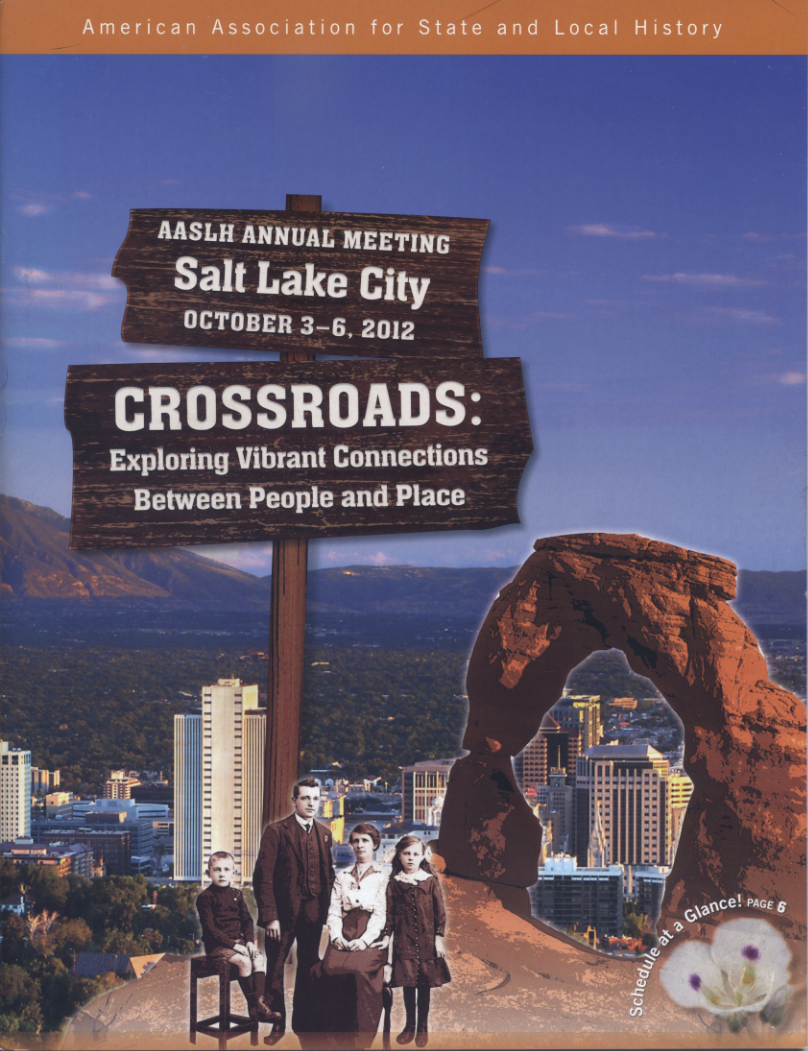
The American Association for State and Local History held its annual meeting in Salt Lake City, Utah last week, attracting about 600 staff, volunteers, and board members of history organizations around the country (and about 30 of them were from the Minnesota Historical Society). Four days of educational sessions, workshops, speeches, and receptions kept everyone busy and thinking about improving our work as historians, educators, collections managers, curators, and directors of historical societies, museums, and historic sites. I’ll provide more reports in the future, but for now, enjoy some pics from the meeting.
Tag Archives: American Association for State and Local History
Schedule Change for ½ Day Workshop at AASLH Annual Meeting
“Connecting Visitors with Inspired Staff: Training Front-line Staff and Volunteers” will be on Wednesday, October 3, 2012, from 1:30-5 p.m. (not Saturday)
As history professionals, we believe that our sites are special places. Helping visitors
find a connection to these places is at the core of what we do—and is essential for our
long-term sustainability. Every year, visitor research and learning theory provide us with
more information about what the public wants from their visits to museums and historic
sites. Yet we often fail to translate this data into meaningful training that enables our
frontline staff to create excellent experiences for our guests. Instead, guided tours and
interpretive programs often take the form of mini lectures on the topics that interest
the front-line interpretive staff or docents. “Connecting Visitors with Inspired Staff:
Training Front-line Staff and Volunteers” will give participants an opportunity to Continue reading
AASLH Workshops for Historic Sites
The American Association for State and Local History offers a wide range of educational workshops and professional training that is particularly helpful for staff and volunteers for work at historic sites and house museums–if you know where to look. I’ve previously mentioned the sessions during its annual meeting but people often forget that it also has half-day and day-long workshops before and after the annual meeting to explore topics in depth. What most people don’t know is that you can register for just these workshops; you don’t have to attend the annual meeting–a great advantage for local folks!
This year, AASLH is offering 14 workshops, including:
- Best Practices for Slavery Interpretation led by Kristin Gallas of the Tracing Center on Histories and Legacies of Slavery with Patricia Brooks, Colonial Williamsburg Foundation; Conny Graft, Conny Graft Research and Evaluation; and Dr. Julia Rose, West Baton Rouge Museum. Full day for $75.
- The Rembrandt Rule Workshop led by Joanna Arrieta of the Atlanta History Center and Michelle Zupan at Hickory Hill. Full day for $75. For background, read Continue reading
AASLH Conference Offering Lots for Historic Sites
The program for the annual meeting (aka conference) of the American Association for State and Local History just arrived in my mailbox. Flipping through its pages, there are more than 70 educational sessions, many that focus specifically on historic sites and house museums including:
- Twilight at Conner Prairie: The Creation, Betrayal, and Rescue of a Museum
- Too Important to Fail: Historic House Museums Meet Communities’ Needs
- Business Models and Earned Income for Historic Houses
- Visitors to Religious Sites: The Whos and Whys
- Historic Places as Museums: Crossroads of Expectations
- Re-imagining Historic Sites: Three Roads to the Same Destination
- Paranormal Policies (if your site hasn’t been contacted by paranormal researchers in pursuit of ghosts, your time will come)
In addition, most of the other sessions are helpful, depending on your needs and interests. There are sessions on fixing poorly functioning Continue reading
AASLH Council Meets in Maine
This past Saturday, the Council (aka board) of the American Association for State and Local History met in Maine for one of their three regular meetings each year. It’s been a tough few months due to the discovery of embezzlement and fraud within the organization, so this meeting had been preceded by nearly a dozen additional meetings of the Council and several committees by conference call to deal with various aspects related to the situation, potential threats to the organization, and improvements to our current financial management by reviewing and revising various policies, procedures, and practices. This meeting adopted revised financial policies and procedures; adopted revised codes of ethics for board, staff, and organization; adopted a revised conflict of interest policy for board and staff; and discussed how the by-laws may need to revise the finance and audit committee responsibilities as well reconsider how Council members are elected to ensure we have sufficient people on board with financial skills. We also began working more strategically, looking longterm to identify priorities so we can preserve those programs that matter most to members and most effectively fulfill the mission. History News and the annual meeting/conference rose to the top as expected, but Continue reading
Historic House Management Workshop in DC Reveals National Issues
For two days last week, about two dozen people gathered in Washington, DC for AASLH’s annual Historic House Management Workshop. George McDaniel and I have been co-teaching this workshop for more than a decade around the country and while all the classes are fun and interesting, the one we recently completed was unusual because it was held in two incredibly significant historic houses designed by two of America’s pioneering architects. Special thanks go to AIA Legacy for hosting the meeting at the Octagon and the White House Historical Association for hosting the meeting at Decatur House. The workshop usually attracts a diverse group of participants but this one especially so with a mix of curators, educators, conservators, directors, boardmembers, college professors, and consultants–it would have been great to conduct a charrette with them!
Each year we ask the participants to identify one issue they’d like to address in the workshop and Continue reading