 The July/August 2017 issue of Museum, the magazine of the American Alliance of Museums, features articles on engaging families, veterans, and LGBTQ audiences and my general article, “A Visitor’s Perspective on Visitor Engagement”. It introduces three major factors that influence visitor engagement at museums: convenience, novelty, and values. I had a limited space so I’d like to share a bit more information about the influence of convenience, the idea that the more convenient it is to visit a museum, the more likely that people will visit. It’s not just about living close by but also other effects, such as traffic, roadway patterns, museum hours of operation, finding a place to park, and ease of purchasing tickets. Nevertheless, distance is a major factor and you can see it through mapping.
In my article I referenced a couple of my clients—Cliveden (Philadelphia) and Caramoor (Katonah, New York)—and described the differences in their program participants or supporters. Below I’m showing these differences through maps created in ArcGIS. Each red dot represents a household and for Cliveden, the map shows that the majority of their supporters live within a 30-minute drive of the site. For Caramoor, the map shows that the majority also live within 30 minutes but there is a significant number who live within 45 minutes to the south (and very few to the north). As you can see, the distance of the audience varies (in other words, the meaning of “convenience” varies). Every place is different and you have to analyze your own data to fully understand it. As I mention in my article, convenience is also affected by novelty and values, which might explain the clustering.
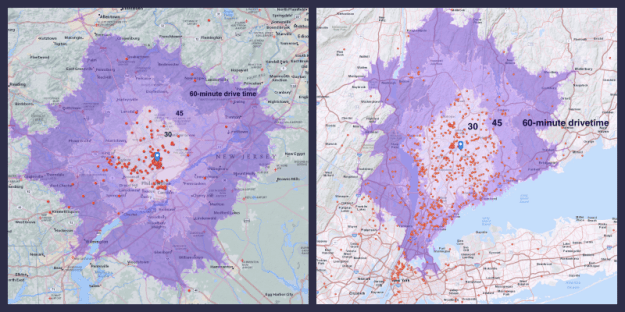
Drive times from Cliveden (left) and Caramoor (right) are shown in graduated drivetimes of 30, 45, and 60 minutes.
This type of mapping also pokes a big hole in one of the most common refrains I hear at museums: “we get visitors from every state in the nation.” Unless that’s your engagement goal, it’s a nonsensical recognition of success. First of all, it’s more likely that a site’s visitors are local, not national, so they’re overlooking the obvious audience for repeat visitation and support. By mapping your visitors and supporters, you can make better decisions about promotion, programming, and fundraising. Secondly, this statement creates a false sense of success. It’s been said numerous times that attendance shouldn’t be the only measure of success and yet it often is. More important is the impact that the history of your site has had on the people who visit. If the significance of your site is insignificant to the people who visit, perhaps it’s time to rethink your purpose and goals.


 I’m in back-to-back conferences—AASLH last week, SEMC this week—because I’m moderating sessions at both. The Southeastern Museums Conference is in New Orleans, which is enjoying incredibly beautiful weather, making it easy to wander the streets to find the many museums that are in walking distance. In the two days I’ve been here so far, I’ve visited the Southern Food and Wine Museum (which includes the Museum of the American Cocktail) and Historic New Orleans Collection, taken a guided tour of St. Louis Cemetery #1, and tonight I’ll be at the evening reception at the National World War II Museum. New Orleans has some unusual museums tackling such unusual topics as tattoos, Mardi Gras, and death but I’m not sure I’ll have time to visit them as well. Over the next few weeks, I’ll share what I’ve learned from the sessions that stood out for me but in the meantime, I’ll post my notes and observations on Twitter during the conference using #SEMC17.


 The simplest things impress me when I visit historic sites, like a good visitor map. They’re hard to find so when I spot one, I’m thrilled.
 The National Park Service has issued an updated version of the
 Educators and interpreters are increasingly expected to engage the community to build support, attract audiences, and confront contemporary issues. So how do you get started? What does an effective community engagement project look like? How do you maintain it?
 This year has been incredibly busy for me, so much so that I’ve been unable to share many of the ideas that I’ve discovered in my travels to historic sites across America through this blog. Along with my active consulting practice, I’ve recently agreed to become the director of
  Friday, July 21 is the deadline to catch the early registration price of $328 ($253 for members); it jumps to $393 the next day. AASLH offers the widest variety of sessions and workshops for house museums and historic sites at a national level and attracts some of the best minds in the field. This year, the annual meeting will be held in Austin, Texas from September 6-9 and include:
