Category Archives: Technology

A New Way to Brainstorm and Mindmap using Scapple

I’m always looking for ways to effectively work with groups to generate and organize ideas.  My usual tactic is flipcharts and colored pens, but you quickly realize the limitations as you run out of space or illegibility reigns with scribbled words and connecting lines.  One answer is to use a huge sheet of paper on the walls, but space isn’t usually available because of pictures hanging on the wall or windows.  More and more I rely on a digital projector and a laptop with a program like MindManager or Visio.  It’s much more legible, items can be easily moved around, you never run out of space, and you generate a nice clean document at the end.  One of the major disadvantages is mind mapping programs force you to start at one point and work your way out (like a hub and spokes) and brainstorming doesn’t usually happen that way.  Ideas come in randomly and are not always related, so there are several individual ideas floating around at the same time.

There may be a solution at hand with Scapple, a new application from Literature and Latte. It’s only available for the Mac but it’s simple (once you master a few keystrokes), handles random isolated ideas, can easily reorganize and group ideas, and can be exported to png, pdf, and txt.  And for $15, it’s a bargain.   I’m working with the free 30-day demo version to try it out on my current projects,  but it’s definitely something I’ll consider for my next group meeting.  Alternatives for Mac are Curio, MindNode, Tinderbox, and Omnigraffle (but I don’t recommend Shapely) and if you’re in a Windows environment, look at MindManager (which is also available for Mac) and Visio. Each offers different features and fill different needs for brainstorming, writing, presenting, and collaborative meetings.  Indeed, you may want a couple different ones for different situations. If you found a program that works for you, share it in the comments below.

AAM Annual Meeting: Report to the Field

Last week’s annual meeting of the American Alliance of Museums was held just 30 miles from my house but I wasn’t able to attend due to other commitments.  I missed seeing so many of my friends!  Fortunately, Terri Anderson, a colleague working at the Corcoran Gallery of Art, shared her experiences:

Terri Anderson

Terri Anderson

I had a great time attending the American Alliance of Museums annual conference this week, held in Baltimore, Maryland. AAM put on an excellent conference, full of interesting sessions. To be completely honest, I haven’t said that about an AAM conference in a while. I was pleasantly surprised by how interesting and informative each session was. Also a first for me was being completely blocked from a session. “How We Did It: The Move of the Barnes Collection” was so full, the AAM volunteer had to close the doors and wouldn’t let in any more people even to stand in the back. All the sessions I attended (in the collections management track) were full or over-full—I hope AAM can get arrange for bigger rooms for its collections sessions next time.

A great feature of this year’s conference is that Continue reading →

Video: Atlanta Lamppost

This video is one of the forty multimedia stops in a new “story-caching” application that allows users to visit and learn more about various historic events and landmarks in Georgia as part of sesquicentennial of the Atlanta and Savannah Campaigns of 1864 and the semicentennial of the Civil Rights Act of 1964.  Once installed on a GPS-enabled smartphone or tablet, the application guides users to a site with a “story-cache”–a streaming multimedia presentation that “projects” the past onto the present location. Atlanta high-rises yield to Civil War trenches; Martin Luther King, Jr. is suddenly standing and speaking just where he once did, giving users the illusion of being transported back in time to become a member of his audience. Content is activated simply by being in the right place and pointing your smart device at a particular sign or statue or object.  This project is developed by ARwerks, an augmented reality design and production company (their web site isn’t fully operational, so they remain a bit mysterious).

The Emergency Response Wheel has Turned into a Mobile App

This slideshow requires JavaScript.

Long known as the authoritative resource for salvaging artifacts after a disaster, the Emergency Response and Salvage (ERS) Wheel has been used by historic sites, museums, libraries, and archives around the world.  In partnership with the National Center for Preservation Technology and Training, Heritage Preservation has turned the Wheel into a mobile application, providing invaluable guidance accessible to anyone who is in need of practical advice for saving collections in the first 48 hours after disaster strikes.

ERS app provides the same reliable content found in the original Wheel. The app outlines critical stages of disaster response and provides practical salvage tips for nine types of collections, from photographs to natural history specimens. ERS can help users protect precious collections and significant records, access reliable information instantly, and save damaged objects.

The “ERS: Emergency Response and Salvage” app is available free for Continue reading →

Highlights from the Virginia Association of Museums conference

This slideshow requires JavaScript.

Last week the Virginia Association of Museums (VAM) held its annual conference at the Homestead Resort in Hot Springs, Virginia, and I was fortunate to be asked to speak at their historic house forum.  It was my first time at their conference and I was so impressed by the quality of the sessions and the camaraderie of the participants.  I wasn’t able to stop by every session, but I wanted to provide some highlights from a few I did attend.

The Nexus of Art and Science.  Rebecca Kamen, professor of art at Northern Virginia Community College, talked about the ability of art to interpret historic scientific and medical collections found in museums and libraries.  Rachel Carson’s The Sense of Wonder (1965) prompted her to work with such diverse institutions as the American Philosophical Society, Chemistry Museum, and the National Institutes of Health.  A recent work, “Divining Nature: An Elemental Garden,” explores the orbital rotations of elements in the periodic table through sculptures.  I’ve seen lots of examples of science being explained in new ways, but I’ve only encountered a few glimpses of it being done with history–anyone have any suggestions?

Using Social Media to Conduct Historical Research.  Lynn Rainville, a professor at Sweet Briar College, discussed how she used Facebook, Tumblr, and other social media to study Continue reading →

WebWise Conference Coming Up in Early March

WebWise 2012: Project demonstrations

WebWise 2012: Project demonstrations

WebWise, the annual conference hosted by the Institute of Museum and Library Services, will be held in Baltimore on March 6-8, 2013. This year’s conference is co-sponsored by the Roy Rosensweig Center for History and the New Media and is being organized and presented in a very different manner.  In advance, participants (anyone, actually) voted on the proposed workshop topics and then the conference organizers recruit speakers to fill the slots. For the project demonstrations, the participants will be divided into three groups and then rotate through three different sets of presentations. In addition, there will be a series of three-minute lightning talks over lunch, facilitated project/partnership incubator groups, and one-on-one speed consulting sessions. Indeed, there’s only one plenary session scheduled for the entire conference–Audrey Watters of Hack Education–as a keynote on the last day.

I’ve attended as many WebWise Conferences as possible because the content has been outstanding and I often come away with new approaches and strategies, even from the sessions that are far outside my field. This year’s reformatting seems intriguing, but much of the content remains a mystery so Continue reading →

Predictions for Education Technology in 2013


Image courtesy of HamiltonRentals.Wordpress.com.

Image courtesy of HamiltonRentals.Wordpress.com.

T.H.E. Journal brought together five technology experts who work in schools to predict the future of technology in the classroom–and may help you decide where the opportunities lie for your museum or historic site as you work with students and teachers. Here’s a quick summary, and if you want more details, check out the entire article in the December 2012 issue.

  • HOT: Common Core Online Assessments. “As more and more curriculum departments align their learning resources to the Common Core, the next step will be to create the systems for implementation, including content management and new methods of assessment. Mobile devices will play a role in Common Core assessments.”  [Every history organization that works with schools should notice that this issue not only suggests following and understanding the Common Core but that schools continue to have inconsistent and unreliable computer technology, so providing information only online may hinder students and teachers, rather than help.]
  • HOT: iPads. LUKEWARM: Tablet Computers other than iPads. “iPads will continue to Continue reading →

An Interactive Holiday Calendar for Historic Sites

Make Your Holidays Historic at The History List.

Make Your Holidays Historic at The History List.

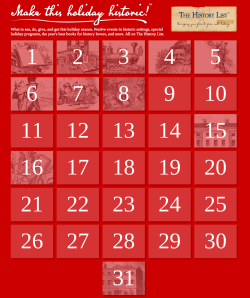
Lee Wright at The History List has developed a clever interactive calendar for the holidays which highlights events at historic sites around the country with changing images and sounds wrapped in an attractive bright red package.  It’s fun to play with it to find what’s hidden underneath each date and the best part is that any historic site or history organization can participate.  So far, it includes a Victorian Christmas at the Ramsey House, a whiskey tasting at Jefferd’s Tavern, and a holiday masquerade at Tryon Palace.  If you’d like to include your event, Lee provides instructions for participating via History List or Facebook.

December’s calendar is part of The History List’s, “Make this Holiday Historic” campaign, however, you can include events from the rest of the year as well.  The History List is Lee Wright’s effort to create a one-stop place for history lovers to find places and events happening near them, whether at home or on the road, as well as provide a convenient, easy-to-use online calendar for Continue reading →

The Many Flavors of Touring Historic Places

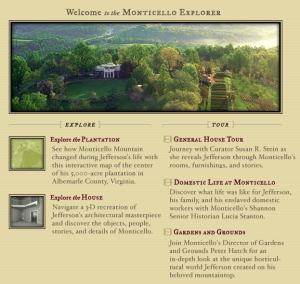
Monticello Explorer provides several virtual tours.

Monticello Explorer provides several virtual tours.

Although guided tours of period rooms is the most common form of interpretation at historic sites, audio tours, video tours, and virtual tours are growing in popularity thanks to technologies that are lowering the cost of production and increasing access to new audiences.  From a short list of examples, the students in my “historic site interpretation” class at George Washington University developed a list of ten best practices for different types of tours of historic sites.  You’ll discover that many of their suggestions emphasize the need for a plan, themes, and a focus–and projects that failed to have these elements were weaker and less effective.

A.  Guided Tours of Period Rooms

Reviewed by Johanna Bakmas, Melissa Dagenais, Emma Dailey
 

Suggested Best Practices

Do
  1. Develop an interpretive plan and themes
  2. Consult primary sources for the property
  3. Decide whether to have reproduction or original pieces Continue reading →

Highlights from the Latest Journal of Travel Research

I doubt many people read the Journal of Travel Research (yes, there are such things!) but I’ve been referring to it in preparation for a presentation at the Historic House Museum Consortium of Washington, DC.  Looking at the September 2012 issue of the Journal of Travel Research, I thought I’d share some of the highlights from articles that might interest historic sites and house museums:

  • In “GPS as a Method for Assessing Spatial and Temporal Use Distributions of Nature-Based Tourists,” Jeffery Hallo et al examine the use of GPS devices to study visitor behavior in national parks (an idea that can be easily be applied to large historic sites).  This research typically has to be done either by asking visitors to recall their experiences in a survey or by asking visitors to record their own behavior in diaries–both cumbersome and highly subjective methods.  GPS provides a better way to study human behavior, but so far the inaccuracy and cost has been major hurdles.  A test of three of the newest GPS devices, however, shows that these hurdles have been overcome by Continue reading →