Tag Archives: Smithsonian Institution

From Julia Child to Lowriders: Interpreting History at the Smithsonian on the Eve of a Shutdown

Although the federal government shutdown has started, the Smithsonian museums will remain open at least through Monday, October 6. Despite the media’s attention on 12:01 am on October 1, shutdowns don’t happen immediately because stopping a huge bureaucracy takes time, plus each agency has to determine who will be furloughed and who is essential—that’s why air traffic controllers keep working at airports but not educators at museums. Secondly, agencies can use private funds to continue operating, which is why the Smithsonian can keep the doors open a few more days.

I was fortunate to visit the National Museum of American History on September 30 with my “Interpreting Historic Sites and House Museums” course at George Washington University. For a couple of hours, my students analyzed the interpretation in two exhibitions that included historic buildings: Food (featuring Julia Child’s kitchen) and Within These Walls (featuring the 1750s Ipswich House, the largest object in the collection). They did a terrific job uncovering topics and themes, discussing how women are represented, and the assessing the use of objects.

Continue reading

Warning: Objects in Museums May Be More Complicated Than They Appear

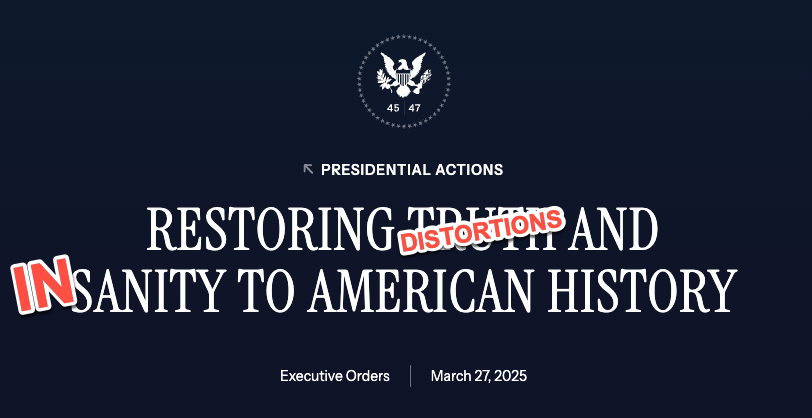
Today, the White House issued an executive order titled “Restoring Truth and Sanity to American History”, which aims to reshape the presentation of history within federal institutions—particularly the Smithsonian. The directive calls for the removal of “divisive or anti-American ideology,” restoration of monuments that have been “improperly removed,” and new restrictions on federally funded exhibits that “degrade shared American values.” While some may see this as a return to patriotic education, as a historian and museum professional, I see troubling implications for our field.

The Illusion of a Single Truth

At the heart of the order is the assertion that a “true” version of American history must be restored. But history is not a static set of facts—it is a discipline grounded in evidence, interpretation, and debate. Historical understanding evolves as new sources emerge, as questions shift, and as voices long excluded are brought into the conversation. There is no single, timeless narrative to return to—only a continuing effort to make sense of the past as honestly and inclusively as possible.

Independence Under Threat

The Smithsonian Institution, like many of our most trusted public history institutions, relies on scholarly rigor and curatorial independence. By assigning Vice President JD Vance a role in overseeing content and linking congressional appropriations to ideological compliance, this executive order politicizes museum interpretation and undercuts professional standards. When history is shaped by political power instead of evidence, public trust erodes.

Continue reading

IMLS Targeted for Elimination—How Museums Can Prepare and Advocate

On March 14, 2025, President Trump issued an Executive Order directing the elimination of the Institute of Museum and Library Services (IMLS) and the Woodrow Wilson Center at the Smithsonian Institution “to the maximum extent consistent with applicable law.” While the full impact of this order is still unfolding, museums that rely on IMLS resources should take immediate steps to safeguard critical information. IMLS websites and databases may be taken down soon, limiting access to funding guidelines, research reports, and professional development materials. If your institution depends on these resources, now is the time to download and archive what you need.

If your museum has an active IMLS grant, there’s reason to believe that existing awards will be honored, but based on past experience with federal grant funding disruptions, delays are highly likely. Be proactive in communicating with your IMLS program officer, tracking your grant-related expenses, and preparing contingency plans for potential funding interruptions.

This Executive Order may also signal broader cuts to federal cultural funding. It wouldn’t be surprising to see similar threats to the National Endowment for the Humanities (NEH), National Endowment for the Arts (NEA), National Gallery of Art, and even the Smithsonian Institution. If these agencies are reduced or eliminated, the impact on museums, historic sites, and cultural organizations nationwide will be profound.

If your museum is affected by these potential cuts, now is the time to act. Inform your board, staff, members, and community stakeholders about what this means for your institution. Contact your elected representatives in Congress and urge them to protect federal support for museums, libraries, and cultural heritage. Without direct advocacy from the field, lawmakers may assume these cuts will go unnoticed.

For more details, see the full Executive Order here: White House Executive Orders.

Continue to speak up! Museums, historic sites, historical societies, and libraries matter—let’s make sure Congress knows it.

Is Twitter Effectively Engaging Your Audiences?

twitter-afpWith the new year on the horizon, I’ve been evaluating my projects from the last year to determine how I can help historic places better connect to their audiences. For the past two years, I’ve used Twitter to share news about history, historic sites, historic preservation, and history museums.  Each morning I scan the New York Times and other newspapers for stories, aiming to tweet about three stories daily to my @maxvanbalgooy account so that my followers can quickly learn what’s happening.  The result? I have created 4,180 tweets and attracted nearly 500 Followers since I joined Twitter in June 2009.  This blog, on the other hand, has 1000 subscribers, so it seems my time is better spent on my blog than Twitter.  It could be very different for you, but how do we decide if Twitter is effectively engaging your audiences?
A useful place to start is with the metrics that Twitter provides: Followers and Likes.  Likes are a low level of engagement because they only require that readers support a specific tweet or find it especially useful or enjoyable—but that’s it. Followers are a mid-level form of engagement because it means that a reader wants to engage with you and read everything that you tweet (“read” is probably overstating things; “scan” is more appropriate for Twitter). Retweets engage at a high level because your Followers share your tweet to their Followers (did you follow that? it’s about the impact of the multiplier effect)—unfortunately, there’s no easy way to measure Retweets (but boy, we would have more impact if we promoted Retweeting instead of Liking).

To better understand how effectively Twitter can engage audiences, I collected statistics for a variety of major history organizations to measure Tweets, Followers, and Likes as of today (December 8, 2016) to develop the following chart: Continue reading

History Relevance Campaign meets at Smithsonian

I’ll be at an all-day workshop today at the Smithsonian’s National Museum of American History to discuss the work of the History Relevance Campaign with representatives of two dozen national organizations, including the Library of Congress, National Archives, National Endowment for the Humanities, National Park Service, American Historical Association, American Alliance of Museums, National Coalition for History, National History Day, National Humanities Alliance, and National Governors Association.  We’ll use our work on the values of history, impact project, and research on popular attitudes towards history to discuss where the campaign should go next and how they might get more involved (most of these organizations have already endorsed the values statement).  I’m not sure what the results will be but you can follow along on Twitter at #historyrelevance.

Online Learning Opportunities for Historic Site Interpreters

The opportunities for sharpening your skills as an historic site interpreter continue to grow online, sometimes even for free.  Here are a sampling of a few non-degree granting organizations where you’ll find workshops and classes on the Internet to keep your thinking fresh and improve your technique.  All times are Eastern unless noted.

American Alliance of Museums

  • Embracing 360 Engagement, Widening the Circle.  September 2, 2014 at 2:00 pm Eastern.
  • Building Trust through High Performance, Becoming Essential.  December 3 at 2:00 pm.

American Association for State and Local History

  • Historic House Calls: Using Futures Thinking to Navigate Ongoing Change.  August 20, 2014 at 2:00 pm. Free for AASLH members.
  • Writing the Grant: What’s the Process Like?  August 27 at 3:00 pm.  $115; $40 members.

Coursera

Continue reading

Million Dollar Salaries at America’s Biggest Museums

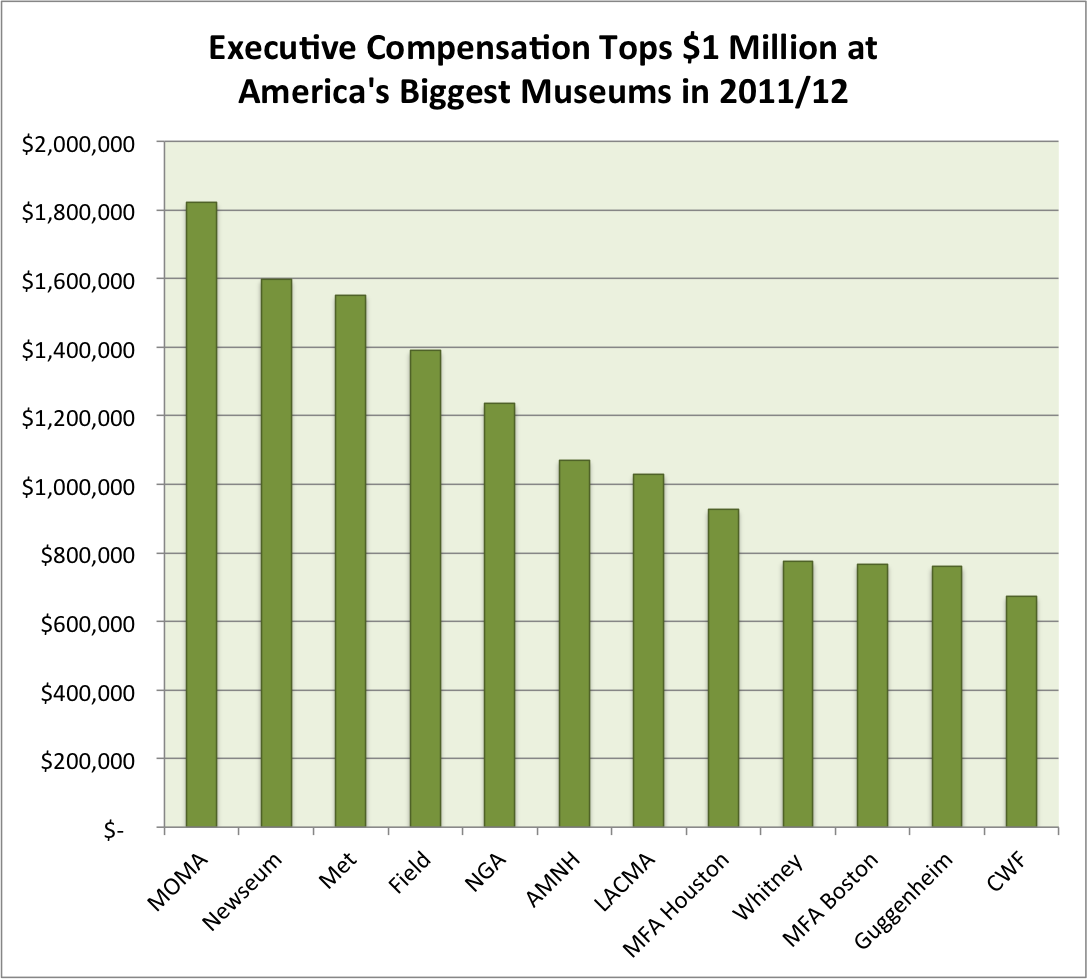
Exec Compensation 2011-12A review of the latest Forms 990 of more than two dozen of America’s biggest museums identified the most highly compensated executives in the field.  Among these museums, annual compensation ranged from $228,000 to $1,822,257 and the average was $727,000.  Seven directors earn more than one million dollars per year, as follows:

Financial Management at America’s Billion-Dollar Museums

Big 5 Museums Assets 2012

The Smithsonian Institution has more than $3 billion in assets and had more than $168 million in income for its 2012 fiscal year, making it the biggest and strongest museum in America.  It’s also the leader of the handful of American museums that have more than a billion dollars in net assets, according to the latest financial reports available through GuideStar.  At the top of the list of America’s wealthiest museums are:

  • Smithsonian Institution (Washington, DC)
  • Metropolitan Museum of Art (New York)
  • Museum of Fine Arts Houston (Texas)
  • Colonial Williamsburg Foundation (Virginia)
  • Museum of Modern Art (New York)

This is a nice trivia question for the next museum reception but what does it mean?  First of all, the size of the museum isn’t based on Continue reading

Responses to Government Shutdown Vary at Historic Sites and Museums

This slideshow requires JavaScript.

Washington, DC is one of the nation’s museum meccas with nearly 19 million annual visitors so with the partial shutdown of the federal government, tourists are frustrated and confused.  Closed are the most popular destinations such as the Smithsonian Institution, National Gallery of Art, Lincoln Memorial, US Holocaust Memorial Museum, National Archives, and Capitol Visitor Center (tours of the White House ended in March 2013 due to sequestration).  Although it is a federal city, many of its museums and historic sites are privately operated so places such as the Phillips Collection, Corcoran Gallery of Art, President Lincoln’s Cottage, Tudor Place, Woodrow Wilson House, and International Spy Museum, are open as usual.  “National” may be in its name, it doesn’t mean it’s affected by the shutdown, so the National Building Museum, National Geographic Museum, National Museum of Women in the Arts, National Museum of Health and Medicine, and National Museum of American Jewish Military History are open (as is the National Aquarium in Baltimore).  Adding to the confusion are parts of the federal government that remain open (hence its more precise definition as a “partial shutdown”), so historic sites such as the US Supreme Court and Arlington National Cemetery (but not Arlington House), continue to be open to tourists.

Washington DC is definitely a confusing places for tourists at the moment, but it’s also confusing at the Continue reading

Video: The Heart of the Matter

The American Academy of Arts and Sciences produced this 7-minute video to accompany its report, The Heart of the Matter: The Humanities and Social Sciences for a Vibrant, Competitive, and Secure Nation.   You’ll see lots of familiar names and faces along with many provocative and inspiring thoughts to bolster your day (and some sufficiently pithy to make great quotes in a fundraising letter).

We’ll be discussing the Heart of the Matter report and the state of history at the AASLH annual meeting this week, first at today’s CEO Forum chaired by Kent Whitworth of the Kentucky Historical Society, which will include presentations by Conny Graft and Pharabe Kolb and discussions facilitated by me.  Tomorrow, Tim Grove of the Smithsonian Institution moderates a general session with Conny Graft, Pharabe Kolb, and Kim Fortney.  I’ll be sharing the results of those meetings in the weeks that follow.