Tag Archives: National Park Service

Bridging the Gap: Tackling Visitor Awareness & Digital Programming

Ask any museum professional about barriers to participation, and you’re likely to hear about time, cost, or location. But two recent studies suggest the real obstacles may be more subtle—and more solvable. Whether your museum operates online, outdoors, or in a traditional building, one persistent challenge remains: many potential visitors don’t know what you offer or don’t believe it’s for them.


Non-Visitors Aren’t Uninterested—They’re Unaware or Uncertain

Wilcox et al. studied visitation patterns at two urban National Park Service sites in Washington, DC: Rock Creek Park and the C&O Canal. They surveyed both visitors and non-visitors during the pandemic and found that the most common constraint for non-visitors wasn’t disinterest—it was lack of awareness. Many simply didn’t know what the parks offered, where they were located, or whether they were open to the public.

Continue reading

History Redacted? What Museums Can Do About Censorship and Content Restrictions

Across the United States, museums and historic sites are feeling the pressure of growing efforts to limit how history is interpreted and shared with the public. Whether it’s school boards restricting curricula, exhibitions removing stories about women or African Americans, or state legislatures targeting specific narratives, the landscape for public history is shifting. Two recent statements—one from national associations of professional historians and another from a leading association of history organizations—offer timely guidance for navigating this challenge.

Upholding Academic Freedom and Public Access to History

In their joint statement, the American Historical Association (AHA) and the Organization of American Historians (OAH) raise alarm over federal directives aimed at censoring public-facing historical content. Specifically, they object to restrictions on the use of terms like “diversity,” “equity,” and “inclusion,” as well as efforts to remove access to resources about gender, race, and immigration history across government platforms. These actions, the associations argue, “deny the American public access to the complex, nuanced, and evidence-based historical knowledge that is essential to democratic society.”

For museum professionals, this serves as a reminder that we are not only stewards of collections but also of public understanding and trust. AHA and OAH call on historians–including those in museums and historic sites–to resist these pressures by reaffirming their commitment to historical accuracy, critical inquiry, and public service. The practical takeaway? Review interpretive plans, online content, and programs to ensure they are grounded in evidence-based scholarship, even–and especially–when the topics are politically charged.

Standing with the National Park Service: A Sector-Wide Response

Continue reading

Fort Vancouver Has a Great Visitor Map (and a Lousy One, Too)

The simplest things impress me when I visit historic sites, like a good visitor map.  They’re hard to find so when I spot one, I’m thrilled.

I recently visited Fort Vancouver National Site in Vancouver, Washington, across the Columbia River from Portland, Oregon. In the Visitor Center, they provide a visitor map printed on 11 x 17″ paper that’s gathered in pads of 50 sheets. I’ve always loved these tear-off maps because they’re always neat and generously sized, and in this particular case, also well designed. Even though it’s simply printed with black ink on white paper, the designer carefully used tinting, serif and sans serif faces in different sizes, varied line weights, and symbols to help visitors easily find their way around this very large site. Most important, information that is not important to visitors is omitted. On the back side are Continue reading

Update: Standards for the Treatment of Historic Properties

The National Park Service has issued an updated version of the Secretary of the Interior’s Standards for the Treatment of Historic Properties with Guidelines for Preserving, Rehabilitating, Restoring, and Reconstructing Historic Buildings (whew!).  Last revised in 1992, it was recently updated as part of NPS’s “A Call to Action: Preparing for a Second Century of Stewardship and Engagement”.
The revised standards more fully develop topics in the previous editions, address the treatment of buildings of the last half of the twentieth century (which introduced new materials and systems, such as composites and curtain walls), include building code-required work, and eliminated energy efficiency (which is now addressed in 2011 in the Guidelines on Sustainability for Rehabilitating Historic Buildings).  The Standards provide guidance for the maintenance, care, or remodeling that might occur through an illustrated set of recommended or discouraged practices easily understood by architects, contractors, staff, and board members. A big thanks to NPS and Anne Grimmer for providing these new guidelines.  They’re free online and every house museum in America should adopt these Standards to help preserve and maintain their buildings and structures.

The Standards are designed to guide work on buildings listed on the National Register of Historic Places, but I’ve used them Continue reading

Reinventing Historic Houses in National Parks

This slideshow requires JavaScript.

Earlier this week I led a workshop on reinventing historic house museums at two great National Parks—Marsh-Billings-Rockefeller in Vermont and Saint-Gaudens in New Hampshire—with Ken Turino of Historic New England. The National Park Service and the American Association for State and Local History co-sponsored this workshop to help their staff rethink the tours of the historic houses at these two sites, especially for visitors under 35 years of age. Using such tools as the Five Forces and a Double-Bottom Line Matrix along with a smorgasbord of ideas from other sites, we explored possible processes and projects that could improve and enhance their tours.  Our goal wasn’t to provide solutions but to raise many useful questions, including: Continue reading

Online Learning Opportunities for Historic Site Interpreters

The opportunities for sharpening your skills as an historic site interpreter continue to grow online, sometimes even for free.  Here are a sampling of a few non-degree granting organizations where you’ll find workshops and classes on the Internet to keep your thinking fresh and improve your technique.  All times are Eastern unless noted.

American Alliance of Museums

  • Embracing 360 Engagement, Widening the Circle.  September 2, 2014 at 2:00 pm Eastern.
  • Building Trust through High Performance, Becoming Essential.  December 3 at 2:00 pm.

American Association for State and Local History

  • Historic House Calls: Using Futures Thinking to Navigate Ongoing Change.  August 20, 2014 at 2:00 pm. Free for AASLH members.
  • Writing the Grant: What’s the Process Like?  August 27 at 3:00 pm.  $115; $40 members.

Coursera

Continue reading

AAM and NAI Announce Awards, but Few are Historic Sites

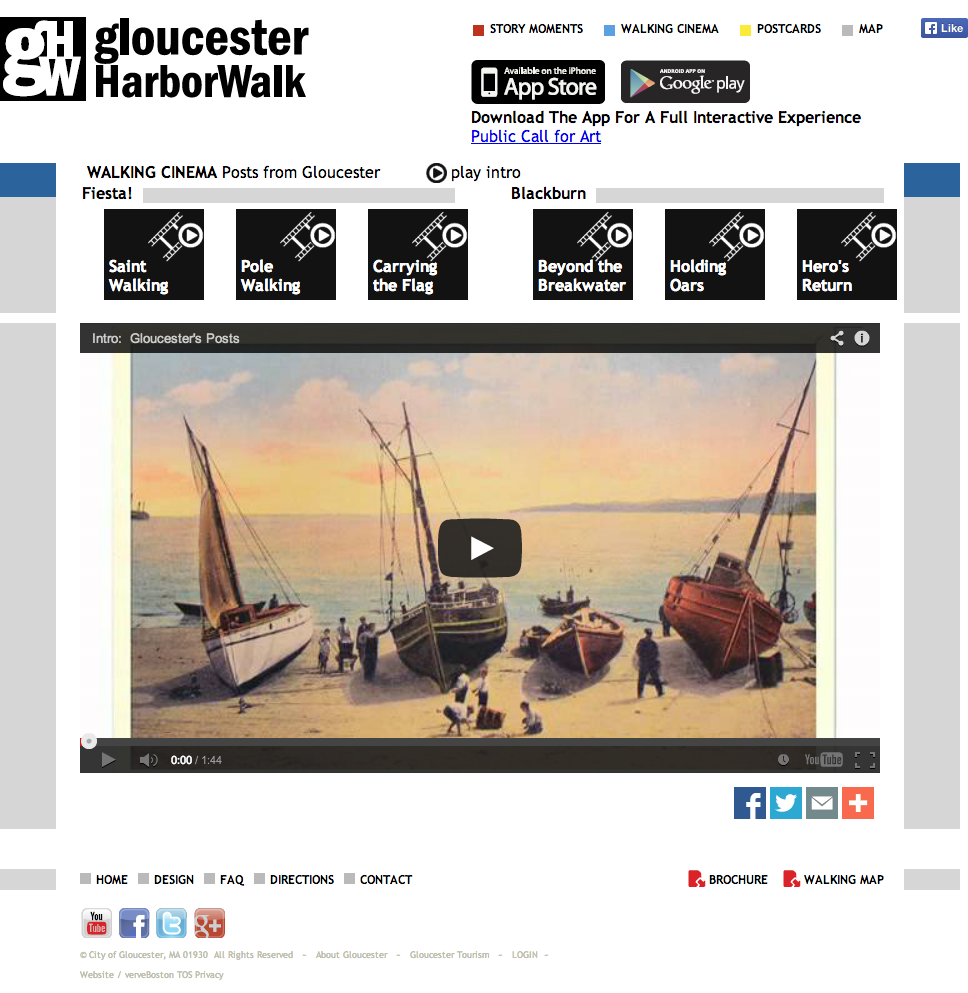
Walking Cinema of Gloucester HarborWalk

Walking Cinema of Gloucester HarborWalk

The American Alliance of Museums and the National Association for Interpretation announced their annual winners in various categories, from label writing to exhibits to publications to programs.  You’ll want to look at the entire list for inspiration, but I especially want to congratulate those people and organizations whose worked focused on historic sites, houses, and places (that’s the point of this blog).

The Media and Technology Professional Network of AAM presented Muse Awards for digital media to: Continue reading

Responses to Government Shutdown Vary at Historic Sites and Museums

This slideshow requires JavaScript.

Washington, DC is one of the nation’s museum meccas with nearly 19 million annual visitors so with the partial shutdown of the federal government, tourists are frustrated and confused.  Closed are the most popular destinations such as the Smithsonian Institution, National Gallery of Art, Lincoln Memorial, US Holocaust Memorial Museum, National Archives, and Capitol Visitor Center (tours of the White House ended in March 2013 due to sequestration).  Although it is a federal city, many of its museums and historic sites are privately operated so places such as the Phillips Collection, Corcoran Gallery of Art, President Lincoln’s Cottage, Tudor Place, Woodrow Wilson House, and International Spy Museum, are open as usual.  “National” may be in its name, it doesn’t mean it’s affected by the shutdown, so the National Building Museum, National Geographic Museum, National Museum of Women in the Arts, National Museum of Health and Medicine, and National Museum of American Jewish Military History are open (as is the National Aquarium in Baltimore).  Adding to the confusion are parts of the federal government that remain open (hence its more precise definition as a “partial shutdown”), so historic sites such as the US Supreme Court and Arlington National Cemetery (but not Arlington House), continue to be open to tourists.

Washington DC is definitely a confusing places for tourists at the moment, but it’s also confusing at the Continue reading

The Many Flavors of Touring Historic Places

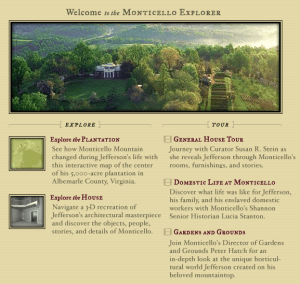
Monticello Explorer provides several virtual tours.

Monticello Explorer provides several virtual tours.

Although guided tours of period rooms is the most common form of interpretation at historic sites, audio tours, video tours, and virtual tours are growing in popularity thanks to technologies that are lowering the cost of production and increasing access to new audiences.  From a short list of examples, the students in my “historic site interpretation” class at George Washington University developed a list of ten best practices for different types of tours of historic sites.  You’ll discover that many of their suggestions emphasize the need for a plan, themes, and a focus–and projects that failed to have these elements were weaker and less effective.

A.  Guided Tours of Period Rooms

Reviewed by Johanna Bakmas, Melissa Dagenais, Emma Dailey
 

Suggested Best Practices

Do
  1. Develop an interpretive plan and themes
  2. Consult primary sources for the property
  3. Decide whether to have reproduction or original pieces Continue reading

Challenges and Opportunities Facing Historic Sites and House Museums

This fall I’ll be teaching the historic site and house museum interpretation class in the Museum Studies Program at George Washington University.  Department Chair Kym Rice graciously offered me this opportunity earlier this summer and I couldn’t resist.  I’ve been impressed by the caliber of GW students and I count many of their graduates among my friends and colleagues.  Today is the first class and participating are fifteen graduate students, mostly in museum studies with a handful from history and anthropology.  We will  have some fun discussions!

During the next few months, I’ll share my experiences with you and I thought I’d start by laying out the initial readings for the course, which focus on the opportunities and challenges in interpreting historic sites.  It was hard to pick and choose among Continue reading