
Category Archives: Fundraising

What’s the ROI of Your Historic Site?

Jack Phillips (right) discussing ROI at ASTD 2014.

Jack Phillips (right) discussing ROI at ASTD 2014.

Foundations and donors are increasingly questioning the impact of their funds at museums and historic sites, a trend that’s growing as well in  business according to Jack Phillips and James Kirkpatrick at a session at the ASTD conference yesterday. After the recent recession, they’ve found that CEOs are increasingly asking about the return on investment (ROI) of every program and activity, including employee training and education.  Although training claims to be an essential contributor to business productivity and performance, it hasn’t been adequately measured or evaluated, and thus can’t prove their value.  That surprised me because I thought that was a struggle only for museums and historic sites.  We seem to be continually fighting to prove our worth and other than economic impact, haven’t been able to show why we matter in our communities.  It looks like we’re not alone.

Phillips and Kirkpatrick are the leaders in the field of measuring performance in business and developed frameworks that “define the levels at which programs are evaluated and how data are captured at different times from different sources.”  Although they disagree on whether the framework should have four or five levels, they both agree that Continue reading

Million Dollar Salaries at America’s Biggest Museums

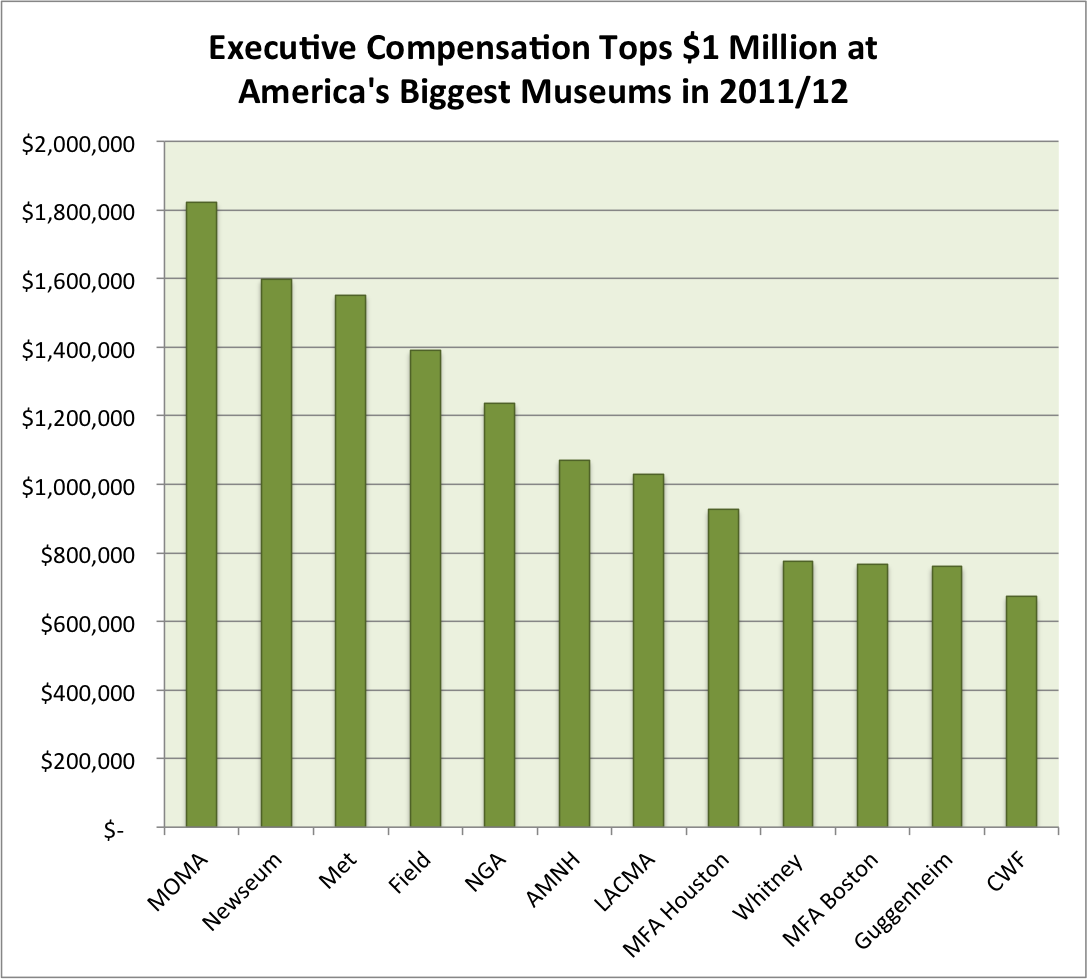
Exec Compensation 2011-12A review of the latest Forms 990 of more than two dozen of America’s biggest museums identified the most highly compensated executives in the field.  Among these museums, annual compensation ranged from $228,000 to $1,822,257 and the average was $727,000.  Seven directors earn more than one million dollars per year, as follows:

Financial Management at America’s Billion-Dollar Museums

Big 5 Museums Assets 2012

The Smithsonian Institution has more than $3 billion in assets and had more than $168 million in income for its 2012 fiscal year, making it the biggest and strongest museum in America.  It’s also the leader of the handful of American museums that have more than a billion dollars in net assets, according to the latest financial reports available through GuideStar.  At the top of the list of America’s wealthiest museums are:

  • Smithsonian Institution (Washington, DC)
  • Metropolitan Museum of Art (New York)
  • Museum of Fine Arts Houston (Texas)
  • Colonial Williamsburg Foundation (Virginia)
  • Museum of Modern Art (New York)

This is a nice trivia question for the next museum reception but what does it mean?  First of all, the size of the museum isn’t based on Continue reading

Building Membership Relies on Research

Curate Your Own Membership at the Whitney Museum of American Art

Curate Your Own Membership at the Whitney Museum of American Art

The November/December 2013 issue of Museum, the magazine of the American Alliance of Museums, includes two helpful articles on membership, which is typically the fundamental fundraising program for historic sites.

In “Join the Club,” Daniel Grant describes several museums that have successfully broken the traditional “give more/get more” membership structure.  The Whitney Museum of American Art nows offers a Curate Your Own Membership program, which includes Continue reading

Celebrating the New Year by Looking Back

Freedom's Eve at President Lincoln's Cottage

Freedom’s Eve at President Lincoln’s Cottage

President Lincoln’s Cottage in Washington, DC is hosting a New Year’s Eve party with meaning by marking the “stroke of midnight, January 1, 1863” when “thousands of men, women, and children celebrated as the Emancipation Proclamation finally took effect.”  Tickets are $150 to $250 per person, with a special discount for persons under 40 years old.  Although the staff will be working on a holiday, it’s a clever way to connect history and support a good cause, too.  What popular events in your community can be connected to your site’s history or mission?

Amazon.com May Help Your Fundraising Efforts

AmazonSmile customer start-up page.

AmazonSmile customer start-up page.

This holiday season, Amazon.com is mixing business with charity in its newest project, AmazonSmile.  By shopping at smile.amazon.com instead of plain old amazon.com, 0.5 percent of the value of their purchases will be donated to the customer’s preferred charity (i.e., a $100 purchase becomes a 50 cent donation).  When first visiting AmazonSmile, customers are prompted to select a charitable organization from almost one million eligible organizations.   What’s even more amazing is that there seems to be no limit to the amount Amazon will give to charity, although as of now auto-renewed subscription purchases and digital products aren’t included.  Donations will be made by the AmazonSmile Foundation, so customers using AmazonSmile will not be able to claim donations as charitable deductions.

Charitable organizations can register for free to receive donations at Continue reading

Video: Baltimore: A History, Block by Block

James Singewald, is photographing and researching ten historic streets in Baltimore for his project, Baltimore: A History Block by Block.   This 4:30 video explains his project and presents a series of his photographs that show the rich variety of architecture that survives (and may be soon demolished) and is raising funds for 4×5 film, processing, research, and publication on Kickstarter.   It’s a great way to raise funds to research and document historic neighborhoods, and he’d appreciate your support with a gift of $10 or more (he’s raised nearly half of his expenses with 65 backers).  Singewald received his MFA from the Maryland Institute College of Art abd is currently the imaging services technician at the Maryland Historical Society>  He funded his previous book, Old Town, East Baltimore, in 2010 through Kickstarter.

Responses to Government Shutdown Vary at Historic Sites and Museums

This slideshow requires JavaScript.

Washington, DC is one of the nation’s museum meccas with nearly 19 million annual visitors so with the partial shutdown of the federal government, tourists are frustrated and confused.  Closed are the most popular destinations such as the Smithsonian Institution, National Gallery of Art, Lincoln Memorial, US Holocaust Memorial Museum, National Archives, and Capitol Visitor Center (tours of the White House ended in March 2013 due to sequestration).  Although it is a federal city, many of its museums and historic sites are privately operated so places such as the Phillips Collection, Corcoran Gallery of Art, President Lincoln’s Cottage, Tudor Place, Woodrow Wilson House, and International Spy Museum, are open as usual.  “National” may be in its name, it doesn’t mean it’s affected by the shutdown, so the National Building Museum, National Geographic Museum, National Museum of Women in the Arts, National Museum of Health and Medicine, and National Museum of American Jewish Military History are open (as is the National Aquarium in Baltimore).  Adding to the confusion are parts of the federal government that remain open (hence its more precise definition as a “partial shutdown”), so historic sites such as the US Supreme Court and Arlington National Cemetery (but not Arlington House), continue to be open to tourists.

Washington DC is definitely a confusing places for tourists at the moment, but it’s also confusing at the Continue reading

Review of 2013 NEH Grants Reveals Opportunities and Challenges

This slideshow requires JavaScript.

The National Endowment for the Humanities has announced their last round of grants in the America’s Historical and Cultural Organization‘s (AHCO) program for fiscal year 2013, and a review suggests that opportunities and challenges await applicants–and NEH.  AHCO offers the largest grants for both planning and implementation of exhibits, programs, and activities for history organizations, and it’s often the one that people think of first for funding from NEH.

NEH awarded twenty-five grants totaling $4.2 million in 2013, with history organizations (i.e., historical societies, history museums, historic sites) receiving ten grants (40 percent) and $1.3 million in funding (32 percent).  That’s pretty good compared to the other categories, such as art museums and universities, although I’ll admit it’s a bit subjective depending on how you categorize an organization (I counted the Peabody Essex Museum as a history organization but could as easily be considered an art museum).  NEH funding has long been known as prestigious but rare (NEH states that about 9 percent of applications are funded) so history organizations are doing pretty well.

A Closer Look

A deeper analysis suggests that the chances of obtaining a grant may be easier for some than others.  When you examine Continue reading

Historic Sites Gather in Tennessee to Share Challenges and Solutions

This slideshow requires JavaScript.

Last week I led an AASLH workshop with George McDaniel on the management of historic house museums at Oaklands, a mid-nineteenth century house in Murfreesboro, Tennessee.  Eighteen people participated, most from Tennessee, but we had a couple from as far as Alaska!  Adding to the diversity were several graduate students from Middle Tennessee State University (which has strong programs in history, public history, and historic preservation) and even though it was near the end of the semester and finals were on their minds, they helped enrich the discussions.

One of the features in the workshop is that every participant brings an issue or problem that they’d like to address.   The range is wide and unpredictable, but it’s a helpful way to check the pulse on the challenges facing historic sites.  In this class, these issues were:

  1. How to prevent staff burn-out (how to keep growing despite small staff; finding the right mix of skills for staff)
  2. How to fund preservation and staffing. Continue reading